CLEP U.S. History I 064: Nullification and Competing Union Theories
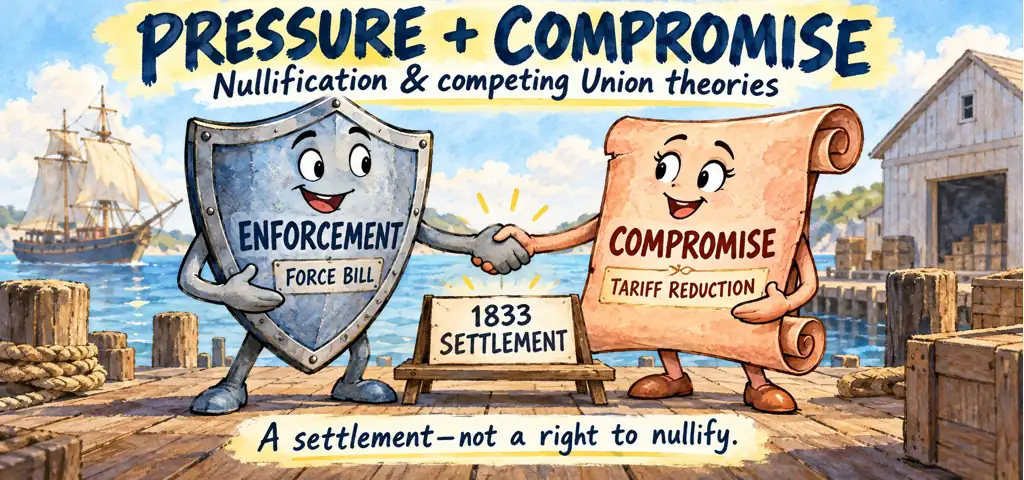
Lesson 12.3 of Chapter 12 of the U.S. History to 1877 study guide on Effortless Math covers CLEP U.S. History I 064: Nullification and Competing Union Theories: the key terms, the core ideas, and worked examples showing how this topic is tested on the exam.
U.S. History to 1877 | Chapter 12 | Lesson 12.3
High protective tariffs, especially the 1828 “Tariff of Abominations,” angered South Carolinians who imported manufactured goods and feared federal hostility to slavery. Vice President John C. Calhoun anonymously developed a compact theory: sovereign states had formed the Union and a state convention could nullify an unconstitutional federal law within its borders. This was not ordinary judicial review. It claimed a unilateral state mechanism.
Webster and Hayne debated union theory in the Senate in 1830. Robert Hayne stressed state sovereignty and protection against majority abuse. Daniel Webster argued that the Constitution came from the people and that the Union was not merely a revocable agreement among states. Jackson, though a slaveholding southerner and tariff moderate, declared that the Union must be preserved.
In 1832 South Carolina nullified the tariffs of 1828 and 1832 and threatened secession if federal collection continued. Jackson denounced nullification, prepared enforcement, and requested authority. Congress passed a Force Bill. At the same time, Henry Clay negotiated a compromise tariff that gradually reduced rates. South Carolina repealed its tariff ordinance, then symbolically nullified the Force Bill.
The settlement combined threat and concession. It did not establish a recognized state power to nullify law. It did show that tariff policy could merge with constitutional theories and slavery fears. Jackson’s unionism should not be mistaken for broad support of federal activism. He opposed nullification while vetoing other national programs. Calhoun’s arguments later supplied part of secessionist reasoning, though nullification and secession are distinct claims.
Watch the topic in context
This The Center for American Civics lesson supplies a second explanation of the same period. Note where chronology, cause, and perspective connect.
Video: Andrew Jackson, Calhoun, And The Crisis That Nearly Split The Union, The Center for American Civics.
Check your understanding
- Calhoun’s nullification theory claimed that a state convention could
- declare an allegedly unconstitutional federal law inoperative within that state
- refer a disputed federal law to arbitration by neighboring states
- require Congress to reconsider a law protested by the state legislature
- authorize state courts to reverse a Supreme Court judgment
- suspend a disputed law nationally pending approval by three-fourths of the states
- Which combination best explains the negotiated end of the crisis?
- South Carolina won immediate tariff repeal without federal resistance
- Congress authorized enforcement while adopting a gradual tariff reduction
- the Supreme Court recognized nullification but limited its duration
- Jackson withdrew customs officers and Calhoun abandoned compact theory
- southern states jointly seceded and then negotiated readmission
- Deep Practice: select all that apply. Issues included
- tariff burdens
- majority power
- union theory
- slavery-related fear
- women’s suffrage
- Deep Practice: open response. Contrast compact theory with Webster’s account of the Union.
Write a brief response using a named fact from the lesson.
Open the answers and reasoning
Independent preparation. CLEP is a registered trademark of the College Board, which does not endorse this lesson.

Related to This Article
More math articles
- Material Properties: Hardness, Toughness, and More
- The Best Grade 3 Math Book for Missouri Students
- Free Common Core (CCSS) Grade 5 Math Worksheets: 49 Printable Skill Pages with Step-by-Step Answer Keys
- How to Prepare for the OAR Math Test?
- Free Grade 2 English Worksheets for South Dakota Kids
- Is ALEKS a Good Mathematics Program?
- District courts
- The Best Grade 8 ELA Practice Tests for Indiana Students
- 8th Grade STAAR Math FREE Sample Practice Questions
- Geometry Made Easy: Tips and Strategies for Success



















What people say about "Nullification and Competing Theories of Union"?
No one replied yet.