CLEP U.S. History I 063: Spoils System and the Presidency
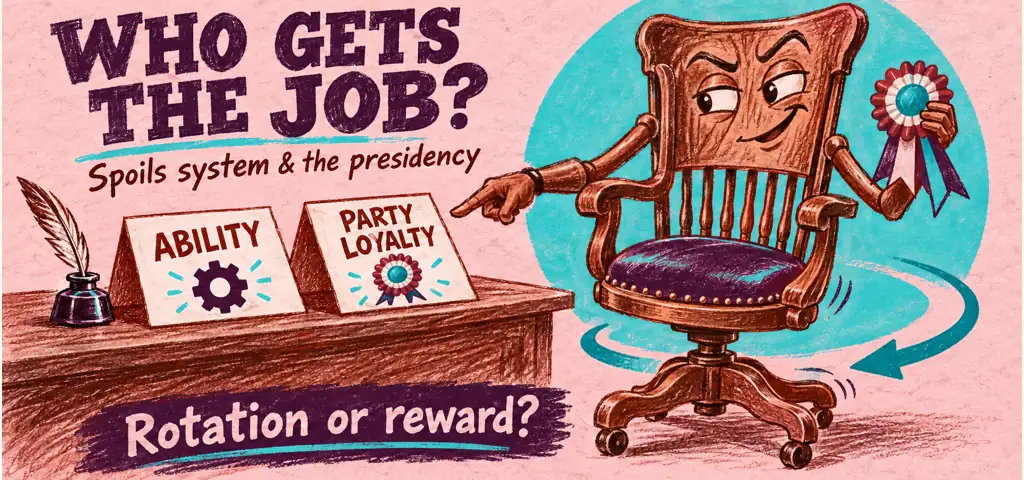
Lesson 12.2 of Chapter 12 of the U.S. History to 1877 study guide on Effortless Math covers CLEP U.S. History I 063: Spoils System and the Presidency: the key terms, the core ideas, and worked examples showing how this topic is tested on the exam.
U.S. History to 1877 | Chapter 12 | Lesson 12.2
Jacksonians defended “rotation in office” as republican. Long-serving officials, they argued, could become an insulated bureaucracy. Ordinary capable citizens should share public service. Jackson replaced roughly one-tenth of federal officeholders, a much greater turnover than earlier presidents but not a complete purge. Opponents called the resulting patronage a spoils system because party loyalty often influenced appointments.
Rotation could make administration responsive and open positions beyond an established elite. It could also sacrifice expertise, reward campaign work, and invite corruption. The scandal involving customs collector Samuel Swartwout, who fled with a large public shortfall, became evidence for critics, although patronage did not begin with Jackson. The deeper development was disciplined party control of appointments.
Jackson strengthened the presidency by claiming a direct relationship with the national electorate. Earlier presidents used the veto mainly for constitutional objections. Jackson vetoed on constitutional, economic, and policy grounds. He rejected more bills than all predecessors combined. His Bank veto message addressed the public, arguing that government-granted privilege benefited the wealthy. Jackson also relied on informal advisers whom enemies called the “Kitchen Cabinet” and forced a cabinet reorganization after the social conflict called the Eaton affair.
Opponents labeled him “King Andrew,” pointing to the veto, removal of deposits, defiance of critics, and forceful executive style. Supporters answered that the president was the one federal officer chosen by a national constituency and could check privileged institutions. That reasoning strengthened a democratic presidency while weakening older assumptions that Congress should lead policymaking.
Watch, then test the claim
Watch this account from Hip Hughes (HipHughes) with one question in mind: which evidence makes the lesson's strongest claim hold up?
Video: The Spoils System Explained: US History Review, Hip Hughes (HipHughes).
Check your understanding
- Jacksonians defended rotation in office chiefly as a way of
- placing appointments under judicial review
- creating a professional civil service examination
- preventing an entrenched permanent bureaucracy
- transferring appointments to state legislatures
- insulating administrators from election results
- Jackson enlarged the president’s legislative role most clearly by using the veto
- after a court had declared the proposed law unconstitutional
- to defend state legislation against federal preemption
- when he believed Congress exceeded an explicit constitutional power
- to fill Senate vacancies without action by state governments
- for broad policy objections as well as constitutional ones
- Deep Practice: select all that apply. Criticisms included
- lost expertise
- partisan reward
- corruption risk
- executive aggrandizement
- no removals at all
- Deep Practice: open response. Why could the same presidency look democratic and monarchical?
Write a brief response using a named fact from the lesson.
Open the answers and reasoning
Independent preparation. CLEP is a registered trademark of the College Board, which does not endorse this lesson.

Related to This Article
More math articles
- How to Find Equation of a Circle? (+FREE Worksheet!)
- How to Support Grade 4 Reading at Home: 12 Smart Strategies That Build Independence
- How to Solve Radical Equations? (+FREE Worksheet!)
- The Ultimate MEGA Elementary Education Multi-Content Math Course
- Geometry Puzzle – Challenge 59
- Math Exploration: A Journey into Graphs, Tables, and Fractional Word Problems
- How to Deciphering the Puzzle of Time: A Step-by-Step Guide to Solving Age Problems in Mathematics
- Free Grade 5 English Worksheets for Montana Students
- The Best Algebra 1 Book for Mississippi Students
- Conflict, White-Collar Crime, and Corporate Power


















What people say about "The Spoils System and the Presidency"?
No one replied yet.