Free Grade 7 English Worksheets for Alaska Students
In March, a seventh grader in Fairbanks rides the bus home with the sun still high at six in the evening, while a seventh grader in Utqiagvik is watching the daylight come back for the first time in weeks. Spring in Alaska is the season of returning light, longer reading time at the kitchen table, and, for families, the slow buildup to the AK STAR window. The work that pays off most in those weeks is not cramming. It is the quiet, daily kind: one skill, one page, one answer key, one conversation.
The reading expectations have changed since elementary school in a way that surprises a lot of parents. A Grade 7 student is no longer asked to find one piece of evidence and call it done. They are asked to gather several, weave them, and acknowledge the counterargument before they refute it. That is a real cognitive jump, and it is the heart of the seventh-grade Alaska English/Language Arts Standards.
This page is forty-three printable worksheets that match those standards skill by skill. Every PDF was built for an evening when the bush plane is delayed, the dog needs walking, or the village school’s gym is locked for the night. Print, work, check, repeat.
What’s on this page
The PDFs follow a simple three-part shape. A short Quick Review your seventh grader can read independently. Practice items in the middle. A student-facing answer key at the end that explains why the wrong choices were attractive, because in Grade 7, the wrong choices are designed to look reasonable.
No account. No email. No paywall waiting at the second click.
Reading: Literature
- Citing Several Pieces of Textual Evidence, [RL.7.1] practice pulling a stack of quotes that all point at the same inference
- Theme and Its Development Over the Text, [RL.7.2] write the theme as a full sentence and trace where it grows
- How Setting, Character, and Plot Interact, [RL.7.3] explain the pull and push between story elements
- Word Choice, Figurative Language, and Tone, [RL.7.4] analyze how a single replaced word can shift a whole paragraph’s mood
- How Form Shapes Meaning in Drama and Poetry, [RL.7.5] line breaks and stage directions as carriers of meaning
- Developing and Contrasting Points of View, [RL.7.6] track two viewpoints inside the same text
- Comparing a Story to Its Audio, Film, or Stage Version, [RL.7.7] what changes when the medium changes
- Comparing Fictional and Historical Portrayals, [RL.7.9] separate the documented record from the novelist’s invention
Reading: Informational Text
- Citing Several Pieces of Evidence in Nonfiction, [RI.7.1] back up an inference with two or more lines from the article
- Two or More Central Ideas and Their Development, [RI.7.2] name multiple central ideas working at once
- How Individuals, Events, and Ideas Interact, [RI.7.3] how people and ideas change each other across an article
- Word Meaning in Nonfiction: Figurative, Connotative, Technical, [RI.7.4] three jobs a single word can perform
- How Text Structure Develops the Author’s Ideas, [RI.7.5] see the writer’s blueprint and what it accomplishes
- Author’s Point of View and How They Distinguish It, [RI.7.6] locate the writer’s stance and the techniques that mark it
- Comparing a Text to Its Audio or Video Version, [RI.7.7] what each medium adds and what it strips out
- Evaluating an Argument: Reasoning and Evidence, [RI.7.8] judge whether reasons and evidence actually support the claim
- How Two Authors Shape Their Presentation of the Same Topic, [RI.7.9] same subject, different choices, different effects
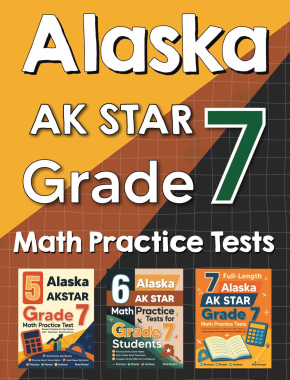
Working on Math Too? Try the Alaska AK STAR Grade 7 Math Bundle
Many third graders are getting ready for the AK STAR in both subjects. If your child also needs math practice that matches the same standards, this companion bundle is the shortest path, workbook, study guide, and full practice tests in one download.
Writing
- Argument Writing: Claims, Reasons, Evidence, and Counterclaims, [W.7.1] the new Grade 7 move: name the counterclaim before refuting it
- Informative and Explanatory Writing, [W.7.2] build an explainer with a thesis, sections, transitions, and a real conclusion
- Narrative Writing, [W.7.3] pacing, dialogue, sensory writing, and an ending that does not fizzle
- Coherent Writing for Task, Purpose, and Audience, [W.7.4] adjust the same idea for three different readers
- Planning, Revising, and Editing, [W.7.5] when revising means scrapping the plan, not polishing it
- Short Research Projects: Question and Refocus, [W.7.7] let the early findings sharpen the question
- Gathering, Evaluating, and Citing Sources, [W.7.8] author, date, publisher, citation, the basics done right
Speaking & Listening
- Collaborative Discussions, [SL.7.1] show up prepared, listen actively, build on what someone else said
- Analyzing Information in Diverse Media, [SL.7.2] read a graphic, a clip, and a photo as one combined argument
- Evaluating a Speaker’s Argument, [SL.7.3] claim, reasons, evidence, and the spots where the speaker is bluffing
- Presenting Claims with Focus and Coherence, [SL.7.4] open with the point, walk through evidence, end clean
- Adapting Speech to Context, [SL.7.6] the words you use in the hallway are not the words you use at the podium
Grammar
- Phrases and Clauses: Placement and Function, [L.7.1a] name what each chunk of a sentence is doing
- Sentence Structures: Simple, Compound, Complex, Compound-Complex, [L.7.1b] count the clauses, then name the structure
- Avoiding Dangling and Misplaced Modifiers, [L.7.1c] the sentence error that quietly makes a paragraph ridiculous
Conventions: Punctuation, Spelling
- Commas with Coordinate Adjectives, [L.7.2a] when two adjectives in a row need a comma and when they do not
- Spelling Grade-Appropriate Words, [L.7.2b] homophones, double letters, and frequent Grade 7 trip-ups
Knowledge of Language and Style
- Precise and Concise Language, [L.7.3a] cut the filler, pick the exact word, keep the sentence tight
Vocabulary and Word Study
- Using Context Clues, [L.7.4a] name the type of clue before using it
- Greek and Latin Roots and Affixes, [L.7.4b] the parts of long words that open whole word families
- Using Reference Materials Effectively, [L.7.4c] pick the right tool for the actual question
- Verifying Word Meaning, [L.7.4d] confirm a guess instead of riding it
- Allusions and Figures of Speech, [L.7.5a] Grade 7 is when myth, Bible, and literary references start showing up on purpose
- Word Relationships: Synonyms, Antonyms, Analogies, [L.7.5b] say the relationship in plain words before picking an answer
- Connotation and Denotation, [L.7.5c] same fact, different emotional weight
- Academic and Domain-Specific Vocabulary, [L.7.6] Tier 2 cross-subject words and Tier 3 specialist words
How to use these worksheets at home
A seventh-grade routine in Alaska is rarely tidy. Some weeks the family is out on the river, some weeks the road is closed, some weeks the basketball team is flying back from a regional tournament at midnight. Build practice around that, not against it.
Try one PDF on a slow weeknight. Fifteen minutes is plenty. Have your child mark the items they were not sure about even when they got them right. Those are the ones to revisit. Reading the answer-key explanation aloud builds the underlying skill better than silent rereading, and it gives a parent a window into how their seventh grader is actually thinking.
Spread the worksheets across the month, not the night before a quiz. The Grade 7 reading skills, multi-evidence inference, central-idea development, allusion recognition, are slow-build skills. Twelve minutes on Tuesday and twelve minutes on Friday will outperform a marathon Sunday session by a large margin.
A note about AK STAR ELA
The AK STAR is the Alaska System for Teaching and Assessing Rigorous Standards. The Grade 7 ELA portion is administered in a spring window that the state typically opens for several weeks between late March and early May, with each district scheduling its own testing dates inside that window. The test is aligned to the Alaska English/Language Arts Standards, so what your child is doing in seventh-grade ELA all year is what the AK STAR draws from.
Expect passages that require citing more than one piece of textual evidence, items on theme development across a full text, vocabulary in context with attention to connotation, and writing prompts that look like the work your child is doing in class, including arguments that must acknowledge a counterclaim. Worksheets on this page are not test-week filler; they are the kind of slow preparation that makes the test feel familiar instead of foreign.
Want everything in one bundle?
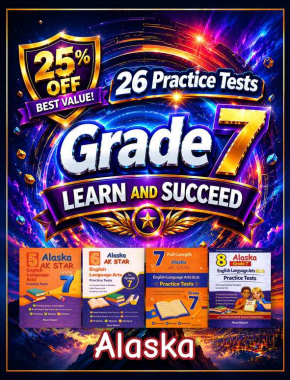
For families who prefer one organized resource over a long shopping list of single PDFs, the Grade 7 ELA Preparation Bundle pulls everything together. Full-length practice tests, answer keys with explanations, and rehearsal that mirrors the pacing of the real spring assessment.
Alaska Grade 7 ELA Preparation Bundle, four practice-test books, 26 unique full-length tests, complete answer keys with explanations.
A short closing
Seventh grade in Alaska runs through long dark winters and long bright springs, and reading practice ought to fit somewhere in between. Bookmark this page, pull a PDF when the evening is quiet, and let your seventh grader work one skill at a time. That is how AK STAR readiness actually gets built.
Best Bundle to Ace the Alaska AK STAR Grade 7 ELA
Looking for the best resource to help your kid ace the Alaska AK STAR? Try this bundle, four full practice-test books (5 + 6 + 7 + 8 tests) covering the same Grade 7 reading, writing, and language skills your child is already learning. Instant PDF download, answer keys included.

Related to This Article
More math articles
- Fundamental Theorem of Calculus: A Principle That Saves Your Life
- How to Use Properties of Integer Exponents? (+FREE Worksheet!)
- 8th Grade MAAP Math Worksheets: FREE & Printable
- Top 10 6th Grade NYSE Math Practice Questions
- How to Help Your 8th Grade Student Prepare for the North Dakota NDSA Math Test
- Long-Run Growth, Productivity, and Living Standards
- Idaho Algebra 1 Free Worksheets: 72 Free Algebra 1 PDF Worksheets, One Skill at a Time
- How to Find Asymptotes: Vertical, Horizontal and Oblique
- Full-Length 6th Grade SBAC Math Practice Test
- How to Solve Composition of Functions? (+FREE Worksheet!)









What people say about "Free Grade 7 English Worksheets for Alaska"?
No one replied yet.