CLEP U.S. History I 062: Expanded White Male Suffrage and Mass Parties
Lesson 12.1 of Chapter 12 of the U.S. History to 1877 study guide on Effortless Math covers CLEP U.S. History I 062: Expanded White Male Suffrage and Mass Parties: the key terms, the core ideas, and worked examples showing how this topic is tested on the exam.
U.S. History to 1877 | Chapter 12 | Lesson 12.1
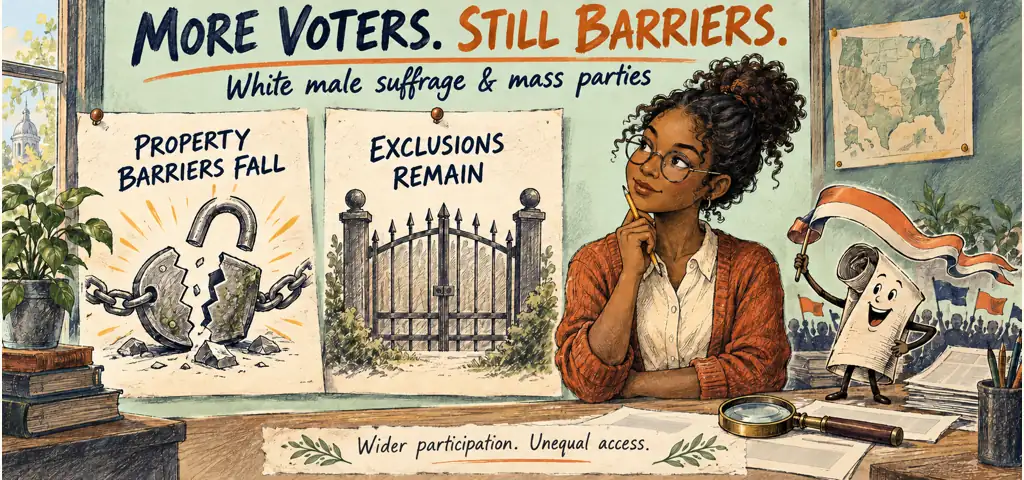
From the 1810s through the 1830s, many states removed property requirements for white male voters. New western constitutions often began with broad white manhood suffrage, and older states revised rules under political pressure. Presidential electors were increasingly chosen by voters rather than legislatures. Turnout rose as parties made campaigns social events: rallies, parades, songs, partisan newspapers, local committees, and nominating conventions connected national candidates to neighborhood organization.
This was a genuine widening of participation, not universal democracy. Women remained formally excluded. Enslaved people could not vote, and several states disfranchised free Black men even while lowering property barriers for whites. Rhode Island retained restrictive rules until the Dorr movement challenged them. Citizenship was becoming more participatory and more explicitly racial at once.
Party organizers defended organization as a way to make leaders answerable to voters. Critics saw manipulation, spectacle, and patronage. Both perceptions have evidence: parties educated and mobilized voters while rewarding loyalty and simplifying complicated policy into slogans. The secret ballot had not yet become standard, so public voting could expose citizens to social pressure.
Jackson’s image as a military hero and self-made westerner helped his coalition, though he was a wealthy enslaver and landowner. His supporters portrayed the 1824 result as elite theft and 1828 as restoration of majority rule. Their political achievement was to turn resentment into a durable national organization. The key change was not that ordinary people suddenly entered politics for the first time. Artisans, farmers, and crowds had participated earlier. Formal eligibility, scale, regularity, and party machinery expanded.
See the history take shape
Heimler's History offers a visual route through this topic. As you watch, compare its explanation with the source limits in the written lesson.
Video: Expanding DEMOCRACY [APUSH Review Unit 4 Topic 7] Period 4: 1800-1848 (Re-Upload), Heimler's History.
Check your understanding
- The principal legal change expanding voting in this period was state removal of
- citizenship rules applied to recently arrived immigrants
- property or taxpaying qualifications imposed on white men
- county residency rules for established citizens
- the minimum voting age of twenty-one
- sex-based exclusions from the electorate
- Which development best distinguished the new mass-party system?
- congressional caucuses operating with limited public campaigning
- family patronage networks serving as the main route to office
- judges and courts nominating presidential and state tickets
- conventions, partisan newspapers, rallies, and local committees
- militia companies determining which candidates appeared on ballots
- Deep Practice: select all that apply. Limits included exclusion of
- women
- enslaved people
- many free Black men
- some propertyless Rhode Islanders
- every white adult man in every state
- Deep Practice: open response. Explain how participation broadened and racialized simultaneously.
Write a brief response using a named fact from the lesson.
Open the answers and reasoning
Independent preparation. CLEP is a registered trademark of the College Board, which does not endorse this lesson.

Related to This Article
More math articles
- Order of Operations for 5th Grade: PEMDAS Made Easy
- Percent Problems Practice — Percent of a Number & More
- Collective Action, Environmental Inequality, and Environmental Racism
- Top 10 8th Grade MCAS Math Practice Questions
- FTCE Test Facts and FAQs
- How to Understand Convergent and Divergent Series
- How to Compare Fractions?
- Math Exploration: A Journey into Graphs, Tables, and Fractional Word Problems
- CLEP College Algebra Formulas
- Invention, Discovery, Diffusion, and Cultural Change














What people say about "White Male Suffrage and Mass Parties"?
No one replied yet.