CLEP U.S. History I 061: Cotton Expansion, Forced Migration, and Slavery
Lesson 11.6 of Chapter 11 of the U.S. History to 1877 study guide on Effortless Math covers CLEP U.S. History I 061: Cotton Expansion, Forced Migration, and Slavery: the key terms, the core ideas, and worked examples showing how this topic is tested on the exam.
U.S. History to 1877 | Chapter 11 | Lesson 11.6
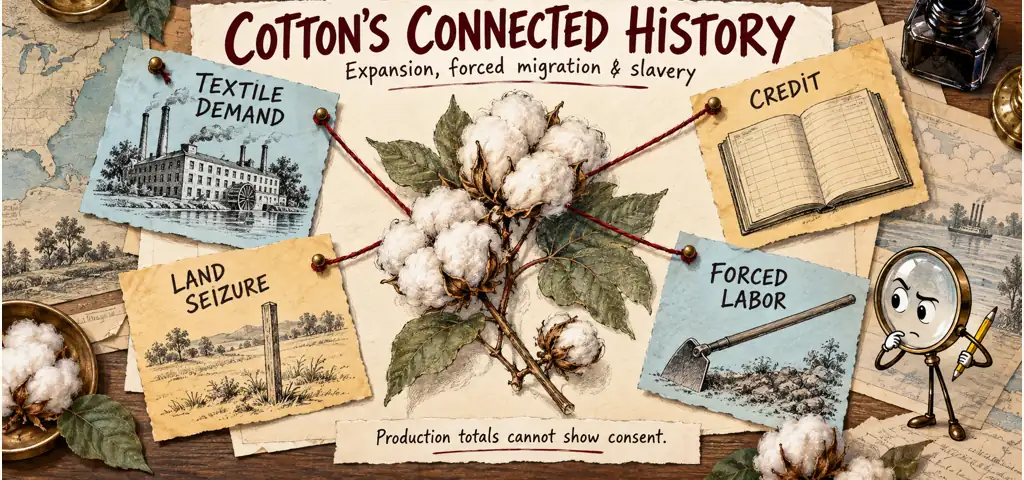
Short-staple cotton became highly profitable after the cotton gin made seed removal faster, but the machine did not reduce slavery. It made wider inland cultivation profitable and increased demand for land and enslaved labor. Global textile demand, fertile soil, credit, steamboats, and Native dispossession produced a “Cotton Kingdom” stretching from the older Southeast toward Alabama, Mississippi, Louisiana, Arkansas, and Texas.
Federal and state policy forced Native nations from much of this land. Surveying and sale converted homelands into plantations and farms. Planters borrowed to buy acreage and enslaved people, binding expansion to finance. The broader forced migration from the Upper South to the Deep South displaced roughly one million enslaved people between 1790 and 1860. Sale through the domestic slave trade was a major mechanism, but forced movement with enslavers also contributed. Traders separated spouses, parents, and children. Overland coffles and coastal shipments made human sale a visible business.
Enslaved workers cleared forests, drained land, planted, hoed, and picked cotton under violence and surveillance. The gang system coordinated labor and punishment. People nevertheless formed families, worshiped, shared knowledge, slowed work, broke tools, fled, negotiated limited space, and sometimes rebelled. Survival and community were forms of resistance, though they did not erase owners’ coercive power.
Cotton connected regions and the Atlantic. Northern mills processed it. Northern and British merchants shipped and insured it. Banks financed plantations. Western farms sold food to plantation districts. The prosperity of “free” states was therefore not separate from slavery. At the same time, the South invested heavily in land and enslaved property, developed fewer large manufacturing centers, and became vulnerable to cotton-price shifts.
Slaveholders described cotton wealth as evidence of social stability and later claimed slavery was a positive good. Enslaved testimony and the repeated need for patrols, punishment, and law expose the coercion underneath that claim. Production statistics show output, not consent.
A focused video lesson
Use this lesson from The Curiosity Cabinet to review the period and its central historical problem. Pause when the video reaches the turning point named above.
Video: APUSH US History Cotton, Slavery, and the Old South overview – Unit 4 Chapter 11, The Curiosity Cabinet.
Check your understanding
- The cotton gin contributed to slavery’s expansion chiefly by
- reducing the field labor required for planting and picking
- making short-staple cotton more profitable to process
- shifting demand from raw cotton to wool
- making long-staple coastal cotton the only profitable variety
- reducing planters’ demand for new land
- Within the broader forced migration of enslaved people after 1790, the domestic slave trade’s principal regional flow ran
- from Deep South plantations toward Upper South cities
- from Caribbean islands into the Old Northwest
- from the Atlantic seaboard toward northern free states
- from the Upper South toward the expanding Deep South
- from Texas cotton districts toward Chesapeake tobacco farms
- Deep Practice: select all that apply. Cotton expansion depended on
- Native dispossession
- credit
- global textile demand
- forced labor
- absence of northern commercial ties
- Deep Practice: open response. Explain why northern industrial growth and southern slavery should not be studied as isolated systems.
Write a brief response using a named fact from the lesson.
Open the answers and reasoning
Independent preparation. CLEP is a registered trademark of the College Board, which does not endorse this lesson.

Related to This Article
More math articles
- 10 Most Common 7th Grade Georgia Milestones Assessment System Math Questions
- The Ultimate SIFT Math Formula Cheat Sheet
- Full-Length 6th Grade PSSA Math Practice Test
- Top 10 Tips You MUST Know to Retake the AFOQT Math
- 10 Most Common 4th Grade MEAP Math Questions
- Full-Length 6th Grade FSA Math Practice Test-Answers and Explanations
- The Vermont SBAC Grade 3 Math Worksheet Set — 49 Free Printable PDFs
- FREE 5th Grade NYSE Math Practice Test
- 49 Free RICAS Grade 5 Math Worksheets for Rhode Island Students (Aligned, One Skill Per Page)
- The Best Grade 7 ELA Practice Tests for Delaware Students



















What people say about "Cotton Expansion and Forced Migration"?
No one replied yet.