CLEP U.S. History I 060: Banking, Credit, and the Panics of 1819 and 1837
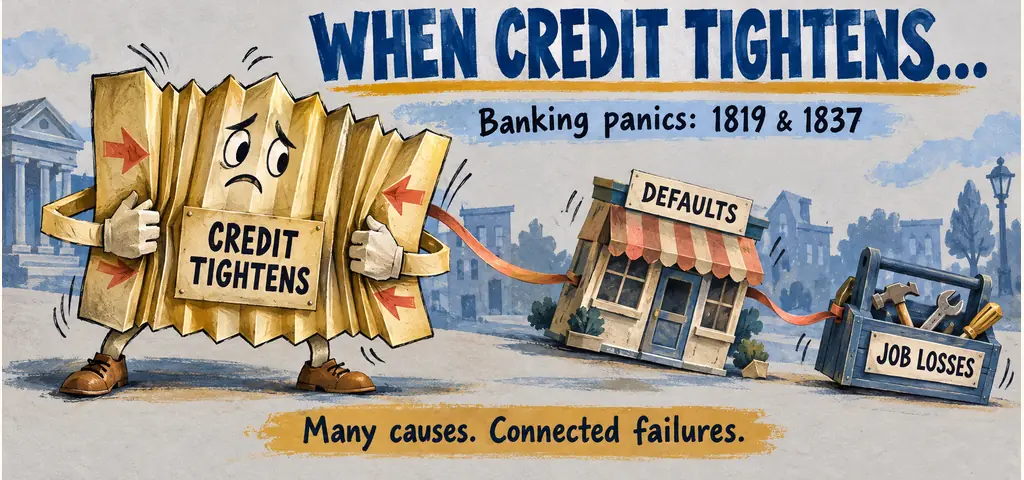
Lesson 11.5 of Chapter 11 of the U.S. History to 1877 study guide on Effortless Math covers CLEP U.S. History I 060: Banking, Credit, and the Panics of 1819 and 1837: the key terms, the core ideas, and worked examples showing how this topic is tested on the exam.
U.S. History to 1877 | Chapter 11 | Lesson 11.5
Credit allowed families and firms to act before they had accumulated cash. Banks issued notes and loans, merchants extended credit, governments sold bonds, and buyers purchased land with borrowed money. This accelerated construction, commerce, and settlement. It also connected distant failures: when lenders contracted credit or commodity prices fell, debtors sold property, banks suspended payment, and unemployment spread.
The Panic of 1819 followed wartime expansion, land speculation, unstable state-bank lending, and changing international commodity demand. The Second Bank of the United States first extended credit and then tightened it as it tried to control its branches and protect specie reserves. Cotton prices fell sharply. Land purchasers defaulted, businesses failed, and workers lost jobs. Western and southern borrowers blamed the Bank, even though several forces contributed. The crisis increased hostility toward concentrated financial power and complicated the postwar nationalist mood.
The Panic of 1837 likewise had multiple causes. State-bank credit and land speculation expanded. Cotton prices and international capital flows mattered. British credit tightened. President Jackson’s Specie Circular required payment in gold or silver for most federal land purchases, while movement of federal deposits after the Bank War disrupted finance. When confidence broke, banks suspended specie payments, prices fell, businesses collapsed, and a long downturn followed. Martin Van Buren inherited the crisis and supported an Independent Treasury that separated federal funds from private banks.
Bank notes were not a uniform national currency. Their value depended on the issuing bank’s reputation and distance. Counterfeit or failed-bank notes circulated. The national banks attempted discipline but drew criticism as privileged corporations. Debtors often wanted abundant credit and relief, while creditors prized stable money and repayment. Yet positions changed: a person could be a creditor in one transaction and debtor in another.
Watch the topic in context
Professor Barth traces the people and chronology behind this lesson. Listen for the evidence that sharpens the written account, then try the questions below.
Video: The Banking Bubble and Panic of 1819 (HOM 22-B), Professor Barth.
Check your understanding
- In an expanding market economy, credit most directly enabled a farmer or firm to
- shield an investment from changes in commodity prices
- transfer private repayment obligations to the government
- raise working capital without borrowing from a lender
- standardize the value of notes issued by different banks
- finance land, equipment, or inventory before accumulating cash
- Which mechanism was common to both the Panics of 1819 and 1837?
- declining confidence and contracting credit amplified defaults
- Congress prohibited cotton exports
- wartime blockade closed Atlantic ports
- federal law canceled private debt
- the national bank expanded lending throughout the downturn
- Deep Practice: select all that apply. Factors in 1837 included
- land speculation
- international credit
- cotton prices
- specie policy and deposit disruption
- construction of the Erie Canal as a sufficient cause
- Deep Practice: open response. Build a three-link causal chain from easy credit to unemployment.
Write a brief response using a named fact from the lesson.
Open the answers and reasoning
Independent preparation. CLEP is a registered trademark of the College Board, which does not endorse this lesson.

Related to This Article
More math articles
- DAT Quantitative Reasoning Math FREE Sample Practice Questions
- Patterns of Intergroup Relations
- The Best Algebra 1 Book for Kentucky Students
- 3rd Grade PSSA Math Practice Test Questions
- Delaware Smarter Balanced Grade 7 Math Worksheets: 95 Free Single-Skill PDFs
- The Ultimate 7th Grade WVGSA Math Course (+FREE Worksheets)
- The Ultimate MAP Algebra 1 Course (+FREE Worksheets)
- Idaho Algebra 1 Free Worksheets: 64 Free Algebra 1 PDF Worksheets, One Skill at a Time
- Free Grade 7 English Worksheets for Alaska Students
- Best Calculators For 12th Grade Students











What people say about "Banking, Credit and the Panics of 1819 and 1837"?
No one replied yet.