Idaho Algebra 1 Free Worksheets: 64 Free Algebra 1 PDF Worksheets, One Skill at a Time

Ninth-grade math has a personality of its own. Sixth grade was about connection, fractions meeting decimals, ratios meeting percents. Seventh and eighth grades stretched into algebra-flavored arithmetic, letting “x” creep onto the page without yet asking students to take it seriously. Algebra 1 is the course where students finally have to take it seriously. The variable is no longer a placeholder for a single missing number. It’s a stand-in for any number that could fit, or every number that could fit, or the relationship between two quantities that both change. Linear equations, functions, slope, systems, quadratics, every topic in the course is some flavor of the same idea: write down a rule, manipulate the rule, and use it to learn something you didn’t already know.
That’s a big shift for a fourteen-year-old, and it doesn’t get easier by being explained. It gets easier by being practiced. A student in a Boise high school, a freshman taking Algebra 1 in Meridian, a homeschooler in Nampa working at their own pace, a Saturday tutor session in Idaho Falls, every one of them needs the same thing. Not more theory. More reps. Specifically, more reps on the skills that aren’t yet automatic, with enough structure that the student doesn’t have to hunt for what to practice next.
These 64 worksheets are the structure. Each one is a single skill. Each one is a short, finishable sitting. And each one is aligned to the Idaho Algebra 1 standards.
What’s on this page
Sixty-four single-skill worksheets, aligned to the Idaho Algebra 1 standards, which are Common Core-aligned. The collection covers the entire Algebra 1 course, algebraic expressions, the properties of operations, every level of linear equation from one-step through literal, inequalities, compound inequalities, absolute value, the formal idea of a function with domain and range, arithmetic and geometric sequences, slope and rate of change, the equation of a line in three forms, parallel and perpendicular lines, direct and inverse variation, systems of equations and inequalities, linear-quadratic systems, exponent rules, polynomial operations, special products, factoring, factoring trinomials, solving quadratics by factoring, completing the square, the quadratic formula, and a closing arc of statistics, probability, and exponential models.
Every PDF is shaped the same way so the format never gets in the way. The first page is a Quick Review: the skill stated plainly, one example walked through with every step visible, and a short note on the typical mistake. After that come 12 practice problems that climb from approachable to challenging. The final page is the answer key, written student-to-student in tone, with short, plain-language explanations a ninth grader can read alone and learn from. No login, no email, no signup. Print and go.
Algebra Foundations
- Variables, Expressions, and Properties, use letters for unknown values and the laws that govern them
- Order of Operations and Evaluating Expressions, PEMDAS in action, what to do first, second, and last
- Simplifying Algebraic Expressions, combine like terms and distribute to tidy any expression
- Introduction to Equations and Solutions, what it means for a value to ‘solve’ an equation
- Personal Financial Literacy, real-money algebra: interest, discount, markup, tax
Solving Linear Equations
- Solving One-Step Equations, undo one operation to isolate the variable
- Solving Two-Step Equations, two careful moves, in the right order
- Solving Multi-Step Equations, distribute, combine, then isolate, a full solve
- Equations with Variables on Both Sides, collect like terms on one side first
- Literal Equations and Formulas, solve a formula for a different letter
Inequalities and Absolute Value
- Solving One-Step Inequalities, one move, with one new rule for negatives
- Solving Multi-Step Inequalities, solve like an equation; flip the sign when dividing by a negative
- Compound Inequalities, AND vs. OR, and how to graph each
- Absolute Value Equations and Inequalities, split into two cases and read ‘and’ vs ‘or’ correctly
Functions and Sequences
- Relations and Functions, every input gets exactly one output, and how to check
- Function Notation and Evaluating Functions, read \(f(x)\) and plug in to evaluate
- Domain and Range, the inputs you may use and the outputs you get back
- Graphing Functions and Transformations, shift, stretch, and flip a parent graph
- Arithmetic Sequences as Linear Functions, add the same step each time, a line in disguise
- Geometric Sequences, multiply by the same ratio each time
- Graphing Square Root, Cube Root, and Piecewise Functions, graph nonlinear parent functions and split rules
- Comparing Functions, compare functions given as equations, tables, and graphs
- Combining Functions, add, subtract, multiply, and divide functions
- Inverse Functions, swap input and output, then solve for \(y\)
Linear Functions and Graphs
- Slope and Rate of Change, rise over run, a real-world rate of change
- Slope-Intercept Form, \(y = mx + b\), read slope and intercept right off it
- Point-Slope Form, build a line from one point and a slope
- Standard Form of a Linear Equation, \(Ax + By = C\), and when it’s most useful
- Writing Linear Equations from Graphs and Tables, turn a graph or a table into an equation
- Parallel and Perpendicular Lines, equal slopes for parallel, negative reciprocals for perpendicular
- Direct and Inverse Variation, \(y = kx\) versus \(y = k/x\)
- Understanding Graphs as Solution Sets, every point on the line satisfies the equation
Systems of Equations and Inequalities
- Solving Systems by Graphing, two lines, one shared point
- Solving Systems by Substitution, solve one equation for a variable, then substitute
- Solving Systems by Elimination, add or subtract the equations to cancel a variable
- Applications of Systems of Equations, two unknowns, two equations, one word problem
- Systems of Linear Inequalities, shade two regions and find where they overlap
- Solving Linear-Quadratic Systems, find where a line crosses a parabola
Exponents and Polynomials
- Properties of Exponents, product, quotient, power, zero, and negative-exponent rules
- Adding and Subtracting Polynomials, combine like terms in higher-degree expressions
- Multiplying Polynomials, FOIL and the box method, when each one helps
- Special Products of Polynomials, perfect squares and difference-of-squares patterns
- Rational and Irrational Numbers, tell a fraction-able number from one whose decimal never repeats
Factoring Polynomials
- Greatest Common Factor and GCF Factoring, pull out the biggest common piece first
- Factoring Trinomials: \(x^2 + bx + c\), two numbers that multiply to \(c\) and add to \(b\)
- Factoring Trinomials: \(ax^2 + bx + c\), the AC method and trial-and-error, side by side
- Factoring Special Products, spot difference of squares and perfect-square trinomials
Quadratic Functions
- Graphing Quadratic Functions, the parabola, its vertex, and the axis of symmetry
- Characteristics of Quadratic Functions, zeros, vertex, max/min, and end behavior
- Solving Quadratics by Factoring, set the product to zero, then each factor
- Solving Quadratics by Completing the Square, rewrite as \((x-h)^2 = k\) and take square roots
- The Quadratic Formula and the Discriminant, the formula every Algebra 1 student remembers, plus what the discriminant tells you
- Solving Quadratics by Square Roots, isolate the square, then take both roots
- Quadratic Applications and Modeling, real-world parabolas: projectiles, area, profit
Statistics and Probability
- Measures of Center and Spread, mean, median, range, and the feel of standard deviation
- Displaying Data: Histograms and Box Plots, two ways to picture a distribution
- Scatter Plots and Correlation, read clustering, outliers, and the direction of a trend
- Lines of Best Fit and Predictions, draw a trend line and predict the next value
- Probability and Counting Principles, count outcomes by multiplying and combine events
- Two-Way Frequency Tables, organize categorical data and read relative frequencies
Exponential Functions and Models
- Graphing Exponential Functions, the shape of \(y = ab^x\), growth or decay
- Exponential Growth and Decay, real-world doubling, half-life, and interest
- Comparing Linear, Quadratic, and Exponential Models, which model fits the pattern, and how to tell
- Interpreting Functions and Parameters, what every letter in the model actually means
How to use these worksheets at home
Think of these PDFs as a set of small ladders, not a list of disconnected drills. The Algebra 1 sequence is full of pairs where one skill is the natural setup for another. Do “Solving Two-Step Equations” before “Solving Multi-Step Equations.” Do “Slope and Rate of Change” before “Slope-Intercept Form.” Do “Factoring Trinomials” before “Solving Quadratics by Factoring.” Each pair is a tiny ladder, and a student who climbs the rungs in order rarely falls off the top. The other useful thing about pair-based practice is what it does to motivation. When the second worksheet of a pair feels lighter than the first one did, and it almost always does, the student notices, and that noticing is what builds the kind of confidence that lasts past the test.
The right pace is unhurried. Two short sessions a week, twenty minutes each, is plenty. A ninth grader is fourteen or fifteen, which means they want autonomy and they will lose interest fast when a parent hovers. Print the worksheet the night before. Leave it on the desk. Stay out of the way during the work itself, and bring the answer key back out for ten minutes afterwards. Walk only the problems that came out wrong. Read the answer-key explanation aloud, let your student point to where the slip happened, and stop. That short post-mortem, five minutes, six minutes, is where the worksheet earns its keep.
Idaho schedules can be unusual: four-day school weeks in some districts, long winter snow days, late-summer fairs and county events that swallow a weekend. Lean into the irregular pace. A skipped Wednesday is fine if Saturday gets a real sit-down. What you’re trying to protect isn’t a fixed hour. It’s the habit of returning to the work.
A note about Algebra 1 in Idaho
Idaho does not administer a separate statewide Algebra 1 end-of-course exam. Algebra 1 mastery is measured through the course itself, daily classwork, unit tests, district benchmarks, and through Idaho’s broader high school math assessment, which folds Algebra 1 standards into its general math measure. The Idaho Algebra 1 standards are aligned to the Common Core framework, so the topics on these worksheets and the topics in your student’s classroom come from the same source.
That alignment is the case for skill-by-skill practice in Idaho. Without one decisive end-of-course test pulling the year, the right question for parents and teachers is which standards your student really owns and which still wobble. The 64 PDFs let you answer that honestly, page by page, week by week. After each classroom unit, pull the matching worksheets and use them as a private checkpoint. If a topic comes back smooth, great, keep moving. If it wobbles, the practice for tomorrow is already chosen.
A short closing
Algebra 1 is the course where careful work compounds. Bookmark this page, print one PDF tonight, pick a skill that feels almost easy, and let your ninth grader finish it before bed. From the panhandle down to the high desert, Idaho kids do thoughtful, capable work when the next step is on the desk in front of them. A worksheet tomorrow morning is exactly that step.
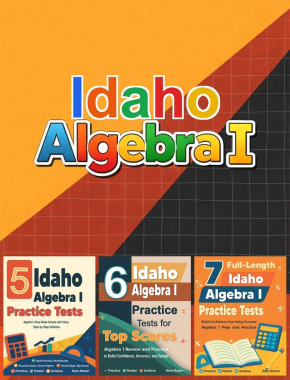
Best Bundle to Ace the Idaho Algebra 1 Test
Want the fastest path through Idaho Algebra 1 math? This bundle pulls it together, four full practice-test books with complete, step-by-step answer keys, instant PDF download.

Related to This Article
More math articles
- Overview of the SAT Mathematics Test
- Top 10 Free Websites for SAT Math Preparation
- The Best Grade 8 Math Book for Idaho Students
- Top 10 Tips to ACE the GED Math Test
- Descent, Residence, and Authority
- Ecclesia, Church, Denomination, Sect, and New Religious Movement
- Social Darwinism, the Gospel of Wealth, and Their Critics
- Sterilizer Quality Tests
- Geometry Puzzle – Challenge 59
- 10 Most Common 7th Grade MCAS Math Questions










What people say about "Idaho Algebra 1: Free Worksheets"?
No one replied yet.