TOEFL Adaptive Reading and Listening: What Changes in Practice? (2027 Prep)
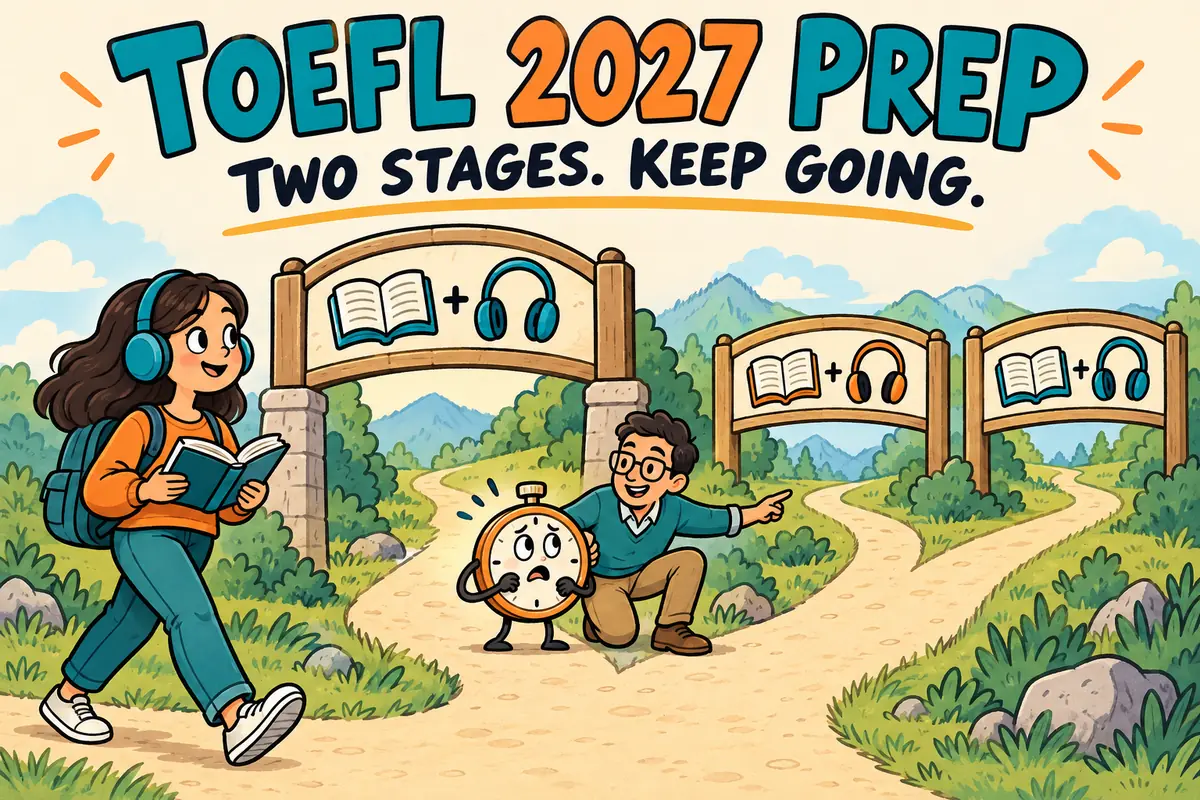
A reading set felt manageable yesterday, but today's listening practice suddenly feels much harder. It is tempting to treat that feeling as a score report. Pause. A difficult passage can reveal a vocabulary gap, an unfamiliar topic or a moment when your attention wandered, without telling you which route an official test would assign.
The useful question is what to do next. This guide explains the confirmed two-stage structure, then uses an invented practice record to show how you can choose a better study task without guessing a score.
What changes between the two stages
ETS describes Reading and Listening as multistage adaptive. Performance in the first module guides the difficulty of the second module, and the final section result uses both stages. You cannot return to a previous stage after moving between them. ETS teacher FAQ: multistage adaptation and scoring
Think of the first module as a set of tasks that contributes information to a later selection. The adjustment happens between stages. Avoid treating every challenging question as evidence that the computer has just changed your route, because that is a different claim from the structure ETS describes.
Keep working. A second module still supplies information about your performance, so deciding that the outcome is already settled can distract you from the material in front of you. Follow the instructions and clock on your actual screen.
Reading and Listening adapt separately from the other skills
The published blueprint identifies Reading and Listening as two-stage adaptive sections. Writing and Speaking are linear: candidates taking a particular form receive its set of tasks. ETS TOEFL iBT blueprint and specifications
That distinction matters when choosing practice. A provider advertising adaptive Speaking or Writing should explain what its product means and how that differs from the official format. A practice system can personalize lessons without reproducing the examination's delivery or scoring.
Check the task names too. Current Reading includes Complete the Words, Read in Daily Life and Read an Academic Passage. Listening includes choosing a response, conversations, announcements and academic talks. ETS lists these on its current test-content page. ETS current test content and timing
An older academic passage can still help you work on reading, but a collection containing only long academic passages will leave other current task types unpracticed. Write down the missing type before you buy another resource.
Use the current screen clock for pacing
ETS currently gives approximate base times of 30 minutes for Reading and 29 for Listening, with a note that time and item counts may vary as the test adapts. It advises allowing about two hours for the whole test. ETS current test content and timing
Use those figures to understand the overall commitment. For actual practice, follow the timer and instructions supplied by the official resource you have opened, including any module boundary. Do not replace that resource's clock with a timing formula copied from an older screenshot.
Suppose you make a short practice set for Tuesday evening. You may choose ten minutes because that is the time you have available. Label it a ten-minute study drill, rather than an official module simulation, and keep its results separate from a timed full-section attempt.
A practice percentage is not a TOEFL band
ETS says Reading and Listening scoring considers answers across both modules and the difficulty of the questions, with statistical equating used to produce comparable reported results. ETS teacher FAQ: multistage adaptation and scoring
Imagine two homemade sets with ten questions each. You answer eight correctly in the first and six correctly in the second, giving practice accuracy of 80% and 60%. That subtraction tells you the second set had twenty percentage points less accuracy.
It does not establish a fall in your TOEFL band. These are invented classroom sets with no official calibration, equating or score conversion. Even equal question counts do not make their difficulty comparable, especially when one set tests familiar vocabulary and the other demands an inference.
Save the percentage as a description of that set. Then inspect the missed answers. A record that says "60%, inferential detail, missed a contrast word" gives you something to work on, while converting 60% into an invented band creates confidence the evidence cannot support.
Turn one difficult session into a specific study action
Consider the fictional record below. These are observations from three separate study activities, not official TOEFL items or an adaptive test simulation. The purpose is to show how a learner can move from a broad complaint to an action that can be checked.
Read the middle column carefully. "The listening was hard" is too broad to guide tomorrow's practice, but "I heard the location and missed the change of plan" points toward the relationship you need to follow.
For that listening example, choose a short permitted practice recording and listen for the original arrangement, the change and its consequence. Afterward, compare your note with the explanation. If the explanation identifies a change you missed, return to the exact audio segment during review when replay is available.
Keep review conditions clear. Replaying an audio clip to learn from it is useful study work, while a timed attempt should follow the playback rules of its resource. Record which conditions you used so you do not compare a replay-assisted attempt with a first-listen attempt as if they were equivalent.
| Activity | Observed mistake | Next action |
|---|---|---|
| Reading inference | Chose an answer without text support | Locate support; check each alternative |
| Word completion | Guessed a word without checking grammar | Check meaning and sentence structure |
| Listening conversation | Missed a change to an earlier plan | Note original plan and revision |
Keep an error log small enough to use
Download the blank practice error log (CSV) and use one row for a mistake you want to revisit. The sheet asks for the resource, section, task type, attempt conditions, what happened, your next action and the result of a later check.
You can leave the correct-answer and total-question fields blank. The most useful entry may be a sentence naming the word or relationship you missed, especially when the resource provides no validated score estimate. Keep personal account details out of the file.
Try the action on a fresh activity. Recalling yesterday's correct answer can make the old question feel easy without showing whether you can use the skill on unfamiliar material. Your follow-up note should say what changed in the new attempt and what still needs attention.
Check what a practice product actually promises
ETS links its current preparation resources from the official TOEFL preparation page. Start there when you want to check how current task types are presented. ETS TOEFL preparation resources
For another provider, inspect a sample before purchasing. Look for the exam version, task coverage, module handling, feedback and a clear explanation of how any claimed score estimate was validated. A branching animation alone does not establish that its scoring matches ETS.
A fixed set can still teach vocabulary, comprehension or listening detail. Use it for the skill it actually exercises, and describe the result accordingly. Claims about an official route, a guaranteed band or an exact number of mistakes need evidence beyond your experience of one practice set.
Choose the next session from the evidence you have
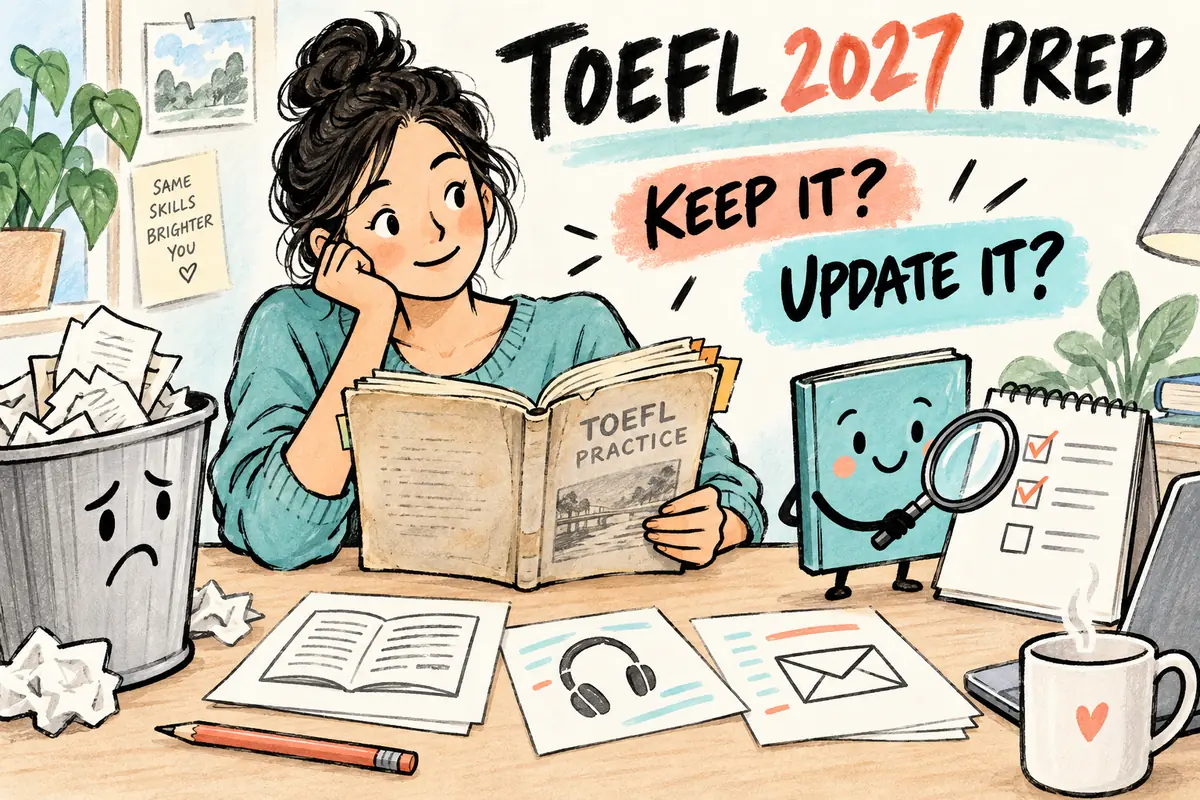
After reviewing today's work, write one small next action. For the fictional reading entry, that could be finding the sentence that supports an inference and checking why a tempting alternative conflicts with it. Tomorrow's task now has a purpose.
Our TOEFL study hub brings study resources together. Use it alongside the official task descriptions, check that a resource fits the skill you are practicing and return to your error log after the next attempt. You can measure whether your explanation improved without trying to identify a hidden route.
2027 preparation edition. Official specifications and resources checked October 11, 2026. Worked practice records, question counts and percentages are original hypothetical teaching examples, not official questions, adaptive simulations or score conversions. Recheck current ETS instructions before a later appointment.

Related to This Article
More math articles
- 10 Most Common 4th Grade OST Math Questions
- Alaska AK STAR Grade 7 Math Worksheets: 95 Printable PDFs with Worked Examples & Answer Keys
- Comparison and Number Ordering
- 5th Grade Common Core Math Practice Test Questions
- 7th Grade Scantron Math Worksheets: FREE & Printable
- Urbanization, Urban Growth, Suburbanization, and Metropolitan Regions
- Top 10 Tips to Create an ATI TEAS 7 Math Study Plan
- The Best Grade 3 ELA Practice Tests for Pennsylvania Students
- Missouri Algebra 1 Free Worksheets: Printable Practice for Every Algebra 1 Topic
- Gravity, Dynamic-Air-Removal, Standard, and Advanced Cycles














What people say about "TOEFL Adaptive Reading and Listening: What Changes in Practice? (2027 Prep) - Effortless Math"?
No one replied yet.