YOUR PSAT/NMSQT STUDY COMPANION
10 PSAT/NMSQT Math Practice Questions with Explanations
Try these 10 free PSAT/NMSQT math practice questions, then open each explanation to check your work. This Effortless Math skill set reviews equations, ratios, percentages, inequalities, and geometry. It is independent practice, not an official test or a complete digital PSAT simulation.
Try these 10 free PSAT/NMSQT math practice questions, then open each explanation to check your work. This Effortless Math skill set reviews equations, ratios, percentages, inequalities, and geometry. It is independent practice, not an official test or a complete digital PSAT simulation.
Current math section and how to practice
College Board lists 44 math questions across two 35-minute modules. The four domains are Algebra, Advanced Math, Problem-Solving and Data Analysis, and Geometry and Trigonometry. See College Board’s PSAT/NMSQT Math section overview for the current format and official practice path.
Choose an answer before opening its explanation. Write down the step that caused trouble: translating words, setting up a proportion, keeping a sign, or simplifying an expression. This short set does not cover every tested skill or predict a score.
10 practice questions with explanations
1. Rates and costs
A taxi driver earns $9 per hour and works 10 hours. The taxi uses 2 liters of fuel each hour, at $1 per liter. After paying for fuel, how much of that day’s earnings remains?
- $90
- $88
- $70
- $60
Show answer 1 and explanation
C. $70
Gross earnings: 9 × 10 = $90. Fuel: 2 × 10 = 20 liters, costing $20. Remaining earnings: 90 − 20 = $70.
2. Ages and equations
Five years ago, Amy was three times as old as Mike. Mike is 10 years old now. How old is Amy now?
- 4
- 8
- 12
- 20
Show answer 2 and explanation
D. 20
Mike was 5 years old five years ago. Amy was 3 × 5 = 15 then, so she is 15 + 5 = 20 now.
3. A system of equations
Solve the system: −x/2 + y/4 = 1 and −5y/6 + 2x = 4.
- x = 48, y = 22
- x = 50, y = 20
- x = 20, y = 50
- x = 22, y = 48
Show answer 3 and explanation
D. x = 22, y = 48
Multiply the first equation by 4: −2x + y = 4. Add the second equation: y/6 = 8, so y = 48. Then −2x + 48 = 4, giving x = 22. Substitution checks both original equations.
4. Similar triangles
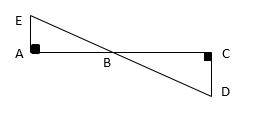
In the diagram, AE = 4, CD = 6, and AC = 12. What is the length of AB?
- 3.8
- 4.8
- 7.2
- 24
Show answer 4 and explanation
B. 4.8
The right triangles ABE and CBD share equal vertical angles at B, so they are similar. Let AB = x; then BC = 12 − x. Use 4/6 = x/(12 − x): 48 − 4x = 6x, so x = 4.8.
5. Quadratic roots
If a and b solve 2x² − 11x + 8 = −3x + 18, and a > b, what is a/b?
- 1/5
- 5
- −1/5
- −5
Show answer 5 and explanation
D. −5
Move everything to one side: 2x² − 8x − 10 = 0. Divide by 2 and factor: (x − 5)(x + 1) = 0. Thus a = 5, b = −1, and a/b = −5.
6. Area and units
A rectangular floor measures 6 cm by 24 cm. How many tiles, each covering 8 cm², are needed to cover it without gaps or overlap?
- 6
- 12
- 18
- 24
Show answer 6 and explanation
C. 18
The floor area is 6 × 24 = 144 cm². Divide the total area by one tile’s area: 144 ÷ 8 = 18 tiles.
7. A linear inequality
Solve 2x + 4 > 11x − 12.5 − 3.5x.
- x < 3
- x > 3
- x ≤ 4
- x ≥ 4
Show answer 7 and explanation
A. x < 3
Combine like terms: 2x + 4 > 7.5x − 12.5. Subtract 2x and add 12.5: 16.5 > 5.5x. Divide by positive 5.5: 3 > x, or x < 3.
8. Proportional relationships
If a, b, and c are positive integers and 3a = 4b = 5c, how many times a is a + 2b + 15c?
- 11.5
- 12
- 12.5
- 15
Show answer 8 and explanation
A. 11.5
Write b = 3a/4 and c = 3a/5. Then a + 2b + 15c = a + 1.5a + 9a = 11.5a.
9. A percentage model
A company pays an employee a fixed $7,000 plus 2% of its sales profit, x dollars. Which expression represents the employee’s total pay?
- 0.02x
- 0.98x − 7,000
- 0.02x + 7,000
- 0.98x + 7,000
Show answer 9 and explanation
C. 0.02x + 7,000
Convert 2% to 0.02, multiply by x, then add the fixed pay. For a check, if x = $100, the commission is $2 and total pay is $7,002. The coefficient is 0.02, not 0.2.
10. Equivalent rational expressions
For x ≠ 1 and x ≠ −1, simplify (5x² + 75x − 80)/(x² − 1).
- (5x + 75)/(x − 1)
- (x + 16)/(x + 1)
- (5x + 80)/(x + 1)
- (x + 15)/(x − 1)
Show answer 10 and explanation
C. (5x + 80)/(x + 1)
Factor the numerator as 5(x + 16)(x − 1) and denominator as (x − 1)(x + 1). Cancel the common factor x − 1 to get 5(x + 16)/(x + 1). Keep both restrictions x ≠ 1 and x ≠ −1 from the original denominator.
Review your misses and choose the next resource
Redo missed questions without looking at the solution. For broader practice, choose from the free PSAT math practice collection or use the PSAT Math hub to find worksheets, formulas, and topic review. Use official digital practice when you need to rehearse the testing interface and module format.
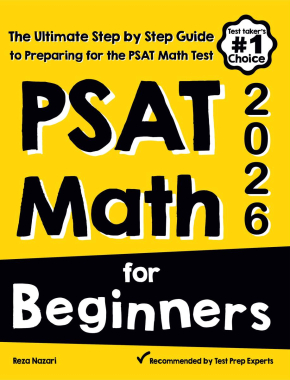
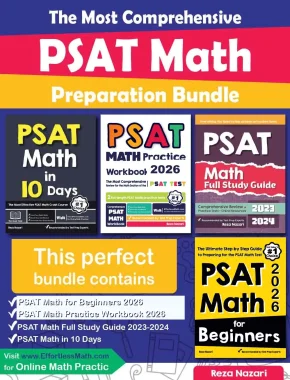
If you need a longer study sequence, compare the existing book options below and view the product details before choosing.
PSAT study guide option
PSAT review option

Related to This Article
More math articles
- Fifteenth Amendment
- How to Create a Praxis Core Math Study Plan?
- 7th Grade GMAS Math Worksheets: FREE & Printable
- Free Grade 4 Math Worksheets: 43 Printable PDFs with Answers
- Utah RISE Grade 5 Math at Home — 49 Free Single-Skill PDF Worksheets with Friendly Keys
- The Best Grade 8 ELA Practice Tests for Tennessee Students
- The Harlem Renaissance and Garveyism
- 3rd Grade OST Math FREE Sample Practice Questions
- Modern Political Campaigns
- Best Online MFT Programs in California










What people say about "10 Free PSAT Math Practice Questions with Answers"?
No one replied yet.