Rosie the Riveter, Child Care, and Women’s Wartime Work
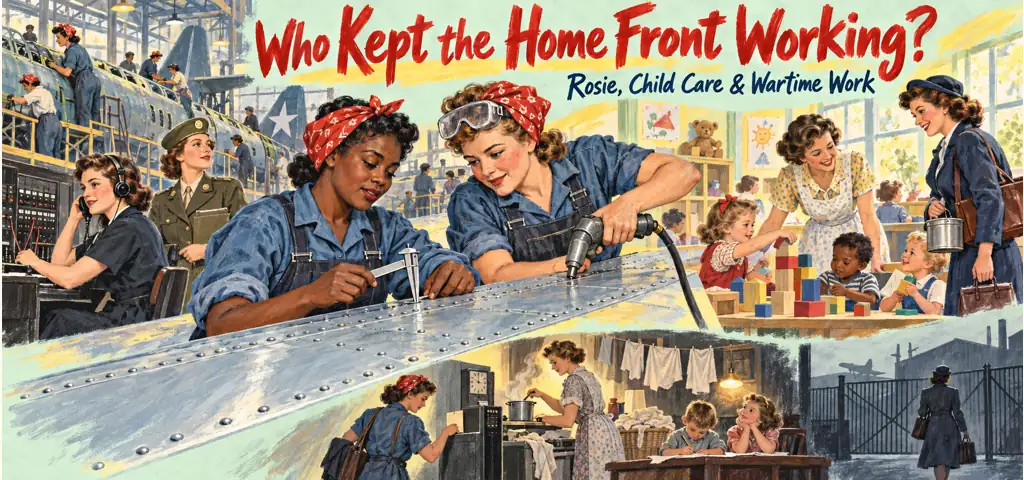
Chapter 10 of the CLEP History of the United States II study guide on Effortless Math covers Rosie the Riveter, Child Care, and Women’s Wartime Work: the key terms, the core ideas, and worked examples showing how this topic is tested on the exam.
CLEP History of the United States II, Chapter 10
Mobilization widened demand for women's labor
Conscription and expanding war contracts created labor shortages. Government campaigns and employers recruited women into aircraft, shipbuilding, ordnance, offices, farms, and transportation. Women's paid employment rose substantially, especially among married women. The famous Rosie image represented a real opening but not the whole workforce: women had always worked for wages, and millions remained in clerical, domestic, agricultural, and service occupations.
Propaganda promised duty more than permanent equality
Recruiting posters framed industrial work as patriotic service for the duration. They often combined strength with conventional femininity, reassuring audiences that women could handle tools without abandoning gender identity. The message helped overcome employer resistance, yet its temporary language also prepared for postwar displacement. A poster shows what officials wanted viewers to believe; payroll, occupation, and wage evidence reveal how opportunity actually changed.
Training opened skilled jobs but segregation persisted
Employers and public programs trained women as welders, riveters, inspectors, and machinists. Women frequently received lower pay or narrower job classifications than men doing related work and were blocked from promotion. Black women faced both racial and gender exclusion, often remaining concentrated in service work or the lowest industrial grades even as activists pressed defense employers and federal agencies. Labor scarcity weakened some barriers without erasing institutional hierarchy.
Lanham Act centers treated care as production infrastructure
Federal Lanham Act funds supported child-care centers in defense communities. Centers enabled mothers to take war jobs by providing supervised care, meals, and extended hours. They were locally administered and unevenly available, never serving every eligible family. Their rationale tied child care to emergency production rather than a permanent universal entitlement. Most federal support ended in 1946 as officials expected mothers to leave war employment, although some communities fought to preserve centers.
Women entered military institutions in new ways
The Women's Army Auxiliary Corps became the Women's Army Corps with full military status in 1943. Navy WAVES, Coast Guard SPARS, Marine women, and military nurses filled communications, clerical, technical, medical, and other positions, freeing men for combat assignments. Women Airforce Service Pilots ferried and tested aircraft as civilians and did not receive veteran status until decades later. Expanded service remained structured by sex and race, and most women were barred from combat roles.
The Hello Girls reveal why legal status matters
During the First World War, bilingual women telephone operators served with the Army Signal Corps in France, wore uniforms, took military oaths, and worked close to operations. The government nevertheless classified them as civilians after the war and denied veterans' benefits until Congress recognized their status in 1977. By contrast, WAC members in the Second World War held statutory military status. Similar duties or uniforms do not guarantee the same legal relationship to the armed forces.
Wartime households carried a double burden
Women working long industrial shifts still managed food rationing, shopping, laundry, and care. Housing shortages and transportation problems lengthened daily work. Husbands' military absence could increase autonomy and responsibility while allotments and letters maintained family ties. The home front was not separate from production: whether a worker could find housing, child care, meals, and transit affected factory output.
Reconversion narrowed some openings
After victory, contracts ended and returning servicemen claimed jobs under seniority systems and public expectations. Employers dismissed or reassigned many women, particularly from heavy industry. Federally supported centers closed, reinforcing the pressure to resume full-time care. Yet women's employment did not return to its prewar pattern. Many married women continued or later reentered paid work, and experience altered expectations even when a specific war job disappeared.
Veterans' policy and housing shaped the transition
The GI Bill favored eligible veterans through education, loans, and unemployment support, while a severe housing shortage constrained new families. Women veterans could use benefits but confronted discriminatory counseling and institutions. Public housing and later high-rise projects followed different local and postwar policies; their siting should not be explained as a direct continuation of Lanham child care. Gender transition depended on labor demand, veteran status, housing, and family policy together.
test Rosie against employment data
A poster shows one white woman operating industrial machinery, while a table shows growth among married workers and continued occupational segregation.
The war created precedent without linear liberation
Mobilization showed that government could subsidize care, train women, and authorize military service when production required it. The retreat after 1945 showed that emergency inclusion could be reversed when policy and demand changed. Long-term consequences emerged through memory, veteran claims, union experience, and later employment growth. The central analytical distinction is between access, legal status, job quality, duration, and lasting institutional support.
Watch the history in motion
This short lesson adds voices, images, and chronology to the ideas you just studied.
Video: Women at War: Life on the Homefront in World War II | BRIdge from the Past, Bill of Rights Institute.
Try four CLEP-style questions
- A recruiting poster celebrates one woman riveter, while payroll records show many women entering clerical and service work as well as factories. What is the best use of the two sources?
- The poster supplies a complete occupational census, while payroll records reveal only government intentions.
- The sources prove that industrial and clerical workers received identical wages.
- Posters show recruitment imagery; payrolls measure actual job distribution.
- The poster establishes that married women were barred from war plants.
- Payroll evidence makes public persuasion historically irrelevant.
- A factory trains many women for war work but keeps most in lower-paid classifications with few promotions. What does the evidence show?
- Training expanded entry, while seniority rules quickly equalized promotion within each department.
- Skilled assignments grew, but lower classifications mainly reflected temporary differences in prior experience.
- Mobilization widened access without ending inequality in job assignment and advancement.
- Labor scarcity opened industrial work, but equal wage scales removed the importance of promotion patterns.
- Federal recruitment widened the labor pool, while union contracts displaced employer control over job classification.
- Why can women's wartime gains and postwar displacement both be historically true?
- War industries opened jobs to women only after demobilization had begun.
- Returning veterans expanded defense contracts and women's industrial employment.
- Employers retained women's wartime share of heavy-industry jobs through reconversion.
- Postwar displacement resulted from inadequate training rather than reconversion or gender rules.
- Wartime demand opened jobs; reconversion and gender rules later displaced workers.
- What most clearly distinguishes the First World War Signal Corps operators from members of the Women's Army Corps?
- The operators held Army commissions equivalent to the statutory status later given the WAC.
- Operators lacked veteran status; WAC members held statutory status.
- WAC members remained civilian communications workers assigned to military offices.
- The statute creating the WAC also granted retroactive veteran status to the operators.
- WAC authority ended with the First World War armistice and was not renewed.
Check your answers and reasoning
Independent preparation. CLEP is a registered trademark of the College Board, which does not endorse this lesson.

Related to This Article
More math articles
- Mastering Exponential Growth And Decay: A Comprehensive Guide
- Environmental Corrective Actions and Area Cleaning
- CLEP U.S. History I 093: Republican Party and the Collapse of the Whigs
- Estimating Irrational Numbers: Complete Guide with Video and Examples
- The Best Grade 8 ELA Practice Tests for New Hampshire Students
- Vectors Introduction
- What Sociology Studies
- The Best Grade 7 ELA Practice Tests for Georgia Students
- Best Laptops for Math Majors in 2026
- Draft Needs a Boost? A Guide to the Best AI Essay Rewriters for Students
















What people say about "Rosie the Riveter and Women's War Work"?
No one replied yet.