The Double V Campaign and the Second Great Migration
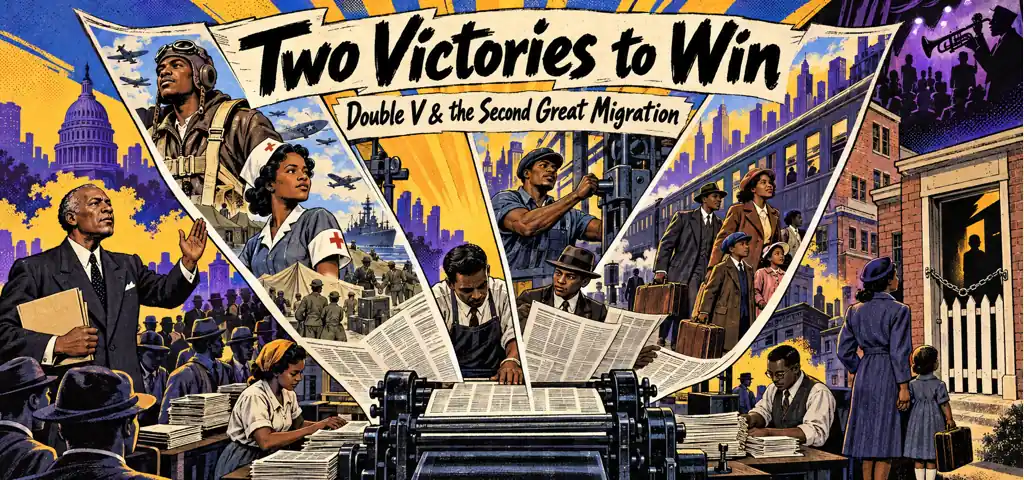
Chapter 10 of the CLEP History of the United States II study guide on Effortless Math covers The Double V Campaign and the Second Great Migration: the key terms, the core ideas, and worked examples showing how this topic is tested on the exam.
CLEP History of the United States II, Chapter 10
Defense mobilization renewed Black migration
War plants expanded in northern and western cities while mechanization, low wages, and racial violence pushed families from the South. Black populations grew in Detroit, Chicago, Los Angeles, Oakland, Seattle, and other centers. This Second Great Migration extended beyond the earlier northward stream to the West. Federal contracts created jobs, but restrictive housing, segregated unions, and discriminatory employers concentrated opportunity and conflict.
Randolph converted a march threat into executive action
A. Philip Randolph, leader of the Brotherhood of Sleeping Car Porters, threatened a mass March on Washington in 1941 against discrimination in defense employment and the armed forces. Roosevelt issued Executive Order 8802 barring discrimination in defense industries and federal vocational programs and created the Fair Employment Practice Committee. Randolph suspended the march. The order did not desegregate the armed forces, and the FEPC depended on investigation, publicity, negotiation, and limited presidential backing rather than strong punitive authority.
Double V joined foreign victory to domestic democracy
The Pittsburgh Courier popularized the Double V campaign: victory over fascism abroad and racism at home. Black newspapers documented military segregation, job exclusion, and violence while promoting participation in the war. The argument did not treat the Axis and American racial systems as identical. It exposed the contradiction between democratic war aims and unequal citizenship and made patriotic service a platform for stronger claims.
Earlier institutions supplied wartime pressure
Randolph's porters' union had become the first predominantly Black AFL-chartered union and built organizational experience. New Deal Black appointees informally called the Black Cabinet gathered evidence and pressed agencies without holding collective statutory power. When the Daughters of the American Revolution denied Marian Anderson Constitution Hall in 1939, Interior Secretary Harold Ickes arranged her Lincoln Memorial concert after Eleanor Roosevelt resigned from the DAR. Labor, administration, and public culture offered different channels of protest.
Military service remained segregated
Black servicemembers served in segregated units, often under white officers. The Tuskegee Airmen proved effective in combat while operating within a segregated training system. The Army Nurse Corps imposed a small quota on Black nurses even as need grew. Separate service could create leadership and pride, but it also restricted assignments, promotion, and facilities. Achievement did not validate the color line that constrained it.
Freeman Field officers challenged segregated facilities
In 1945 Black officers of the 477th Bombardment Group attempted to enter an officers' club at Freeman Field, Indiana, that commanders reserved for white officers. More than one hundred were arrested after refusing a segregated club rule; most were later released, though some faced discipline. Their action used military status to demand equal treatment inside the institution they served. It was organized nonviolent resistance, not a refusal to perform military duty.
Defense-city conflict joined jobs, housing, and policing
Detroit's Black population and war workforce grew rapidly, while housing segregation and overcrowding intensified. A 1942 confrontation over Black occupancy of the Sojourner Truth housing project required police and federal intervention. In June 1943 rumor, street conflict, white attacks, Black resistance, and unequal policing produced a deadly riot. Explaining the violence requires demographic pressure and defended racial boundaries; migration itself was not an inherent cause.
The federal government sometimes protected production against discrimination
In 1944 white transit workers in Philadelphia struck to oppose promotion of Black employees to operating jobs. Because the walkout disrupted essential war transportation, Roosevelt authorized federal seizure of the transit system, troops guarded operations, and workers returned. The episode joined civil rights to production necessity. Federal action defeated a discriminatory strike, though it did not establish equal employment nationwide.
Associational growth widened political capacity
NAACP membership expanded dramatically during the war as migration, defense work, and military service created new constituencies. Branches pursued voting, legal challenges, workplace complaints, and protest. Growth did not mean one organization represented every Black strategy. Randolph's labor pressure, newspaper campaigns, litigation, local self-defense, and federal appointments overlapped while retaining different institutions and tactics.
Postwar violence tested the meaning of victory
Black veterans returning in uniform faced assaults, including attacks in the South during 1946. Such violence targeted visible claims to equal citizenship and helped generate pressure for federal action. Earlier Gold Star mother pilgrimages had also been segregated by race, showing that even official remembrance separated bereaved families. Military sacrifice enlarged the moral claim, but white supremacy did not disappear when the Axis surrendered.
Gold Star pilgrimages forced a choice between protest and mourning
The War Department placed Black Gold Star mothers on segregated ships for government-funded visits to European graves. Walter White and the NAACP urged families to refuse an arrangement that separated mothers whose sons had died in the same war. Some boycotted; others traveled because the chance to visit a son's grave after more than a decade outweighed the pressure their refusal might create. Their decision did not endorse segregation. It exposed how a discriminatory public program could put collective protest and private grief in conflict.
Desegregation became policy and then operational practice
President Truman's Executive Order 9981 in 1948 declared equality of treatment and opportunity in the armed services. Implementation proceeded unevenly. During the Korean War, replacement shortages and command decisions accelerated assignment of Black soldiers to previously white units. The sequence distinguishes legal commitment from institutional execution: the order established policy, while later personnel decisions dismantled units in practice.
trace pressure through an institution
A march is announced, an executive order follows, and organizers suspend the demonstration.
The war accelerated a freedom struggle already underway
Black migration, union organization, newspapers, military protest, litigation, and federal action changed the scale of civil-rights politics. Wartime contradictions made discrimination costly to the nation's claims and sometimes to production. Yet housing violence, segregated service, narrow enforcement, and attacks on veterans showed continuity. The war was neither the beginning nor the completion of the modern movement; it redistributed people and organizational capacity into institutions later campaigns would use.
Watch the history in motion
This short lesson adds voices, images, and chronology to the ideas you just studied.
Video: World War II: Black American History #31, CrashCourse.
Try four CLEP-style questions
- Why is it misleading to describe wartime Black civil-rights mobilization as beginning from nothing in 1941?
- Earlier labor, administrative, and cultural institutions supplied organizers and pressure networks.
- The federal government had already enacted sweeping civil-rights laws during the 1920s.
- Defense employment erased the need for organizations formed before mobilization.
- Black newspapers suspended political reporting until the United States entered the war.
- Migration prevented prewar organizations from participating in wartime campaigns.
- A city gains defense jobs but preserves restrictive housing boundaries as thousands of workers arrive. Which outcome is most likely?
- Housing supply expands evenly because labor demand overrides property rules.
- Segregated housing intensifies crowding and rent pressure amid migration.
- Migration prevents employers from using racial job classifications.
- Employment growth removes the need for public transportation.
- Residential segregation declines without any change in law or behavior.
- What common principle linked the Freeman Field protest and the Double V campaign?
- Military necessity required Black citizens to postpone claims until after demobilization.
- Civil-rights demands could operate only through federal court litigation.
- Segregated institutions were acceptable when Black units performed successfully.
- Democratic service strengthened claims to equal citizenship at home.
- The campaigns sought withdrawal of Black workers and soldiers from mobilization.
- What do attacks on Black veterans returning in uniform after victory most strongly demonstrate?
- Military service had displaced racial conflict from civilian politics before demobilization.
- Federal veterans' protections prevented local authorities from identifying or targeting Black servicemen.
- Military service strengthened equality claims while also provoking white-supremacist resistance.
- Postwar attacks reflected labor rivalry rather than citizenship claims expressed by the uniform.
- Victory placed veterans' civil rights under exclusive federal enforcement in local communities.
Check your answers and reasoning
Independent preparation. CLEP is a registered trademark of the College Board, which does not endorse this lesson.

Related to This Article
More math articles
- The Best Grade 5 Math Book for New York Students
- What Does ALEKS Stand for?
- Rosie the Riveter, Child Care, and Women’s Wartime Work
- Texas Grade 6 Math Worksheets and STAAR Review
- 5th Grade IAR Math Practice Test Questions
- CLEP U.S. History I 017: The Transatlantic Slave Trade and Middle Passage
- Writing an Accurate Summary
- Multiplying 3-Digit by 1-Digit Numbers for 4th Grade
- The Best Grade 6 ELA Practice Tests for California Students
- How to Solve One-Step Equations? (+FREE Worksheet!)












What people say about "Double V and the Second Great Migration"?
No one replied yet.