Internment, the Bracero Program, and Minority Wartime Experiences
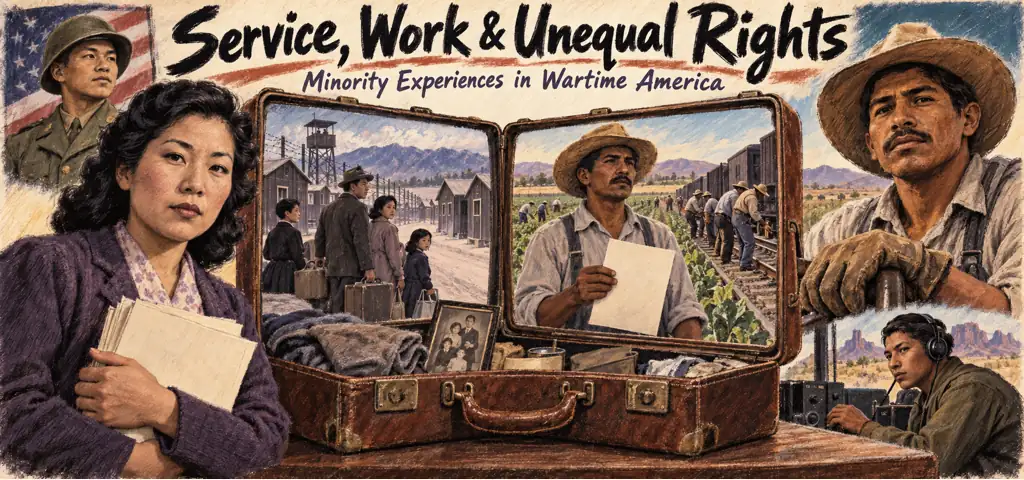
Chapter 10 of the CLEP History of the United States II study guide on Effortless Math covers Internment, the Bracero Program, and Minority Wartime Experiences: the key terms, the core ideas, and worked examples showing how this topic is tested on the exam.
CLEP History of the United States II, Chapter 10
Executive Order 9066 authorized zones, not a named ancestry
Executive Order 9066, issued in February 1942, authorized military commanders to designate exclusion areas and remove people from them. Its text did not name Japanese ancestry. Western Defense Command orders nevertheless used that authority to remove nearly the entire Japanese American population from the West Coast, including United States citizens. About two-thirds of those confined were citizens by birth. A formally geographic order became a mass ancestry-based program through its administration.
Treatment differed among enemy-alien populations
German, Italian, and Japanese nationals were classified as enemy aliens after Pearl Harbor. German and Italian aliens faced registration, restrictions, searches, and individual internment, but their communities were not removed wholesale on the West Coast model. Japanese immigrants and citizens were excluded together. Hawaii, despite its large Japanese-descended population and military importance, did not carry out removal on the continental scale. These contrasts weaken any claim that military risk alone produced one uniform national rule.
Removal caused immediate property and community loss
Families often received only days to store, lease, sell, or abandon farms, shops, homes, and household goods. Assembly centers preceded transfer to remote War Relocation Authority camps. Barracks offered little privacy; residents shared mess halls and latrines, worked for very low camp wages, and lived behind fences and armed guards. The government did not pay market value for property at removal. Economic loss began before confinement and continued long after the gates opened.
Korematsu and Endo addressed different legal questions
On December 18, 1944, the Supreme Court decided two cases after the administration had announced rescission of West Coast exclusion one day earlier. In Korematsu v. United States, the Court upheld Fred Korematsu's conviction for violating the exclusion order, accepting military necessity as its wartime justification. The ruling did not order the program closed. In Ex parte Endo, the Court held that the War Relocation Authority lacked power to detain a concededly loyal citizen. Endo constrained loyal-citizen detention, while Korematsu left the exclusion conviction standing; the decisions answered distinct legal questions.
Return did not restore what removal had destroyed
Public Proclamation No. 21, issued on December 17, 1944, rescinded the West Coast exclusion orders effective January 2, 1945, and camps closed through 1945. Returnees encountered missing property, housing scarcity, vandalism, and hostility in some communities. The Evacuation Claims Act of 1948 compensated a fraction of documented property losses and did not pay for lost earnings or the injury of confinement itself. Later redress activism produced the Civil Liberties Act of 1988, a federal apology, and payments of $20,000 to surviving incarcerees. That later outcome did not come from a Supreme Court reversal of Korematsu in 1988.
Military service existed beside family confinement
Japanese American military service exposed the contradiction between mass suspicion and individual loyalty. The 100th Infantry Battalion, largely formed from Hawaiian Nisei, and the 442nd Regimental Combat Team, which included volunteers from Hawaii and families confined on the mainland, fought in Europe with distinction. Military Intelligence Service linguists also served in the Pacific. Service did not erase confinement, but it supplied powerful evidence against ancestry as a measure of loyalty.
The Bracero Program supplied temporary contract labor
Beginning in 1942, agreements between the United States and Mexico brought Mexican workers on temporary contracts, principally to farms and also to railroad maintenance. The program continued until 1964. It promised wages, transportation, housing standards, and return, but growers and local administrators often controlled information and enforcement. Withholding part of wages for savings and unequal living conditions produced long disputes. A bilateral contract system could expand legal labor mobility without giving workers equal bargaining power.
Braceros were not repatriates or deportees
The program must be separated from the coercive repatriation campaigns of the 1930s and the mass immigration raids of 1954, often called Operation Wetback, which targeted Mexicans without papers and also swept up some United States citizens. Braceros entered through temporary contracts. The categories could interact because unauthorized migration, employer demand, and contract recruitment operated in the same labor market, but a contract admission and a deportation drive were not the same policy instrument.
Wartime labor demand did not dissolve housing conflict
Shipyards, aircraft plants, and other defense centers attracted workers faster than housing could be built. Federal Lanham Act construction added units, but restrictive covenants, segregation, and local resistance narrowed access. Detroit's severe crowding and racial conflict showed how abundant jobs could coexist with blocked neighborhoods. Migration changed the scale of cities without automatically changing the rules governing residential space.
The Zoot Suit attacks exposed unequal policing
In June 1943, groups of sailors and soldiers attacked Mexican American youths in Los Angeles, pulling some from theaters and streetcars and stripping their zoot suits. Police arrested hundreds of Mexican American youths while charging few servicemen. The city council approved a resolution asking the city attorney to prepare a prohibition on wearing zoot suits, but no such ordinance became law. The convictions in the separate Sleepy Lagoon case were later overturned on appeal. Arrest totals therefore cannot be read as a neutral count of who initiated wartime street violence.
Chinese exclusion ended only in a narrow first step
The Magnuson Act of 1943 repealed the Chinese exclusion laws and opened naturalization to Chinese immigrants already in the United States. It imposed a tiny annual immigration quota of roughly one hundred rather than admitting Chinese migrants on the same terms as immigrants from high-quota European countries. Wartime alliance with China helped make repeal politically possible, but the quota showed that racial immigration hierarchy survived the symbolic change.
The War Brides Act opened a family route outside quotas
The War Brides Act of 1945 admitted the alien spouses and minor children of American service members outside the numerical quotas. Most early arrivals were European or Australian women. Asian spouses still faced racial restrictions until later amendments and changes in naturalization law widened eligibility. The act reunited military families; it was not the Displaced Persons Act, a general refugee program, or a suspension of the national-origins system.
Native mobilization combined service, migration, and cultural use
Roughly forty-four thousand Native men and women entered the armed forces, while many more left reservations for defense work. Navajo Marines used a code built on their language, turning knowledge once targeted by assimilation policy into a military asset. Wartime work accelerated Native urban residence, and some veterans remained in cities. The Indian Reorganization Act had restored a measure of tribal self-government in 1934, before the war; wartime mobilization did not enact it.
separate legal form from administration
A prompt pairs the text of Executive Order 9066 with removal records for several ancestry groups.
Wartime inclusion and exclusion operated together
War mobilization opened jobs, military roles, migration routes, and limited immigration reform while also producing confinement, coerced labor conditions, street violence, and residential conflict. Minority communities used service, litigation, consumer power, journalism, and later redress campaigns to challenge those contradictions. A strong interpretation does not label the war simply inclusive or exclusionary. It identifies the institution, legal status, labor relationship, and place that shaped each experience.
Federal waivers opened a wartime labor channel in 1917
During World War I, growers and railroad employers sought Mexican workers while immigration law imposed a head tax, literacy test, and contract-labor restrictions. The secretary of labor temporarily waived those barriers for admitted workers. This was an administrative labor-supply program, not the 1942 Bracero agreement. Its rules show how wartime demand could reshape enforcement without Congress repealing the underlying restrictions.
The Delano boycott converted workplace action into outside pressure
After the 1965 Delano strike began, organizers asked consumers across the country to stop buying table grapes. Churches, students, unions, and civil-rights supporters widened the conflict beyond the fields. Growers faced lost sales and reputational pressure, while elected officials confronted organized constituencies far from California. Contract renewals later depended on whether workers and employers could sustain those coalitions after the first agreements.
The end and repeated renewal of Bracero contracts shaped bargaining power
Congress repeatedly extended the Bracero Program after the war because growers and allied officials argued that contract labor was necessary for harvests. That employer constituency helped keep the program operating until 1964. When it ended, growers lost a federally organized reserve of temporary contract workers that could weaken a strike by supplying replacements. Farmworker organizing still faced undocumented labor, mechanization, and employer resistance, but Bracero expiration changed the bargaining setting in which the Delano strike began.
Watch the history in motion
This short lesson adds voices, images, and chronology to the ideas you just studied.
Video: Japanese American Internment Camps Explained, Mr. Beat.
Try four CLEP-style questions
- Which research design best tests whether a facially geographic military order was administered unequally?
- Read the order alone and assume every authorized zone produced identical treatment.
- Compare its text with removal records by ancestry, citizenship, and region.
- Count only criminal convictions entered before the order was issued.
- Exclude Hawaii because regional variation cannot reveal administrative choice.
- Treat later redress legislation as the original order's complete administrative record.
- A table shows high wartime military participation by several minority groups. Which conclusion is least justified by that evidence alone?
- Service could furnish communities with experience and claims to equal citizenship.
- Enlistment totals do not measure housing, labor, or family treatment at home.
- Military participation automatically removed civilian exclusion and discrimination.
- Different legal statuses could shape service and civilian experience simultaneously.
- Participation data require institutional context before supporting a claim of equality.
- Why did formal Bracero contract guarantees not necessarily create equal bargaining power?
- Workers selected the growers who would inspect and punish contract violations.
- Congress gave each bracero permanent residence after one harvest season.
- Mexican unions administered American farms and set all regional wage rates.
- Contract workers could freely transfer among employers without official approval.
- Growers and local administrators often controlled work, information, housing, and enforcement.
- Why is it inaccurate to treat Mexican repatriation, Bracero recruitment, and the 1954 raids as one continuous program?
- All three admitted workers under identical bilateral labor contracts.
- Each provided permanent residence before arranging transportation across the border.
- The three policies operated concurrently through one wartime statute.
- They used different instruments: coerced departure, contract admission, and enforcement removal.
- Each focused on Mexican citizens and treated United States citizenship as reliable protection from removal.
Check your answers and reasoning
Independent preparation. CLEP is a registered trademark of the College Board, which does not endorse this lesson.

Related to This Article
More math articles
- New Mexico Algebra 1 Free Worksheets: Printable Algebra 1 PDFs with Worked Solutions
- Free Grade 8 English Worksheets for District of Columbia Students
- New Jersey Plan
- Subtracting Multi-Digit Numbers for 4th Grade
- Matching a Model with a Ratio
- Exponential and logarithmic integrals Simplified
- How to Solve Word Problems Involving the Percentage of a Number?
- The Best Grade 7 ELA Practice Tests for Kentucky Students
- 5th Grade NDSA Math Worksheets: FREE & Printable
- Multiplying Decimals Practice — Free Step-by-Step Drills



















What people say about "Internment, the Bracero Program and Wartime Experience"?
No one replied yet.