Tehran, Yalta, Potsdam, Bretton Woods, and the United Nations
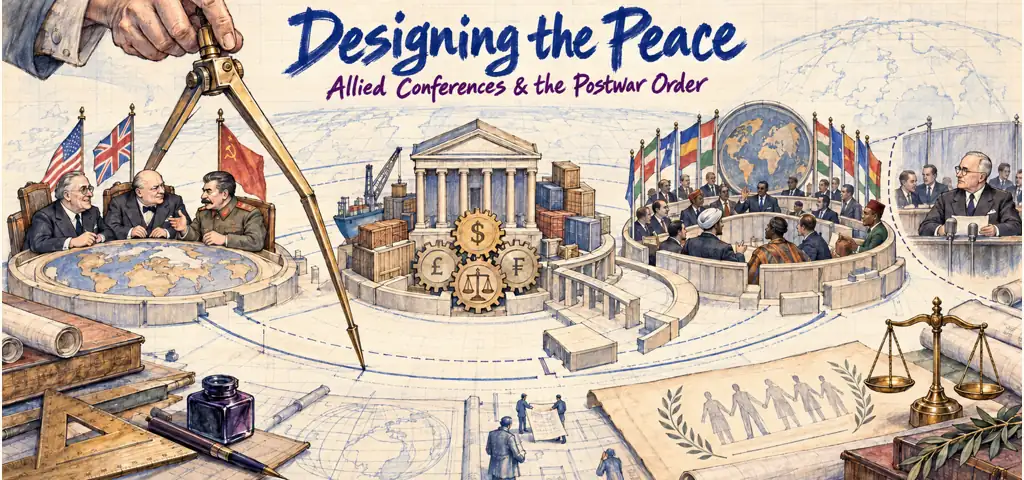
Chapter 10 of the CLEP History of the United States II study guide on Effortless Math covers Tehran, Yalta, Potsdam, Bretton Woods, and the United Nations: the key terms, the core ideas, and worked examples showing how this topic is tested on the exam.
CLEP History of the United States II, Chapter 10
Allied declarations created a coalition before victory
Twenty-six governments signed the Declaration by United Nations in January 1942. Each promised to commit its full military and economic resources and make no separate armistice or peace. The declaration was a wartime alliance pledge, not yet the charter of the later international organization. It helped turn Roosevelt's term "United Nations" into both a military coalition and, eventually, the name of a permanent institution.
Casablanca announced unconditional surrender
At Casablanca in January 1943, Roosevelt and Churchill announced that the Allies would accept the Axis powers' unconditional surrender. Stalin was absent because of the Soviet war effort. The formula aimed to reassure allies that no separate peace would divide them and to eliminate the kind of contested armistice memory left by 1918. Critics feared it might stiffen enemy resistance. It was a war-aim formula, not a detailed occupation plan.
Cairo stated Asian territorial aims
Roosevelt, Churchill, and Chiang Kai-shek met at Cairo in November 1943. Their declaration promised that Manchuria, Formosa, and the Pescadores would return to China and that Korea would become free and independent "in due course." The language opposed Japanese imperial conquest but left timing and enforcement uncertain. The Soviet Union did not sign because it was not yet at war with Japan.
Tehran fixed the European second front
Soon after Cairo, Roosevelt and Churchill met Stalin at Tehran. The three committed to launch Operation Overlord in France in 1944, while the Soviet Union would coordinate pressure from the east. Tehran was the first meeting of the Big Three leaders and gave Stalin the firm northwest-European invasion commitment he had long sought. It differed from Casablanca, where Roosevelt and Churchill had declared unconditional surrender without Stalin.
Yalta joined military bargains to postwar promises
At Yalta in February 1945, Roosevelt, Churchill, and Stalin addressed occupation zones in Germany, the emerging United Nations, Poland, and the Pacific war. Stalin promised Soviet entry against Japan about three months after Germany's surrender in return for territorial and strategic concessions in Asia. The Declaration on Liberated Europe endorsed representative governments and free elections, but its language did not settle who would supervise compliance where Soviet armies stood.
Yalta's agreements contained future conflict
The Allies shared an interest in defeating Germany and creating a postwar organization, but their security priorities differed. Stalin sought friendly governments on the Soviet border; western leaders emphasized political self-determination while accepting practical military realities. Terms such as "democratic" and "free elections" could conceal incompatible meanings. Yalta was neither a simple sale of Eastern Europe nor a complete democratic settlement. It recorded bargains made under unequal military control.
Potsdam met after leadership and battlefield change
Truman, Stalin, and first Churchill and then Clement Attlee met at Potsdam in July and August 1945. Germany had surrendered, Roosevelt had died, Britain changed governments during the conference, and the United States had tested an atomic bomb. The leaders addressed occupation, demilitarization, reparations, borders, and displaced populations amid growing distrust. Potsdam implemented and disputed earlier agreements rather than beginning postwar planning from nothing.
The Potsdam Declaration addressed Japan
On July 26, 1945, the United States, Britain, and China called for Japan's armed forces to surrender unconditionally or face "prompt and utter destruction." The Soviet Union was not a signatory because it had not yet entered the Pacific war. The published text did not explicitly guarantee retention of the emperor. Soviet entry, the atomic attacks, blockade, bombing, and Japanese political conflict all shaped the surrender that followed.
The Morgenthau proposal was not lasting occupation policy
Treasury Secretary Henry Morgenthau Jr. proposed stripping Germany of heavy industry and reducing its capacity for renewed war, often summarized as pastoralization. The United States did divide Germany into occupation zones and supported war-crimes trials, but it did not maintain the Morgenthau program as its postwar economic strategy. Later policy increasingly treated German recovery as important to European stability. Distinguishing a proposal from adopted policy prevents false continuity.
Japan and Germany had different occupation structures
Germany was divided among American, British, Soviet, and French occupation zones. Japan was administered under a single Supreme Commander for the Allied Powers, General Douglas MacArthur, although Allied councils existed. Japan retained the emperor under occupation and adopted a new constitution. The contrast reflected geography, surrender arrangements, and great-power relations; it did not mean Japan regained sovereignty immediately after signing surrender documents.
Bretton Woods built monetary institutions
Delegates from forty-four Allied nations met at Bretton Woods, New Hampshire, in July 1944. They established the International Monetary Fund to support exchange stability and short-term balance-of-payments adjustment and the institution that became the World Bank to finance reconstruction and development. Currencies were tied to the dollar, which was convertible into gold for foreign monetary authorities. Bretton Woods did not create the United Nations, NATO, the Marshall Plan, or the later tariff agreement known as GATT.
The United Nations balanced universality and great-power consent
The 1945 San Francisco Conference completed the United Nations Charter after earlier planning at Dumbarton Oaks and Yalta. The General Assembly gave each member a forum, while the Security Council carried primary responsibility for peace and security. The United States, Soviet Union, Britain, France, and China became permanent council members with veto power over substantive decisions. The veto limited collective action but helped secure participation by powers whose absence had weakened the League of Nations.
The War Refugee Board was a late rescue institution
In January 1944, after Treasury officials documented obstruction within the State Department, Roosevelt created the War Refugee Board to rescue and relieve civilians threatened with murder by the Axis. It financed and coordinated efforts including support for Raoul Wallenberg's work in Budapest. The board acted late and did not suspend national-origins immigration quotas. Its record demonstrates both the possibilities of executive action and the human cost of earlier delay.
Nuremberg made individuals answerable under international law
After victory, the United States, Britain, Soviet Union, and France created the International Military Tribunal at Nuremberg to try major surviving Nazi leaders. Charges included crimes against peace, war crimes, and crimes against humanity. The tribunal rejected the claim that state office automatically erased personal responsibility, although critics raised concerns about retroactivity and victors judging the defeated. This differed from the weak, largely national accountability after the First World War.
Human-rights principles continued beyond the 1945 charter
The United Nations General Assembly adopted the Universal Declaration of Human Rights in 1948. Eleanor Roosevelt chaired the UN Commission on Human Rights and guided its drafting. The declaration articulated civil, political, social, and economic rights as a common standard, but it was not a self-executing treaty that instantly overrode domestic law. Its moral and diplomatic authority extended wartime language of freedom into postwar argument.
match forum to instrument
A prompt lists a currency crisis, an invasion threat, a war-crimes prosecution, and a statement of universal rights.
Postwar order mixed rules, power, and unresolved sovereignty
The conferences built occupation regimes, financial institutions, a security organization, and legal principles before wartime unity disappeared. American leadership was central, but outcomes depended on Soviet military control, British and Chinese participation, colonial claims, and smaller-state consent. Institutions reduced some uncertainty without eliminating great-power rivalry. The postwar order was therefore neither idealist design alone nor raw power alone; it embedded power inside rules that states would contest during the Cold War.
Watch the history in motion
This short lesson adds voices, images, and chronology to the ideas you just studied.
Video: Post-War Rebuilding and the Cold War: Crash Course European History #41, CrashCourse.
Try four CLEP-style questions
- Why did the Declaration on Liberated Europe fail to prevent later conflict over Eastern Europe?
- It avoided commitments to representative government or elections in liberated countries.
- It assigned enforcement to the United Nations rather than to the occupying powers.
- Western military control of the region excluded Soviet participation in implementing the declaration.
- Shared language left incompatible meanings and enforcement under unequal military control.
- It specified a uniform restoration of prewar governments regardless of local political conditions.
- Why should Potsdam not be treated as the beginning of Allied postwar planning?
- It revisited earlier agreements after Germany's surrender and changes in Allied leadership.
- It met before Tehran and supplied the first commitment to invade France.
- It created Lend-Lease before Britain or the Soviet Union entered the war.
- It preceded Bretton Woods and chose the original gold value of the dollar.
- It drafted the Atlantic Charter before Roosevelt and Churchill met at sea.
- What central tradeoff did the Security Council veto embody?
- It gave every General Assembly member unilateral control over military action.
- It excluded the Soviet Union and China from permanent participation.
- It guaranteed enforcement whenever any small state alleged aggression.
- It transferred monetary policy from Bretton Woods to the United Nations.
- It constrained collective action while helping keep major powers inside the institution.
- What most clearly limited the War Refugee Board's reach despite its rescue work?
- It operated before Nazi persecution began and closed when war started.
- It was created late and did not suspend restrictive American immigration quotas.
- It possessed authority to command Allied armies but declined to use them.
- It focused solely on postwar trials rather than civilians in immediate danger.
- It prohibited diplomatic and private organizations from assisting rescue efforts.
Check your answers and reasoning
Independent preparation. CLEP is a registered trademark of the College Board, which does not endorse this lesson.

Related to This Article
More math articles
- How to Find Continuity at a Point?
- 6th Grade ILEARN Math Worksheets: FREE & Printable
- Wisconsin Algebra 1 Free Worksheets: Free Printable PDFs Covering Every Algebra 1 Skill
- Full-Length 7th Grade SBAC Math Practice Test
- South Dakota Smarter Balanced Grade 7 Math Worksheets: 95 Free Printable PDFs
- South Dakota Algebra 1 Free Worksheets: Printable Standards-Aligned Algebra 1 PDFs, Free
- Best tools for Online teachers
- The Ultimate 6th Grade Common Core Math Course (+FREE Worksheets)
- The Best Algebra 1 Book for Delaware Students
- 5 Perfect Blue Light Glasses for Online Teachers




















What people say about "Yalta, Potsdam, Bretton Woods and the UN"?
No one replied yet.