Cold War Origins, the Truman Doctrine, and the Marshall Plan
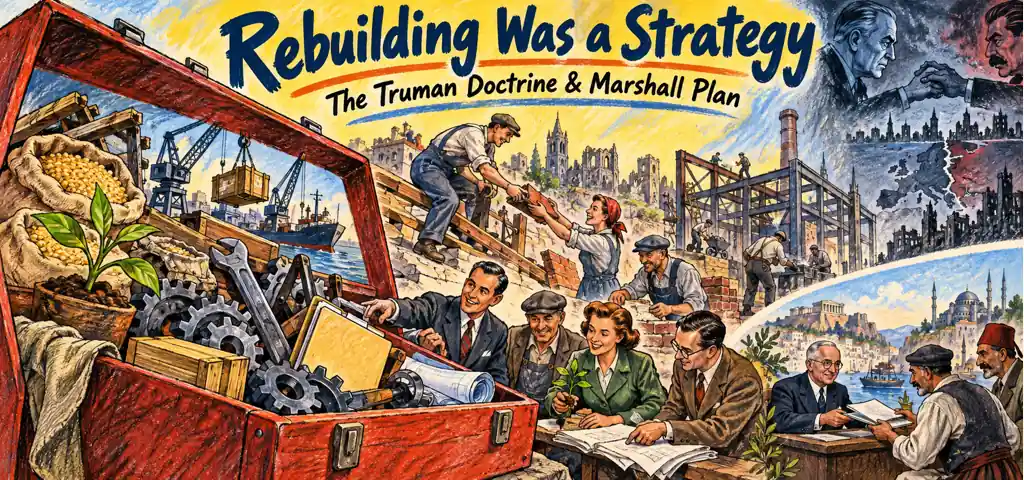
Chapter 11 of the CLEP History of the United States II study guide on Effortless Math covers Cold War Origins, the Truman Doctrine, and the Marshall Plan: the key terms, the core ideas, and worked examples showing how this topic is tested on the exam.
CLEP History of the United States II, Chapter 11
Victory left a security problem rather than a settled peace
In 1945 American and Soviet soldiers had defeated a common enemy, but their governments entered the peace with different experiences and priorities. Soviet leaders remembered repeated invasion from the west and wanted friendly governments on their border. American officials favored access to markets, political self-government, and institutions open to several powers. Disputes over Poland, Germany, reparations, and occupation therefore became arguments about both ideals and security. The Cold War emerged from incompatible arrangements, mutual suspicion, and unequal military positions rather than one formal declaration.
The Iranian crisis tested the new United Nations
British and Soviet forces had occupied Iran during the war under an agreement requiring withdrawal after hostilities. Soviet troops remained in the north beyond the March 1946 deadline while separatist movements there received Soviet support. Iran brought the dispute to the new Security Council. Diplomatic pressure and negotiation preceded Soviet withdrawal. The episode mattered because a smaller state used an international forum and because western officials read the delay as evidence that wartime cooperation would not automatically govern the peace.
Churchill supplied a memorable map of division
At Westminster College in Fulton, Missouri, in March 1946, Winston Churchill warned that an "iron curtain" had descended across Europe. He described governments in Eastern Europe operating within a Soviet sphere and urged close Anglo-American cooperation. The phrase made political division visible, but the speech did not create that division. Nor did it mean every society east of the line had identical institutions or popular attitudes. A metaphor can organize evidence while simplifying the local histories it covers.
Kennan defined containment as patient pressure
Diplomat George F. Kennan's 1946 Long Telegram and his 1947 article signed "X" argued that Soviet policy combined Marxist ideology with a historical sense of insecurity. He expected Soviet pressure to probe weak points but believed the system could be contained by patient, firm resistance at major industrial and strategic centers. Containment was not a promise to liberate every Soviet-controlled territory by force. Kennan emphasized priorities, political confidence, and time; later administrations expanded the doctrine beyond his preferred instruments.
Atomic control exposed the sequence problem
The United States proposed international control of atomic energy through the Baruch Plan in 1946. It called for an international authority owning or controlling dangerous nuclear activities, inspection without a Security Council veto, and eventual elimination of national bombs. The Soviet counterproposal demanded destruction of existing weapons before the proposed inspection system took full effect. Each side feared becoming vulnerable during the transition. Their disagreement concerned sequence and enforcement, showing how mistrust could defeat a plan both described as disarmament.
The Truman Doctrine began with Greece and Turkey
In 1947 Britain told Washington that it could no longer support Greece and Turkey. Greece faced civil war, while Turkey confronted pressure around the straits. Truman asked Congress for aid and declared that the United States should support free peoples resisting armed minorities or outside pressure. Congress funded military and economic assistance to the two governments. The rhetoric sounded global, but the appropriation addressed particular states. That difference between universal language and limited program is essential when tracing how a doctrine became policy.
The Marshall Plan treated recovery as security
Secretary of State George Marshall proposed European recovery aid in a Harvard speech in June 1947. Participating governments assessed needs and cooperated in allocation, while the United States supplied grants and purchases. The offer was formally open to the Soviet Union and Eastern Europe, but Moscow rejected the conditions and prevented its allies from joining. Recovery could weaken extremist politics, restore trade, and reduce dependence. The program used economic capacity as a security instrument rather than stationing American troops in every participating country.
The Rio Treaty placed collective defense in the hemisphere
The American republics signed the Inter-American Treaty of Reciprocal Assistance at Rio de Janeiro in September 1947. Article 3 treated an armed attack on one American state within the defined treaty region as an attack on all, while leaving each government to determine the assistance it would provide. The agreement therefore did not create an integrated command or automatically issue declarations of war. It preceded NATO and the 1948 charter of the Organization of American States, embedding early Cold War collective security in an older inter-American framework.
Aid also moved through the American economy
Congress funded roughly thirteen billion dollars through the European Recovery Program between 1948 and 1951. Much of the money paid for European purchases of American grain, machinery, fuel, and shipping. Europeans received goods and productive capacity; American farmers, manufacturers, and carriers received demand. This circulation does not make the program disguised charity to American business or purely selfless reconstruction. A policy can serve recovery abroad, political stability, and domestic production at the same time.
Point Four carried a different development instrument
In his 1949 inaugural address Truman proposed Point Four, a program sharing technical knowledge with poorer countries. Advisers worked on agriculture, health, administration, and infrastructure. Unlike the Marshall Plan's large capital transfers to reconstruct industrial Europe, Point Four emphasized expertise and development in regions emerging from colonial rule. Technical assistance still carried assumptions about modernization and American models. Knowledge was not politically neutral merely because it arrived through an agronomist rather than a soldier.
Containment had boundaries behind the iron curtain
The United States protested Soviet domination and broadcast information into Eastern Europe, but it did not send armies to support the Hungarian uprising of 1956. Nuclear danger, geography, and prior Soviet control shaped that restraint. Public language about freedom therefore did not equal a military guarantee wherever resistance appeared. Containment sought to prevent further expansion at chosen points; rollback would have required forcing Soviet power out of territory it already held. Confusing the two makes American commitments look either limitless or meaningless.
separate goal from instrument
A prompt lists the Truman Doctrine, Marshall Plan, Point Four, and diplomatic pressure in Iran.
Origins are best explained as an interactive process
Soviet coercion in Eastern Europe and failure to withdraw promptly from Iran alarmed western officials. American atomic advantage, economic plans, and consolidation of western institutions intensified Soviet fears. Domestic politics on both sides rewarded vigilance. Historians debate responsibility and missed alternatives, but a useful explanation distinguishes initiating acts from feedback. By 1949 ideas, aid programs, divided governments, and security organizations had hardened a conflict that neither wartime summit had fully designed.
Watch the history in motion
This short lesson adds voices, images, and chronology to the ideas you just studied.
Video: The Truman Doctrine, Containment, and the Marshall Plan | US HISTORY HELP: The Cold War, US HISTORY HELP.
Try four CLEP-style questions
- Why could one containment strategy produce diplomatic pressure, reconstruction aid, and technical assistance?
- Containment required identical spending in every country.
- The objective was broad, while conditions determined the policy instrument.
- Kennan required military invasion before economic assistance.
- Congress prohibited nonmilitary responses to Soviet influence.
- The strategy applied only to states already occupied by American troops.
- Which evidence best supports describing the Marshall Plan as cooperative European recovery rather than a series of unrelated American gifts?
- Recipient governments surrendered their taxing authority to the United States Treasury.
- Congress assigned each shipment without consulting any participating European institution.
- Aid contracts required nationalized ownership of the firms receiving new machinery.
- Participating governments assessed needs together and coordinated the allocation of aid.
- The Soviet Union administered purchases for both eastern and western European states.
- Which evidence would most weaken an explanation that treats early Cold War conflict as the product of Soviet action alone?
- Records showing western atomic advantage and security planning affected Soviet threat perceptions
- Soviet directives tightening political control after coalition governments resisted Moscow
- Reports that communist parties drew support from wartime resistance organizations
- European surveys recording fear of Soviet pressure after the Czechoslovak coup
- Diplomatic cables describing disputes among Soviet officials over occupation policy
- A speech announces support for "free peoples," but the appropriation funds Greece and Turkey. What distinction should a historian make?
- The appropriation implemented the full doctrine wherever a government faced internal unrest.
- Broad public doctrine and the initial program had different scopes.
- The two-country authorization shows that the public principle referred only to Greece and Turkey.
- The first authorization made military aid the required instrument for every later containment policy.
- Congress narrowed the doctrine by transferring its economic provisions to the Marshall Plan.
Check your answers and reasoning
Independent preparation. CLEP is a registered trademark of the College Board, which does not endorse this lesson.

Related to This Article
More math articles
- 5 Best Programmable Calculators
- 10 Most Common SAT Math Questions
- Parallel, Perpendicular, and Intersecting Lines
- Algebra Puzzle – Challenge 44
- Free Grade 8 English Worksheets for Maryland Students
- Intelligent Math Puzzle – Challenge 92
- Malcolm X, Black Power, and Urban Uprisings
- Word Problems Involving Comparing Ratio
- A Comprehensive Collection of Free CBEST Math Practice Tests
- Social Stratification, Class, Poverty, and Mobility




















What people say about "Cold War Origins and the Marshall Plan"?
No one replied yet.