The Best Grade 7 Math Book for Arizona Students

TL;DR: Arizona’s 7th grade math test is the AzM2 (Arizona’s Academic Standards Assessment), aligned to the Arizona Academic Standards (Common Core-based). The best 7th grade math book for Arizona students covers all five 7th grade Common Core strands with practice problems matched to AzM2 item types.
Key takeaways:
- Arizona’s 7th grade math test is the AzM2 (Arizona’s Academic Standards Assessment).
- Aligned to Arizona Academic Standards (Common Core-based).
- Topics: ratios and proportional relationships, rational-number operations, expressions and equations, geometry, statistics and probability.
- Pair a textbook with AzM2-style practice tests for the strongest preparation.
- Performance levels: Minimally Proficient, Partially Proficient, Proficient, Highly Proficient.
Seventh grade math is easy to underestimate. There is no big test with a famous name, no high school course attached. But underestimating it is a mistake, because seventh grade is where the foundation for all of high school math quietly gets poured.
Proportional reasoning, fluent work with negative numbers, real equations, the heart of seventh grade math is the heart of what Grade 8 and Algebra 1 build on. An Arizona student who finishes seventh grade strong has a real head start. A clear book is the most reliable way to give them one.
What seventh grade math covers in Arizona
Arizona teaches math through its state academic standards, and seventh grade math is assessed each spring through the AASA. The seventh grade course covers a full year of material: ratios and proportional relationships, operations with rational numbers including negatives, writing and solving equations and inequalities, geometry topics like scale drawings, angles, area, and volume, and an introduction to probability and statistics.
A good deal of that is new thinking, and it leads straight into Grade 8. When an Arizona seventh grader struggles, it is rarely about ability. It is usually that a new idea was taught too fast, the gap stayed open, and the next idea was built on the missing piece. Because these topics return in high school, closing the gaps in seventh grade is genuinely worth it.
The book we recommend for Arizona seventh graders
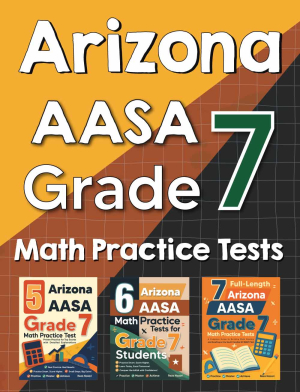
For an Arizona student working through seventh grade math, the book we recommend is Arizona AASA Grade 7 Math Made Ridiculously Simple.

The book keeps the promise in its title. Each topic is introduced in plain, friendly language, then shown with a worked example that leaves out no steps, then handed to the student to practice, with answer keys for instant feedback. It follows Arizona’s standards and the AASA, and it deliberately builds the foundation Grade 8 math will draw on.
Because every explanation is complete, the book teaches the student directly, with no tutor required. That makes it a strong fit for homeschoolers, for summer catch-up, and for any student whose class has moved a little faster than they have.
How to study with it
The routine that makes the book pay off is short and sustainable:
- Short, regular sessions beat long, rare ones. Half an hour a few times a week is plenty.
- Use a pencil on every problem. Math is learned by doing it.
- Check answers as you go and study the misses. They show exactly what to practice next.
- Do not move on until a section feels easy. A weak spot left behind tends to resurface in Grade 8.
When seventh grade is done, Grade 8 math is next. Our guide to the best Grade 8 math book for Arizona students carries the same approach into the bridge year.
Questions Arizona families ask
How is seventh grade math tested in Arizona?
Seventh grade math is assessed each spring through the AASA. The skills it checks lead directly into Grade 8 math and, beyond it, Algebra 1.
Why does seventh grade math matter so much?
It is where the foundation for high school math gets poured. Proportions, rational numbers, and equations in seventh grade become the backbone of Grade 8 and Algebra 1.
Can my child use this book without a tutor?
Yes. It was written to teach a student directly, with self-contained explanations and answer keys for instant feedback. It also works well alongside a tutor or a helping parent.
My child treats seventh grade as an easy year. Is that risky?
It can be. Coasting through seventh grade math means starting Grade 8 behind. Taking it seriously now is far easier than catching up later.
The bottom line
Seventh grade math is easy to underestimate and costly to ignore, because it is where the high school math foundation gets poured. Arizona AASA Grade 7 Math Made Ridiculously Simple gives a student clear teaching and honest practice for the spring AASA, plus a real head start on Grade 8. Give this year the attention it deserves, and the math ahead begins on solid ground.
Frequently Asked Questions
What does 7th grade math cover?
In Arizona, seventh grade math covers ratios and proportional relationships, the number system with negative numbers, expressions and equations, geometry, and statistics and probability. Students solve percent problems such as tax and tips, add and multiply integers, solve equations like 6x − 9 = 15 (x = 4), work with scale drawings, and find the area of circles. The spring AASA math test is built on these same areas.
What are the Arizona 7th grade math standards?
Arizona’s 7th grade expectations are set out in the Arizona Mathematics Standards, which were built from the Common Core and revised by the state. They are organized into five domains: ratios and proportional relationships, the number system, expressions and equations, geometry, and statistics and probability. The Arizona Department of Education posts the full grade 7 standards document, which lists every skill students are expected to master.
What math should a 7th grader know?
An Arizona 7th grader should finish the year able to set up and solve proportions, compute fluently with positive and negative fractions and decimals, and write and solve two-step equations and inequalities. They should also find circle area and circumference, use angle facts to find missing angles, and estimate probability from experiments. For example, they should be able to show that 3/4 ÷ (−1/2) = −3/2.
Can 7th graders take Algebra 1?
Some can. Arizona districts set their own placement rules, and many offer an accelerated track where strong students take a compacted course or Algebra 1 in 7th or 8th grade. Placement usually depends on grades, test scores and teacher recommendation. Before jumping ahead, make sure your child is solid on 7th grade skills like proportions and negative numbers, because Algebra 1 relies on them every day.
Can you take geometry in 7th grade?
Very rarely. High school Geometry normally follows Algebra 1, so even accelerated Arizona students usually reach it in 8th or 9th grade. Seventh grade math still includes plenty of geometry: scale drawings, supplementary and vertical angles, circle measurements, and the surface area and volume of prisms. For instance, if one of two supplementary angles measures 65°, the other measures 180° − 65° = 115°.
What is the 7th grade math curriculum in Arizona?
Arizona sets the standards, and each district or charter school chooses its own 7th grade math curriculum. Most programs follow a similar path: integers and rational numbers, proportional reasoning and percents, equations and inequalities, geometry, and then statistics and probability. Ask your child’s teacher which program the school uses and how the units are paced ahead of AASA testing in the spring.
Related Lessons You May Like
- How to add and subtract integers
- How to solve proportional ratios
- How to solve percent of change
- How to solve one-step equations
- How to solve multi-step word problems
If you want a workbook for these questions, Mastering Grade 7 Math covers every Grade 7 standard. Mastering Grade 7 Math Word Problems adds word-problem practice.

Related to This Article
More math articles
- The budget line shows purchasing possibilities
- Cabinet
- 49 Printable Maryland MCAP Grade 5 Math Worksheets — Free Download with Step-by-Step Keys
- Free Common Core (CCSS) Grade 3 Math Worksheets: 49 Printable Skill Pages with Step-by-Step Answer Keys
- Functionalist, Conflict, Feminist, and Interactionist Views of Family
- Straight-ticket voting
- How to Find Perimeter and Area Relationship
- Top 10 7th Grade PARCC Math Practice Questions
- Ethnocentrism, Relativism, and Cross-Cultural Encounters
- Fraction, Decimal & Percent Conversion Practice (Free)



What people say about "The Best Grade 7 Math Book for Arizona Students"?
No one replied yet.