CLEP U.S. History I 096: Union and Confederate Strengths and Strategies
Lesson 18.1 of Chapter 18 of the U.S. History to 1877 study guide on Effortless Math covers CLEP U.S. History I 096: Union and Confederate Strengths and Strategies: the key terms, the core ideas, and worked examples showing how this topic is tested on the exam.
U.S. History to 1877 | Chapter 18 | Lesson 18.1
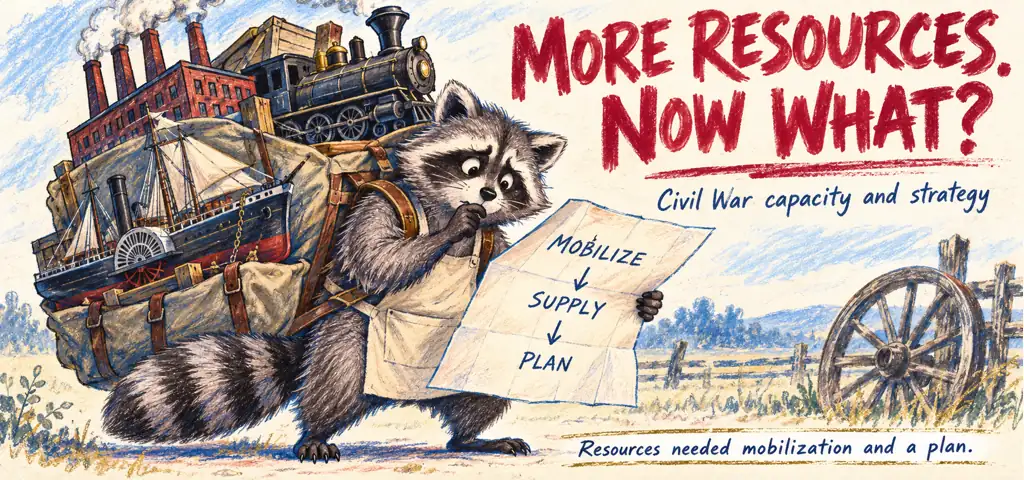
The Union possessed a larger population, more factories, greater railroad capacity, a navy, and established federal institutions. The Confederacy fought defensively across familiar territory and could hope that northern voters would abandon a costly war. It also expected cotton and European economic interest to encourage recognition. Those advantages did not guarantee either outcome. The Union had to invade, occupy, and sustain political will. The Confederacy had to coordinate states, supply armies, and defend a vast perimeter.
The Union’s broad strategy sought blockade, control of the Mississippi, pressure on Confederate armies and infrastructure, and eventually coordinated offensives. Confederate leaders often defended key points while also attempting invasions that might influence northern politics. “More resources” explains capacity, not automatic success. Mobilization and strategy determine whether resources become effective power.
Diplomacy belonged inside both strategies. Confederate leaders expected cotton and European interest to encourage Britain or France to recognize independence. Union diplomacy sought to keep the conflict an internal rebellion and later tied the war publicly to emancipation. European governments granted belligerent status but not diplomatic recognition. The failure to win recognition narrowed Confederate options, yet it followed policy and battlefield developments rather than economic interest alone.
Modeled analysis A table comparing rail mileage and industrial output supports the inference that the Union could replace equipment and move supplies more readily. It does not prove every Union army was well supplied or every campaign well led.
Watch the topic in context
Use this lesson from Heimler's History to review the period and its central historical problem. Pause when the video reaches the turning point named above.
Video: The CIVIL WAR: Military Strategies [APUSH Review], Heimler's History.
Check your understanding
- The Union’s most important structural advantage was its
- ability to finance the war chiefly through cotton exports.
- larger population, industrial capacity, and transportation network.
- strategic need to defend territory without invading the enemy.
- steady political agreement about conscription and emancipation.
- formal military alliance with Britain and France.
- The Confederacy could win strategically by
- capturing and permanently occupying major northern cities.
- matching Union naval production before the blockade took effect.
- sacrificing interior defense to preserve cotton exports alone.
- sustaining resistance until northern will collapsed.
- forcing every border slave state to secede before fighting began.
- Select all Union strategic goals:
- blockade,
- Mississippi control,
- defeat major armies,
- destroy military infrastructure,
- secure Confederate independence.
- Explain why resource superiority does not make victory inevitable.
Write a brief response using a named fact from the lesson.
Open the answers and reasoning
Independent preparation. CLEP is a registered trademark of the College Board, which does not endorse this lesson.

Related to This Article
More math articles
- In-Depth Analysis of Vector Function Derivatives: Theory and Practical Applications
- The Best Grade 4 Math Book for Maine Students
- Institutions can reduce transaction costs
- Migration, Remittances, and Global Care Chains
- The Grocery Store Challenge: How to Use Unit Rates to Solve Word Problems
- Sixth Grade Writing: Argument, Informative, and Narrative Expectations Explained
- Full-Length 6th Grade Common Core Math Practice Test
- Free Grade 7 English Worksheets for Washington, D.C. Students
- 6th Grade Common Core Math FREE Sample Practice Questions
- 5 Best Smartphones for Math Teachers















What people say about "Union and Confederate Strengths and Strategies"?
No one replied yet.