CLEP U.S. History I 039: Launching the Federal Government and the Bill of Rights
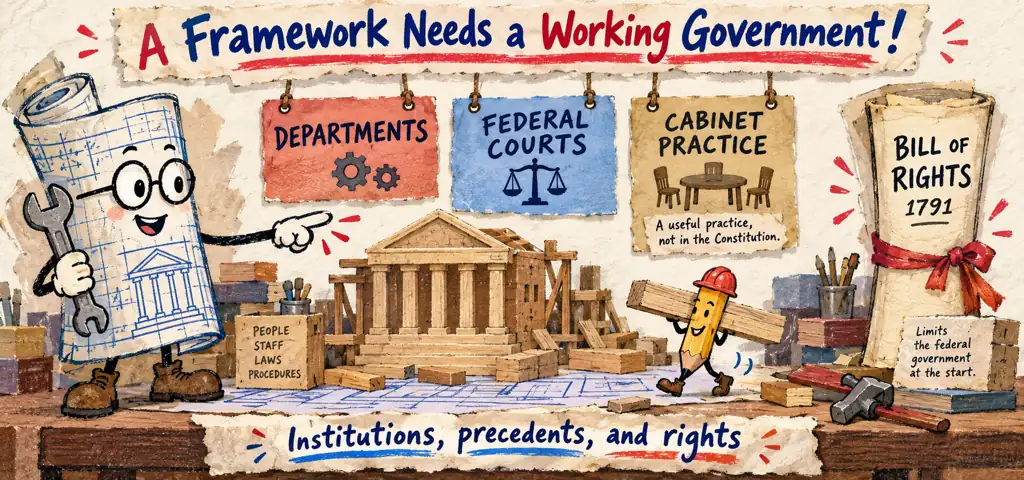
Lesson 8.1 of Chapter 8 of the U.S. History to 1877 study guide on Effortless Math covers CLEP U.S. History I 039: Launching the Federal Government and the Bill of Rights: the key terms, the core ideas, and worked examples showing how this topic is tested on the exam.
U.S. History to 1877 | Chapter 8 | Lesson 8.1
The first Congress and President George Washington had to make the new framework govern. Congress created the Departments of State, Treasury, and War and provided for an attorney general. A central practical question concerned removal: could the president dismiss executive officers without Senate approval? Congress accepted a strong presidential removal power, helping make department heads responsible to the president. Washington then gathered leading officers for advice. The Constitution never names a presidential cabinet, but this informal practice became durable. The Judiciary Act of 1789 supplied another missing structure by creating district and circuit courts beneath the Supreme Court and defining federal jurisdiction. The act did not settle every question about federal and state judicial power, but it made Article III operational.
Washington understood that conduct could define the office. He used the title “President of the United States,” delivered messages to Congress, toured the states, and generally avoided the ceremonial display of a monarch. He served two terms and then retired, establishing a precedent that lasted until the twentieth century. At the same time, the presidency was not modest in every respect: Washington asserted executive authority in administration, diplomacy, and enforcement. Precedent therefore meant translating broad constitutional grants into repeated practice, not simply limiting the office.
Ratification had left a political debt. Many Americans feared that the Constitution did not protect individual liberty explicitly enough. Representative James Madison drafted amendments from state proposals. Ten were ratified in 1791. The Bill of Rights protects religion, speech, press, assembly, petition, criminal-procedure rights, and other liberties. The Ninth warns that listing rights does not deny others retained by the people, while the Tenth reserves undelegated powers to the states or the people. At first these restrictions applied to the federal government, not the states. That distinction matters when interpreting early controversies.
Watch, then test the claim
This US National Archives lesson supplies a second explanation of the same period. Note where chronology, cause, and perspective connect.
Video: The Bill of Rights and the First Federal Congress, US National Archives.
Check your understanding
- Which action most clearly established an unwritten presidential precedent?
- Congress’s creation of executive departments
- Washington’s consultation with department heads as a cabinet
- Congress’s establishment of lower federal courts
- The Senate’s approval of negotiated treaties
- State legislatures’ selection of United States senators
- The Judiciary Act of 1789 primarily
- abolished state courts
- allowed popular election of judges
- made the Supreme Court superior to Congress
- created lower federal courts
- incorporated the Bill of Rights against the states
- Deep Practice: select all that apply. Which were features of the federal government by 1791?
- executive departments
- a national cabinet practice
- lower federal courts
- ten ratified rights amendments
- direct popular election of senators
- Deep Practice: open response. In two or three sentences, distinguish a constitutional rule from a Washington-era precedent.
Write a brief response using a named fact from the lesson.
Open the answers and reasoning
Independent preparation. CLEP is a registered trademark of the College Board, which does not endorse this lesson.

Related to This Article
More math articles
- Can You Cheat on the ALEKS Test?
- ATI TEAS 7 Math Practice Test PDF with Answers (2026 Guide)
- The Ultimate 6th Grade STAAR Math Course (+FREE Worksheets)
- 10 Most Common 8th Grade ACT Aspire Math Questions
- The Ultimate 6th Grade MCAP Math Course (+FREE Worksheets)
- Top 5 Best Math YouTube Channels for High School Students
- How to Become a Better Math Problem Solver & Still Have Steady Nerves?
- Strategies to Help Teachers Improve Student Retention
- How many Questions Are on the STAAR Test?
- The Best Grade 7 Math Book for Idaho Students












What people say about "Launching the Federal Government"?
No one replied yet.