CLEP U.S. History I 038: Federalists, Anti-Federalists, and the Bill of Rights
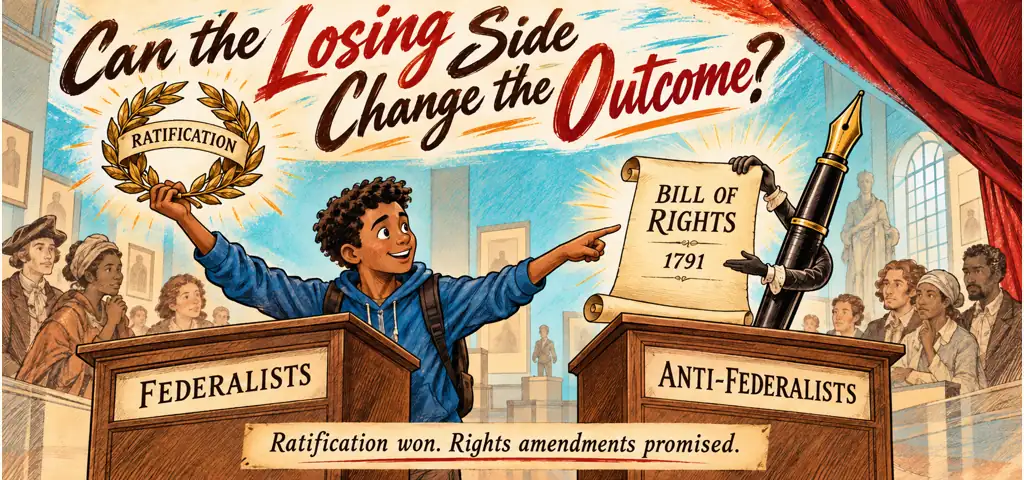
Lesson 7.6 of Chapter 7 of the U.S. History to 1877 study guide on Effortless Math covers CLEP U.S. History I 038: Federalists, Anti-Federalists, and the Bill of Rights: the key terms, the core ideas, and worked examples showing how this topic is tested on the exam.
U.S. History to 1877 | Chapter 7 | Lesson 7.6
The Constitution took effect after conventions in nine states ratified it, making public persuasion essential. Federalists argued that the union needed reliable revenue, commercial regulation, defense, and the ability to act directly on individuals rather than plead with states. In The Federalist, Alexander Hamilton, James Madison, and John Jay defended the structure. Madison argued that a large republic could multiply interests and make it harder for one faction to dominate.
Anti-Federalists were diverse rather than one organized party. They feared a distant consolidated government, a powerful executive, federal courts, taxation, standing armies, and the loss of state authority. “Brutus” argued that a vast republic would not preserve genuine representation. Many objected that the Constitution lacked a declaration of rights. Their skepticism grew from revolutionary experience with remote power.
Federalists answered that enumerated powers limited the government and that listing some rights might endanger unlisted ones. Politically, however, promises of amendments helped win close conventions in Massachusetts, Virginia, and New York. North Carolina initially refused ratification. Rhode Island delayed until 1790. The outcome was neither automatic nor unanimous.
James Madison introduced amendments in the first Congress. Ten were ratified in 1791 as the Bill of Rights, protecting speech, press, religion, assembly, petition, criminal procedure, and other liberties while reserving undelegated powers. Originally these amendments restrained the federal government, not the states. The Bill of Rights was both a Federalist fulfillment and an Anti-Federalist achievement. Debate shaped the Constitution’s accepted meaning even when opponents lost ratification.
See the history take shape
Watch this account from History Heroes with one question in mind: which evidence makes the lesson's strongest claim hold up?
Video: Convention / Ratification, Federalists vs Anti, Federalist Papers, Bill of Rights | US Constitution, History Heroes.
Check your understanding
- Federalists argued a large republic could
- remove the need for state governments by centralizing representation
- replace frequent elections with appointed national legislators
- restore a mixed constitution modeled on parliamentary sovereignty
- keep factions out of Congress by sharply restricting suffrage
- limit factional domination by multiplying interests across an extended republic
- Anti-Federalists’ most influential demand was for
- abolition of state governments
- a hereditary national executive
- a bill of rights
- lifetime hereditary senators
- unrestricted congressional power over elections
- Select all that apply. Anti-Federalist concerns included
- insufficient central revenue as their main argument
- distant courts
- federal taxation
- executive power
- standing armies
- Explain how the losing side of ratification changed the final constitutional settlement.
Write a brief response using a named fact from the lesson.
Open the answers and reasoning
Independent preparation. CLEP is a registered trademark of the College Board, which does not endorse this lesson.

Related to This Article
More math articles
- How to Divide Decimals by Whole Numbers?
- The Ultimate HSPT Math Course (+FREE Worksheets & Tests)
- Cleaning, Disinfection, and Sterilization
- Using Strip Models to Solve Percentage Problems
- Journey to the Edge: A Meticulous Exploration of One-Sided Limits
- Wrenches, Sockets, and Pliers: Making the Right Match
- How to Write Two-variable Inequalities Word Problems?
- What Is a Good ALEKS Score?
- New Mexico MSSA Grade 7 Math Worksheets: 95 Free Printable PDFs with Step-by-Step Keys
- Matter and Its Changes: Particles, Properties, and Mixtures
















What people say about "Federalists, Anti-Federalists and the Bill of Rights"?
No one replied yet.