YOUR SAT STUDY COMPANION
Top 10 SAT Math Practice Questions
Use the SAT Math hub to move from this article into a complete study path: practice tests, formulas, worksheets, topic lessons, flashcards, and recommended books.

High School Equivalency Tests

The Best Books to Ace the SAT Math Test
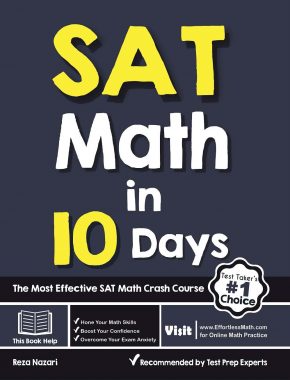
The 10 Most Essential SAT Math Questions: Full Solutions and Strategies
SAT math rewards both accuracy and strategic thinking. Here are 10 question types that appear frequently, with complete solutions and the strategy used by top scorers.
Question 1: Linear Equation and Substitution
Sample: If (2x + 3y = 12) and (x = 3), what is (y)?
Solution: Substitute (x = 3): (2(3) + 3y = 12). Simplify: (6 + 3y = 12). Subtract 6: (3y = 6). Divide: (y = 2).
SAT Strategy: Substitution is the fastest path. Avoid solving for variables symbolically if you have concrete values.
Question 2: Exponents and Growth
Sample: A bacteria population doubles every hour. If there are 100 bacteria initially, how many are there after 3 hours?
Solution: After 1 hour: 200. After 2 hours: 400. After 3 hours: 800. Or use the formula: (100 times 2^3 = 100 times 8 = 800).
SAT Strategy: Recognize exponential growth patterns. (2^3) is faster than (2 times 2 times 2) when you know powers of 2.
Question 3: Percent Change in Context
Sample: A stock price drops 20% from $50, then rises 20%. What’s the final price?
Solution: After 20% drop: (50 times 0.80 = 40). After 20% rise: (40 times 1.20 = 48). Final price is $48, not $50 (a common trap).
SAT Strategy: Percent changes are multiplicative, not additive. 20% down then 20% up ≠ back to start.
Question 4: Quadratic Equations
Sample: Solve (x^2 – 5x + 6 = 0).
Solution: Factor: ((x – 2)(x – 3) = 0). So (x = 2) or (x = 3).
SAT Strategy: Try factoring first. If the quadratic factors nicely, you’re done in seconds. Use the quadratic formula only if factoring fails.
Question 5: Systems of Equations (Linear)
Sample: (x + y = 10) and (2x – y = 2). Solve for (x).
Solution: Add the equations to eliminate (y): (3x = 12), so (x = 4). Then (y = 6).
SAT Strategy: Add or subtract equations to eliminate one variable. This is usually faster than substitution on the SAT.
Question 6: Ratio and Proportion
Sample: A map shows 1 inch = 50 miles. If two cities are 4.5 inches apart on the map, how many miles apart are they?
Solution: (4.5 times 50 = 225) miles.
SAT Strategy: Set up proportions explicitly: (frac{1}{50} = frac{4.5}{x}). Cross-multiply only if needed, but often direct multiplication is faster.
Question 7: Function Notation and Evaluation
Sample: If (f(x) = 3x^2 – 2), what is (f(4))?
Solution: Substitute (x = 4): (f(4) = 3(4)^2 – 2 = 3(16) – 2 = 48 – 2 = 46).
SAT Strategy: Function notation is just substitution. Replace every (x) with the input and evaluate.
Question 8: Geometry with Parallel Lines and Transversals
Sample: If two parallel lines are cut by a transversal, and one angle is 70°, what are the measures of all eight angles formed?
Solution: There are two angle measures: 70° and 110° (supplementary). Corresponding angles are equal. Alternate interior angles are equal. So you get four 70° angles and four 110° angles.
SAT Strategy: Know these angle relationships cold. They appear often in geometry problems and diagrams.
Question 9: Interpreting Data from a Graph or Table
Sample: A table shows test scores: 65, 72, 78, 85, 91. What’s the median?
Solution: The median is the middle value: 78 (the third of five values).
SAT Strategy: Median requires ordered data. Mean requires summing and dividing. Mode is most frequent. Range is max – min. Know which is which.
Question 10: Word Problem with Multiple Steps
Sample: A car rental costs $30 per day plus $0.10 per mile. If you rent for 5 days and drive 200 miles, what’s the total cost?
Solution: Daily cost: (5 times 30 = 150). Mileage cost: (200 times 0.10 = 20). Total: (150 + 20 = 170).
SAT Strategy: Break multi-step problems into parts. Identify what each part costs or covers. Sum at the end. Write intermediate answers to avoid errors.
SAT Math Test Strategy: Timing and Pacing
The SAT math section has 58 questions in 80 minutes (about 82 seconds per question). Questions start easy and get harder. Easy questions might take 20-30 seconds; hard ones 2-3 minutes. The trick: don’t waste time on something hard if you can answer easy questions first. Your goal should be to maximize correct answers, not finish every problem.
If a problem stumps you, flag it and move on. You might have time to return, and you’ll likely answer more correctly by staying in momentum.
Building Your SAT Math Foundation
Master the complete SAT math course to see how all topics integrate. Use the ultimate SAT math formula cheat sheet to memorize must-know formulas. Practice daily with quadratic functions, graphing functions, and order of operations.
Take practice tests every week, time yourself, and review every question you missed. Over time, patterns emerge: maybe you struggle with geometry, or you rush through algebra. Target those gaps.
Common SAT Math Mistakes
Don’t pick the first answer that feels right, check your arithmetic. Don’t assume the diagram is to scale unless stated. Don’t forget to read “which of the following is NOT” (negation changes everything). Don’t second-guess yourself excessively on easy problems. Don’t panic if a problem looks unfamiliar; SAT math is predictable once you’ve done enough practice.
Your SAT math score is improvable. Most students don’t reach their ceiling because they don’t practice systematically. Commit to 30-60 minutes daily for 2-3 months, and you’ll see significant gains.
The 10 Most Essential SAT Math Questions: Full Solutions and Strategies
SAT math rewards both accuracy and strategic thinking. Here are 10 question types that appear frequently, with complete solutions and the strategy used by top scorers.
Question 1: Linear Equation and Substitution
Sample: If (2x + 3y = 12) and (x = 3), what is (y)?
Solution: Substitute (x = 3): (2(3) + 3y = 12). Simplify: (6 + 3y = 12). Subtract 6: (3y = 6). Divide: (y = 2).
SAT Strategy: Substitution is the fastest path. Avoid solving for variables symbolically if you have concrete values.
Question 2: Exponents and Growth
Sample: A bacteria population doubles every hour. If there are 100 bacteria initially, how many are there after 3 hours?
Solution: After 1 hour: 200. After 2 hours: 400. After 3 hours: 800. Or use the formula: (100 times 2^3 = 100 times 8 = 800).
SAT Strategy: Recognize exponential growth patterns. (2^3) is faster than (2 times 2 times 2) when you know powers of 2.
Question 3: Percent Change in Context
Sample: A stock price drops 20% from $50, then rises 20%. What’s the final price?
Solution: After 20% drop: (50 times 0.80 = 40). After 20% rise: (40 times 1.20 = 48). Final price is $48, not $50 (a common trap).
SAT Strategy: Percent changes are multiplicative, not additive. 20% down then 20% up ≠ back to start.
Question 4: Quadratic Equations
Sample: Solve (x^2 – 5x + 6 = 0).
Solution: Factor: ((x – 2)(x – 3) = 0). So (x = 2) or (x = 3).
SAT Strategy: Try factoring first. If the quadratic factors nicely, you’re done in seconds. Use the quadratic formula only if factoring fails.
Question 5: Systems of Equations (Linear)
Sample: (x + y = 10) and (2x – y = 2). Solve for (x).
Solution: Add the equations to eliminate (y): (3x = 12), so (x = 4). Then (y = 6).
SAT Strategy: Add or subtract equations to eliminate one variable. This is usually faster than substitution on the SAT.
Question 6: Ratio and Proportion
Sample: A map shows 1 inch = 50 miles. If two cities are 4.5 inches apart on the map, how many miles apart are they?
Solution: (4.5 times 50 = 225) miles.
SAT Strategy: Set up proportions explicitly: (frac{1}{50} = frac{4.5}{x}). Cross-multiply only if needed, but often direct multiplication is faster.
Question 7: Function Notation and Evaluation
Sample: If (f(x) = 3x^2 – 2), what is (f(4))?
Solution: Substitute (x = 4): (f(4) = 3(4)^2 – 2 = 3(16) – 2 = 48 – 2 = 46).
SAT Strategy: Function notation is just substitution. Replace every (x) with the input and evaluate.
Question 8: Geometry with Parallel Lines and Transversals
Sample: If two parallel lines are cut by a transversal, and one angle is 70°, what are the measures of all eight angles formed?
Solution: There are two angle measures: 70° and 110° (supplementary). Corresponding angles are equal. Alternate interior angles are equal. So you get four 70° angles and four 110° angles.
SAT Strategy: Know these angle relationships cold. They appear often in geometry problems and diagrams.
Question 9: Interpreting Data from a Graph or Table
Sample: A table shows test scores: 65, 72, 78, 85, 91. What’s the median?
Solution: The median is the middle value: 78 (the third of five values).
SAT Strategy: Median requires ordered data. Mean requires summing and dividing. Mode is most frequent. Range is max – min. Know which is which.
Question 10: Word Problem with Multiple Steps
Sample: A car rental costs $30 per day plus $0.10 per mile. If you rent for 5 days and drive 200 miles, what’s the total cost?
Solution: Daily cost: (5 times 30 = 150). Mileage cost: (200 times 0.10 = 20). Total: (150 + 20 = 170).
SAT Strategy: Break multi-step problems into parts. Identify what each part costs or covers. Sum at the end. Write intermediate answers to avoid errors.
SAT Math Test Strategy: Timing and Pacing
The SAT math section has 58 questions in 80 minutes (about 82 seconds per question). Questions start easy and get harder. Easy questions might take 20-30 seconds; hard ones 2-3 minutes. The trick: don’t waste time on something hard if you can answer easy questions first. Your goal should be to maximize correct answers, not finish every problem.
If a problem stumps you, flag it and move on. You might have time to return, and you’ll likely answer more correctly by staying in momentum.
Building Your SAT Math Foundation
Master the complete SAT math course to see how all topics integrate. Use the ultimate SAT math formula cheat sheet to memorize must-know formulas. Practice daily with quadratic functions, graphing functions, and order of operations.
Take practice tests every week, time yourself, and review every question you missed. Over time, patterns emerge: maybe you struggle with geometry, or you rush through algebra. Target those gaps.
Common SAT Math Mistakes
Don’t pick the first answer that feels right, check your arithmetic. Don’t assume the diagram is to scale unless stated. Don’t forget to read “which of the following is NOT” (negation changes everything). Don’t second-guess yourself excessively on easy problems. Don’t panic if a problem looks unfamiliar; SAT math is predictable once you’ve done enough practice.
Your SAT math score is improvable. Most students don’t reach their ceiling because they don’t practice systematically. Commit to 30-60 minutes daily for 2-3 months, and you’ll see significant gains.
Official source: what the SAT covers, how it is structured and how it is scored are published by the College Board, which writes and administers the test, at satsuite.collegeboard.org.

Related to This Article
More math articles
- Vectors Introduction
- Grade 7 Informational Reading: Central Idea, Claims, and Text Structure Strategies
- Understanding How to Use Debit and Credit Cards for Payments
- Montana Algebra 1 Free Worksheets: Free Printable Algebra 1 PDF Worksheets with Full Solutions
- Supply, Demand, and Government Intervention
- How to Calculate and Interpret Correlation Coefficients
- Advanced Vocabulary Words: Impertinence to Keen
- 10 Most Common GED Math Questions [Updated for 2026]
- Application of the Bill of Rights to the states
- Supported vs. Unsupported Claims











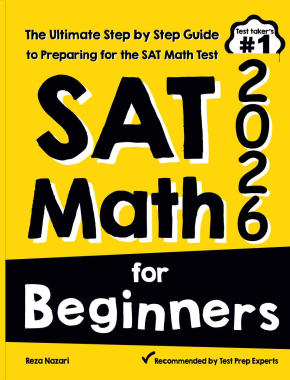
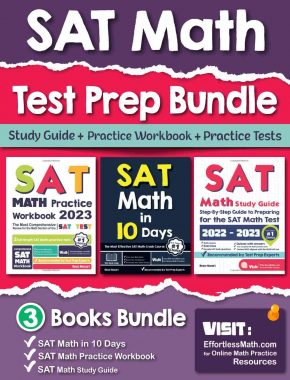


What people say about "Top 10 SAT Math Practice Questions"?
No one replied yet.