Berlin, NATO, NSC-68, and Militarized Containment
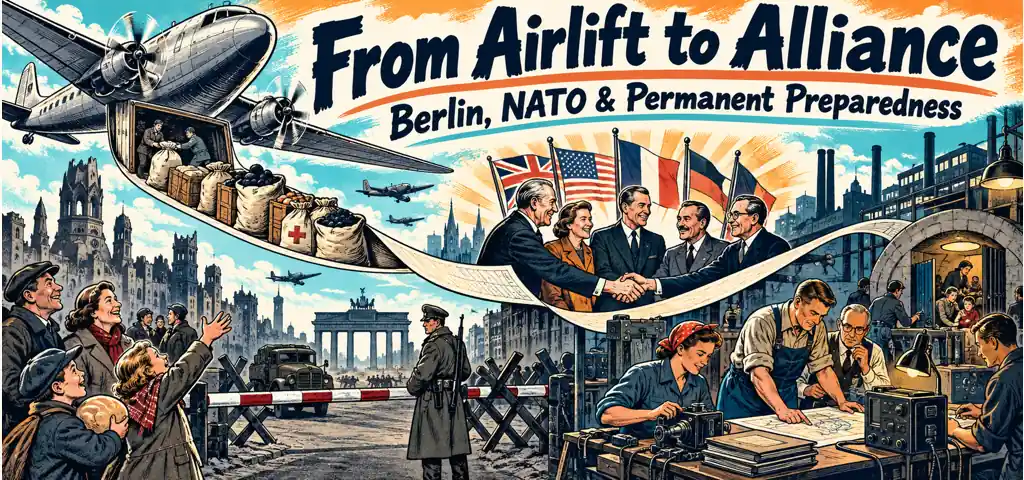
Chapter 11 of the CLEP History of the United States II study guide on Effortless Math covers Berlin, NATO, NSC-68, and Militarized Containment: the key terms, the core ideas, and worked examples showing how this topic is tested on the exam.
CLEP History of the United States II, Chapter 11
Germany made containment a problem of access
The Allies divided Germany and Berlin into occupation zones even though Berlin lay deep inside the Soviet zone. Western authorities combined their zones economically and introduced a new currency in 1948. The Soviet Union then closed rail, road, and canal access to West Berlin. Leaving would weaken western credibility; forcing a ground convoy through risked war. The crisis asked whether a city could be sustained without accepting either withdrawal or immediate armed confrontation.
The airlift turned logistics into strategy
American and British aircraft supplied food, coal, medicine, and industrial necessities for more than ten months. Pilots flew a tightly scheduled corridor system through weather and fatigue. The airlift did not break the surface blockade by force. It made the blockade ineffective while preserving western presence and placing the political cost of continued pressure on Moscow. The Soviet Union lifted the blockade in May 1949. Transport capacity became a diplomatic instrument because it widened the choices between surrender and battle.
The National Security Act reorganized permanent capacity
The National Security Act of 1947 created the National Security Council and Central Intelligence Agency and unified the military departments under a national military establishment that became the Department of Defense. A separate Air Force emerged. The act did not create the FBI, which dated from an earlier Justice Department bureau. Reorganization gave presidents institutions for continuous intelligence and strategy during peacetime. It also concentrated authority whose oversight would remain contested.
NATO made collective defense contractual
The North Atlantic Treaty of 1949 joined the United States, Canada, and ten western European states. Article 5 declared an armed attack on one an attack on all, while each member promised to take such action as it deemed necessary, including armed force. The treaty therefore created a collective commitment without prescribing one identical automatic response. Permanent American connection to European defense marked a departure from the rejection of League membership after the First World War.
NSC-68 globalized and militarized the response
After the Soviet atomic test and Communist victory in China, a National Security Council review in 1950 described a polarized struggle and urged a rapid, sustained expansion of conventional and nuclear power. Earlier containment had relied heavily on economic reconstruction and selective defense of industrial centers. NSC-68 treated weakness almost anywhere as potentially damaging and made military readiness central. Truman initially hesitated at its cost; the Korean War supplied the political urgency and appropriations for rearmament.
The Defense Production Act mobilized a peacetime economy
Congress enacted the Defense Production Act in 1950 after fighting began in Korea. It authorized priority defense orders, allocation of scarce materials, expansion of productive capacity, and wage and price controls. The law shows that militarized containment required factories, finance, and inflation management as well as troops. It adapted wartime economic instruments to an undeclared limited war and a continuing emergency rather than formally returning the economy to Second World War command levels.
Civil defense divided responsibility across governments
The Federal Civil Defense Act of 1950 placed primary operational responsibility in states and localities while Washington coordinated, advised, and assisted. Communities planned warning systems, shelters, evacuation, and public education. The arrangement reflected American federalism and the enormous scale of nuclear vulnerability. It also produced uneven capacity. A national threat did not automatically yield one centrally administered national service in every neighborhood.
Broadcasting carried different institutional identities
The Voice of America openly identified itself as an official United States government broadcaster. Radio Free Europe transmitted news and political programming toward Soviet-controlled Europe while presenting itself as a private organization, though it secretly received American government support. Both belonged to information strategy, but attribution mattered. Open public diplomacy and covertly sponsored broadcasting created different credibility, accountability, and diplomatic risks.
The Bricker fight concerned treaties at home
Senator John Bricker proposed constitutional limits on the domestic effect of treaties and requirements for congressional approval of executive agreements. Supporters feared presidents might use international commitments to change domestic law without the normal legislative process. Eisenhower opposed the amendment, and it failed narrowly. The dispute did not ask whether the United States could sign any treaty. It concerned the relationship among foreign commitments, federalism, executive power, and constitutional procedure.
Warsaw Pact formation followed West German rearmament
Western powers integrated West Germany into NATO in 1955. The Soviet Union and its eastern European allies then formed the Warsaw Treaty Organization. The sequence shows alliance feedback: one coalition described enlargement as defense, while the other treated it as threat. The Warsaw Pact also institutionalized Soviet military leadership in Eastern Europe. Alliance creation reduced uncertainty within blocs while sharpening division between them.
A permanent defense budget survived the armistice
The Korean armistice ended fighting in 1953, but military spending did not return to its small pre-Korean level. Overseas bases, alliances, nuclear forces, intelligence agencies, research contracts, and readiness created continuing obligations. Eisenhower later warned of a military-industrial complex linking a standing establishment with a permanent arms industry. Militarized containment was therefore an institutional settlement, not a temporary spike that disappeared with one battlefield cease-fire.
read a defense-spending line
A chart falls sharply after 1945, rises after 1950, and settles well above its 1948 level after 1953.
Militarization widened capacity and danger
Airlift logistics, alliance commitments, economic controls, intelligence, broadcasting, and civil defense made containment more durable. They also created risks of escalation, secrecy, budgetary influence, and executive concentration. The strongest interpretation does not reduce militarization to troop totals. It follows institutions from treaty language and factory priorities to local shelters and recurring appropriations.
Watch the history in motion
This short lesson adds voices, images, and chronology to the ideas you just studied.
Video: The COLD WAR, Explained [APUSH Review], Heimler's History.
Try four CLEP-style questions
- Why did the Berlin airlift offer an alternative to either abandoning the city or forcing a ground confrontation?
- It sustained western access by logistics without attacking Soviet checkpoints.
- It transferred Berlin permanently to a neutral German government.
- It required Soviet pilots to deliver coal to western sectors.
- It dissolved the four occupation zones before the blockade ended.
- It moved the western sectors from Berlin to the American zone.
- Why did NATO create a different commitment from the temporary operation that supplied West Berlin?
- The treaty transferred Berlin's occupation government to a permanent United Nations commission.
- The alliance required members to merge national forces into one international army.
- It established consultation and collective defense before the next emergency occurred.
- The treaty prohibited peacetime military planning among its original signatories.
- It applied only to shipments delivered while the Soviet blockade remained in force.
- Why is creating the National Security Council in 1947 not equivalent to adopting NSC-68 in 1950?
- The council existed only to distribute Marshall Plan commodities among European governments.
- One created decision machinery; the later paper recommended a particular strategic program.
- The 1947 law prohibited the president from requesting later policy reviews.
- NSC-68 abolished the council and transferred strategic planning to the Federal Bureau of Investigation.
- Both measures were treaty amendments requiring ratification by two-thirds of the Senate.
- NATO planners standardize equipment and conduct joint exercises among forces that remain nationally commanded. What alliance problem are they addressing?
- How to abolish civilian control within the armed forces of each member state
- How to finance European reconstruction without purchasing military equipment
- How to place alliance strategy under the legislative authority of the Warsaw Pact
- How to substitute Atlantic sea routes with airlift service to a blockaded enclave
- How sovereign national forces can operate together without becoming one national army
Check your answers and reasoning
Independent preparation. CLEP is a registered trademark of the College Board, which does not endorse this lesson.

Related to This Article
More math articles
- Decoding the Dynamics: How to Understanding Input/Output Tables
- The Best Math Apps to Make Learning Easier
- Rounding Numbers for 5th Grade: Nearest Ten, Hundred, and Thousand
- Cooley’s Looking-Glass Self
- Continental Drift, Plates, and the Evidence
- Reference Angle Calculator (with Coterminal Angles)
- Betting Odds Made Simple: Probability and Payouts
- Culture Wars and the AIDS Crisis
- How to Solve Point-Slope Form of Equations?
- How Hard Is the ALEKS Math Test?






















What people say about "Berlin, NATO, NSC-68, and Containment"?
No one replied yet.