Revolution in China and the Korean War
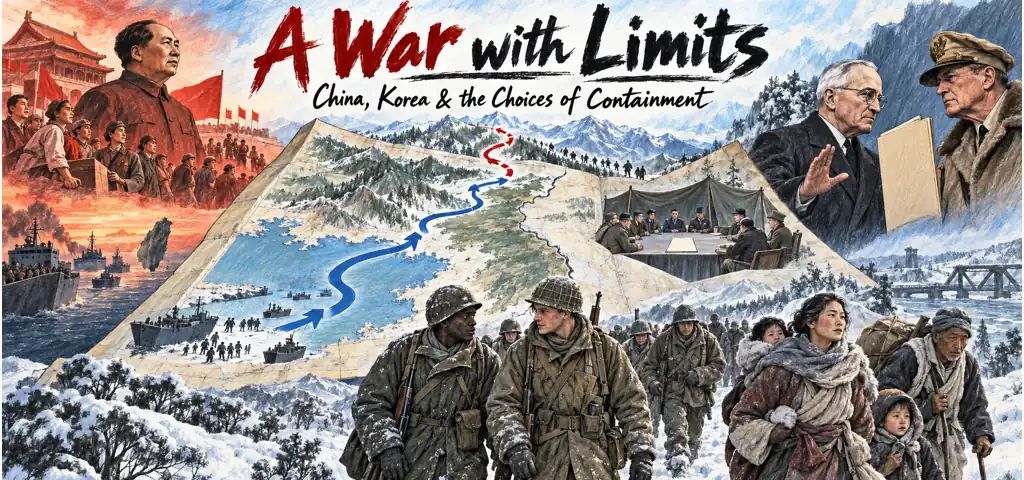
Chapter 11 of the CLEP History of the United States II study guide on Effortless Math covers Revolution in China and the Korean War: the key terms, the core ideas, and worked examples showing how this topic is tested on the exam.
CLEP History of the United States II, Chapter 11
China and Korea presented different kinds of conflict
Mao Zedong's Communist forces defeated Chiang Kai-shek's Nationalists in a long Chinese civil war, and the People's Republic of China was proclaimed in 1949. The Nationalist government retreated to Taiwan. Truman did not send an American army to reverse that outcome. In June 1950 North Korean forces crossed the thirty-eighth parallel into South Korea, an invasion across an internationally recognized dividing line. Officials treated the second event as a test of collective security rather than another civil-war intervention.
Recognition and representation hardened the China conflict
The United States continued to recognize Chiang's Republic of China on Taiwan and opposed seating the People's Republic in the United Nations. Washington restricted trade and diplomatic contact with Beijing. The policy did not mean American leaders believed the Nationalists still governed the mainland in practice. Legal recognition, alliance strategy, and territorial control were different facts. Keeping them separate explains why China policy remained frozen until the opening of the 1970s.
The United Nations acted during a Soviet boycott
The Security Council condemned the North Korean attack and authorized assistance to repel it. The Soviet representative was absent, boycotting the council over its refusal to seat the People's Republic of China, and therefore did not cast a veto. American forces formed the largest part of the United Nations Command, but troops from several countries served. The episode showed collective action through the UN while also revealing how an unusual procedural absence made that action possible.
Pusan defense and Inchon reversed the invasion
North Korean armies drove defenders into a perimeter around Pusan. United Nations forces held the port and supply line. In September 1950 General Douglas MacArthur ordered an amphibious landing at Inchon, far behind North Korean positions. The landing cut supply routes and helped retake Seoul. It was operationally daring because of tides, channels, and seawalls. Success restored South Korea and then encouraged a decision to pursue forces north of the original dividing line.
Advancing to the Yalu changed the risk
The United Nations mandate began with repelling invasion, but forces crossed the thirty-eighth parallel and moved toward the Yalu River on China's border. Chinese leaders had warned against such an advance. Large Chinese forces entered the war, driving UN troops south. The intervention transformed a rapid victory into a prolonged conflict. A battlefield success can alter political objectives, and a changed objective can bring a new adversary into the war.
Limited war produced a command crisis
MacArthur advocated widening the war, including stronger attacks on China and use of Nationalist forces from Taiwan. Truman and the Joint Chiefs feared escalation with China and possibly the Soviet Union. After MacArthur publicly challenged administration policy, Truman relieved him in April 1951. Senate hearings gave MacArthur a forum, but the Joint Chiefs supported the limited-war strategy. Civilian control means elected leaders set political limits even when a commander possesses great prestige and battlefield experience.
Mobilization reversed the postwar military contraction
Active-duty personnel had fallen from about twelve million in 1945 to roughly one and a half million by 1950. By 1952 the total exceeded three and a half million. Korea accelerated the rearmament urged in NSC-68, expanded defense production, and confirmed a large peacetime force. The war was limited in geography and objectives, yet its institutional consequences were national and long lasting. Limited does not mean small in casualties, expenditure, or administrative change.
Army integration accelerated through necessity and policy
Executive Order 9981 had declared equality of treatment and opportunity in 1948, but implementation was incomplete when the war began. Replacement shortages led commanders to assign Black soldiers to previously white units, and successful integration widened the practice. Personnel necessity helped turn a presidential policy into operational change. This does not mean battlefield shortage alone created the principle; law, activism, administration, and wartime practice formed a sequence.
The armistice stopped fighting without settling sovereignty
Negotiations began in 1951 and dragged on over the location of the line and repatriation of prisoners. The July 1953 armistice created a cease-fire near the existing battle line and a demilitarized zone. It was not a peace treaty, and Korea remained divided. The agreement illustrates the purpose of an armistice: regulate the end of combat when the parties cannot resolve the political conflict that caused it.
Japan moved from occupation to security partnership
The 1951 San Francisco peace treaty restored Japanese sovereignty when it took effect in 1952. A linked security agreement permitted American forces to remain. Japan thus left occupation while entering an American-led regional security system. Sovereignty and military alliance could coexist. The settlement also tied Japan's economic recovery to the Cold War order in Asia and left several territorial and memory disputes unresolved.
The Formosa Resolution widened advance authority
During a later crisis over islands near the Chinese coast, Congress passed the Formosa Resolution of 1955, authorizing the president in advance to use armed force to defend Taiwan and related positions as judged necessary. The resolution mattered because it delegated prospective war authority rather than approving one completed action. It belongs to a broader postwar pattern in which presidents sought flexible commitments short of formal declarations of war.
track a changing war aim
A map shows North Korean movement to Pusan, an amphibious landing at Inchon, a UN advance to the Yalu, and a Chinese counteroffensive.
Korea defined the possibilities and limits of containment
The United States defended South Korea, accepted enormous casualties, and built permanent military capacity, but it did not conquer China or reunify Korea. Truman sacrificed a popular commander to preserve limited war. The armistice restored a divided peninsula rather than producing clear victory. Containment could involve major war while still imposing boundaries designed to avoid a wider nuclear confrontation.
Watch the history in motion
This short lesson adds voices, images, and chronology to the ideas you just studied.
Video: APUSH Period 8: Video #1.2 – Truman's Cold War (Pt 2.)…. in ASIA (China and Korean War), Mr. Mac's Class.
Try four CLEP-style questions
- Why could the Security Council authorize force in Korea without a Soviet veto in June 1950?
- The charter denied permanent members vetoes during civil wars.
- China cast the Soviet vote in favor of intervention.
- The General Assembly had expelled the Soviet Union before the invasion.
- The Soviet delegate was absent during a boycott over China's representation.
- North Korea voluntarily accepted United Nations command.
- Why did success at Inchon create a new political choice rather than simply settle the Korean War?
- The landing dissolved the United Nations command and returned authority to Japan.
- Victory transferred command from Truman to the Nationalist government on Taiwan.
- The operation required immediate recognition of Beijing before Seoul could be retaken.
- Restoring South Korea opened the separate question of pursuing unification in the North.
- The landing ended North Korean resistance before United Nations forces reached Seoul.
- What constitutional principle was at stake when Truman removed MacArthur after their public disagreement?
- Military commanders may choose national war aims after Senate confirmation.
- Congress must promote a general before a president can dismiss him.
- Civilian leaders retain authority over the scope and objectives of war.
- A successful landing gives its commander control of foreign policy.
- The United Nations secretary-general appoints American theater commanders.
- Why did the wartime alliance between Chinese Nationalists and Communists not produce a unified postwar government?
- Their competing organizations, territories, and claims to legitimacy survived the anti-Japanese war.
- The United Nations prohibited either movement from administering liberated territory.
- American occupation authorities merged their armies but rejected national elections.
- Japan retained control of mainland China and appointed leaders of both parties.
- Both movements accepted permanent partition before Japan surrendered in 1945.
Check your answers and reasoning
Independent preparation. CLEP is a registered trademark of the College Board, which does not endorse this lesson.

Related to This Article
More math articles
- Free Common Core (CCSS) Grade 5 Math Worksheets: 49 Printable Skill Pages with Step-by-Step Answer Keys
- How to Find the Inverse of a Function: Step-by-Step Guide for 2026
- FREE Praxis Core Math Practice Test
- Free Printable Grade 3 Math for Wisconsin FORWARD Students: 49 Single-Skill PDF Worksheets
- How to Add and Subtract Integers? (+FREE Worksheet!)
- Manual Cleaning: Disassembly, Sinks, and Aerosol Control
- Internment, the Bracero Program, and Minority Wartime Experiences
- Standards of judicial scrutiny
- Geometry Puzzle – Challenge 75
- FREE TASC Math Practice Test



















What people say about "Revolution in China and the Korean War"?
No one replied yet.