Decolonization, Iran, Guatemala, and Covert Containment
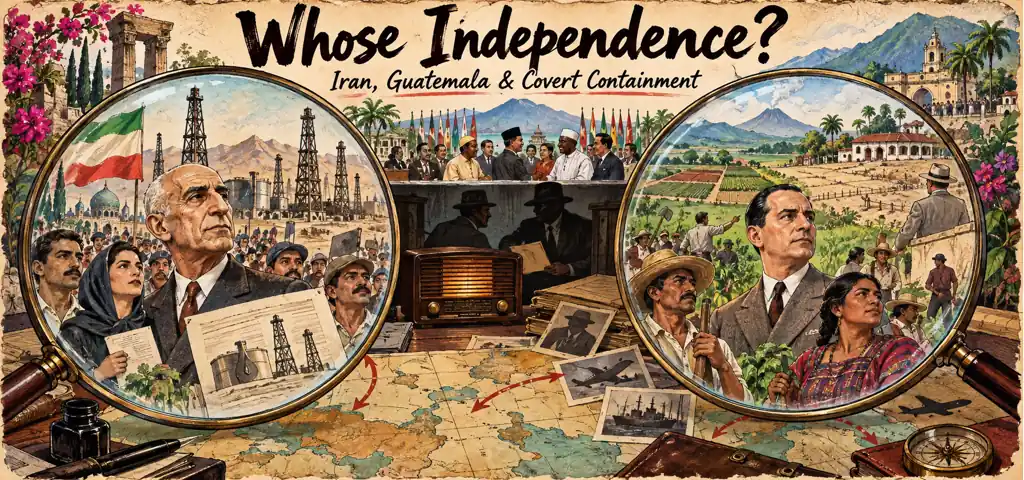
Chapter 11 of the CLEP History of the United States II study guide on Effortless Math covers Decolonization, Iran, Guatemala, and Covert Containment: the key terms, the core ideas, and worked examples showing how this topic is tested on the exam.
CLEP History of the United States II, Chapter 11
Independence movements did not begin as Cold War pieces
European empires emerged from the Second World War economically weakened while anticolonial movements possessed stronger organizations and claims. India and Pakistan gained independence in 1947, Indonesia secured Dutch recognition in 1949 after conflict and diplomacy, and the Philippines became formally independent from the United States in 1946. Nationalists sought sovereignty, land reform, economic control, or political dignity for local reasons. Washington often asked where they stood in the Soviet-American conflict, but that question did not explain why they mobilized.
American principles and alliances pulled in different directions
The Atlantic Charter had endorsed self-government, yet Britain, France, and the Netherlands remained important western allies. American officials sometimes encouraged negotiated independence and sometimes supported colonial partners against movements they feared might turn left. Policy also depended on commercial access and military bases. The result was inconsistency rather than one master rule. Anti-imperial language could coexist with support for an empire when officials ranked alliance unity or anticommunism first.
Nonalignment rejected a forced binary
Leaders such as India's Jawaharlal Nehru, Indonesia's Sukarno, Egypt's Gamal Abdel Nasser, and Yugoslavia's Josip Broz Tito resisted automatic alignment with either superpower. The 1955 Bandung Conference joined Asian and African governments around sovereignty, anticolonialism, economic cooperation, and peaceful coexistence despite major differences among them. Nonalignment did not mean political passivity or perfect neutrality. It was an effort to preserve bargaining room and define national priorities outside a two-bloc map.
Iran joined nationalism to an oil dispute
Iranian prime minister Mohammad Mossadegh nationalized the Anglo-Iranian Oil Company in 1951 after long conflict over British control and revenue. Britain organized an embargo and sought his removal. The Truman administration initially pursued negotiation; the Eisenhower administration became more receptive to claims that instability could benefit the Iranian Communist Party. Oil sovereignty, constitutional politics, royal power, and Cold War fear all entered the crisis. Calling Mossadegh merely a Soviet agent erases the nationalist program that made him popular.
Operation Ajax restored the shah's political advantage
In 1953 the CIA and British intelligence supported a covert operation using propaganda, political contacts, street mobilization, and military allies against Mossadegh. After an initial failure, forces favoring Shah Mohammad Reza Pahlavi prevailed. The shah returned and later concentrated power while western oil interests regained access under a new consortium. Covert action avoided an open American invasion and appeared inexpensive, but it tied the United States to authoritarian rule and became a lasting grievance in Iran.
Guatemala's reform threatened domestic and foreign interests
President Jacobo Arbenz pursued land redistribution under Decree 900. The program expropriated unused portions of large estates with compensation based on declared tax value. The United Fruit Company, a major landholder and employer, opposed the measure. Guatemalan Communists participated in legal politics and supported reform, but the government was not simply directed from Moscow. Land inequality, labor conflict, corporate influence, and anticommunism became intertwined in Washington's interpretation.
PBSUCCESS used pressure and staged strength
In 1954 the CIA trained and supplied a small force led by Carlos Castillo Armas, organized radio propaganda, and encouraged the impression that a much larger rebellion and possible American intervention were underway. Psychological pressure and the Guatemalan army's refusal to sustain Arbenz helped force his resignation. The covert operation did not win through a large conventional invasion. Its success depended on local institutions deciding that resistance was too dangerous.
Iran and Guatemala shared a method but not one story
Both operations used intelligence services, propaganda, local allies, and deniable pressure to remove elected nationalist governments. Yet Iranian politics centered on oil nationalization, monarchy, and British influence, while Guatemala centered on land reform, military allegiance, and a powerful American corporation. Comparison should identify common mechanism without flattening different causes. The category "covert action" describes how Washington intervened, not why every local actor behaved as they did.
French Indochina exposed the colonial-containment overlap
The United States financed much of France's war against the Viet Minh, viewing Ho Chi Minh's movement through both anticolonial and Communist lenses. When French forces faced defeat at Dien Bien Phu in 1954, Eisenhower considered air intervention but did not proceed without British participation and clear congressional support. The Geneva settlement temporarily divided Vietnam. A colonial war became part of containment, laying groundwork for deeper American involvement without resolving Vietnamese nationalism.
Covert success could weaken long-term legitimacy
Officials valued covert operations because they reduced visible American casualties, preserved plausible deniability, and exploited local opposition. Those advantages could encourage intervention under uncertain intelligence. Secrecy narrowed democratic scrutiny, local partners pursued their own agendas, and later disclosure damaged trust. A government removed quickly can be replaced by a fragile or repressive order. Short-term operational success and long-term political success require separate evidence.
Development policy competed with coercion
Technical aid, trade, public health, education, and agricultural programs offered nonmilitary ways to build influence. Yet aid could reinforce unequal landholding or authoritarian allies unless institutions changed. Newly independent governments sought capital without surrendering autonomy. Cold War development therefore became negotiation, not a one-way transfer of neutral expertise. The same administration might support modernization in one country and covert removal in another.
read the local demand first
A source calls for national control of oil, another for redistribution of unused land, and an American memorandum warns about communism.
Decolonization widened the number of actors
The early Cold War was not played only in Washington, Moscow, and European capitals. Nationalists, monarchs, armies, corporations, peasants, labor organizers, and nonaligned governments changed available choices. American leaders sometimes gained tactical advantage through covert action while losing credibility as defenders of self-determination. The central skill is to hold two maps at once: superpower competition and local political economy.
Watch the history in motion
This short lesson adds voices, images, and chronology to the ideas you just studied.
Video: American-Backed Coups, Mapped, Johnny Harris.
Try four CLEP-style questions
- Why did nonalignment at Bandung not require a government to remain neutral on every international issue?
- The conference prohibited trade or diplomatic relations with either superpower.
- Nonalignment placed foreign policy under a permanent joint American-Soviet commission.
- Participants agreed to abstain from United Nations votes concerning colonial rule.
- States could judge particular disputes and accept assistance without joining either military bloc.
- Membership required governments to abandon disputes inherited from European empires.
- What made plausible deniability attractive to officials considering covert action?
- It allowed intervention without relying on local political partners or military officers.
- It required public congressional debate before each propaganda campaign.
- It transferred constitutional war powers permanently to intelligence agencies.
- It prevented local military officers from influencing an operation.
- It allowed intervention with lower visible commitment than an open invasion.
- Which evidence best demonstrates why Iran and Guatemala require separate causal accounts?
- Identical land-tenure records showing that both governments confronted the same American plantation company
- Treaties placing both countries' armed forces under one British commander after 1945
- Voting records proving that neither country contained nationalist or communist organizations
- One operations manual used without records of either country's property and political conflicts
- Oil-concession and monarchy records for Iran alongside landholding and United Fruit records for Guatemala
- A memorandum labels a reform movement Communist, while local petitions emphasize land and sovereignty. How should both sources be used?
- Separate local demands from the way American officials classified strategic risk.
- Treat the memorandum alone as proof that no Communist organization existed.
- Assume local reform made international rivalry irrelevant.
- Discard the petitions because foreign-policy records define local motives.
- Combine separate movements into one centrally directed anticolonial organization.
Check your answers and reasoning
Independent preparation. CLEP is a registered trademark of the College Board, which does not endorse this lesson.

Related to This Article
More math articles
- The Best Grade 3 ELA Practice Tests for Texas Students
- TOEFL Score Scale and Rounding: Read Your Report (2027 Prep)
- Berlin, NATO, NSC-68, and Militarized Containment
- Digital Clock for 4th Grade
- Intelligent Math Puzzle – Challenge 92
- Praxis Core Math: Topics, Format, and Smart Study Tips
- How to Complete a Table and Graph a Two-Variable Equation?
- How to Classify Numbers?
- How to Solve One-step and Two-step Linear Equations Word Problems
- 10 Most Common ASTB Math Questions


















What people say about "Decolonization and Covert Containment"?
No one replied yet.