Function Grapher — Plot y = f(x) Online (Free)
AlgebraFreeNo sign-up
To graph y = f(x), find a few points, mark the intercepts, turning points and asymptotes, then join them with a smooth curve. For f(x) = x³ − 3x, the graph crosses the x-axis at x = −√3, 0 and √3, has a local maximum at (−1, 2) and a local minimum at (1, −2). The function grapher below plots any function and lists these features for you.
How each feature is found
- DomainThere is no denominator, even root or logarithm with x, so f is defined for all real numbers.
- x-interceptsSolve f(x) = 0. Factor out x: this gives x = 0. Quadratic formula for x² − 3 = 0: x = (−b ± √(b² − 4ac))/(2a) with a = 1, b = 0, c = −3. The discriminant is b² − 4ac = 12. √12 is irrational, so the exact roots are x = −√3 ≈ −1.73205 and x = √3 ≈ 1.73205. Result: −√3, 0, √3.
- y-interceptPut x = 0: f(0) = 0.
- Turning pointsThe derivative is f′(x) = 3x² − 3. Solve f′(x) = 0 (the numerator): Divide 3x² − 3 = 0 by 3: x² − 1 = 0. Quadratic formula for x² − 1 = 0: x = (−b ± √(b² − 4ac))/(2a) with a = 1, b = 0, c = −1. The discriminant is b² − 4ac = 4. √4 = 2, so x = −1 or x = 1. Where f′ changes from + to − there is a local maximum, from − to + a local minimum.
- AsymptotesThere is no variable denominator, so there are no vertical asymptotes. The leading term x³ controls the ends: degree 3 (odd), leading coefficient positive.
- Symmetryf(−x) = −x³ + 3x. This equals −f(x), so f is odd.
Table of values
| x | f(x) |
|---|---|
| −5 | −110 |
| −4 | −52 |
| −3 | −18 |
| −2 | −2 |
| −1 | 2 |
| 0 | 0 |
| 1 | −2 |
| 2 | 2 |
| 3 | 18 |
| 4 | 52 |
| 5 | 110 |
Next: graph several functions with sliders, zoom and trace · domain and range · derivative with steps

How to use the function grapher
- Type your function after f(x) =, for example x^2 – 3, 2x + 1, sqrt(x – 1), (x^2 – 4)/(x – 1) or sin(x). The “Reads as” line shows how it was understood.
- Set the x range (“x from” and “x to”), or use the + and − buttons to zoom. The y range adjusts itself so the important points stay in view.
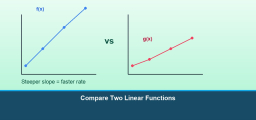
- Optionally add a second function g(x) to compare. The grapher draws it dashed and lists where the two graphs meet.
- Read the key features under the graph. Move over the graph or tap it to read any point, and open Table of values or How each feature is found for the working.
This page is for one function at a time. To graph several functions together, use sliders or trace intersections of many curves, open the full graphing calculator.
Reading the graph: key features
| Feature | What it means | How to find it |
|---|---|---|
| Domain | The x values where f is defined | Exclude zeros of denominators, negative inputs of even roots and non-positive inputs of logarithms |
| x-intercepts (zeros) | Where the graph meets the x-axis | Solve f(x) = 0 |
| y-intercept | Where the graph meets the y-axis | Compute f(0) |
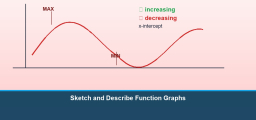
| Local maximum and minimum | Peaks and valleys, the turning points | Solve f′(x) = 0 and check where f′ changes sign |
| Vertical asymptote | A line x = a the graph shoots up or down along | Zeros of the denominator after cancelling common factors |
| Horizontal or slant asymptote | The line the graph approaches far to the left or right | Compare the degrees of the numerator and denominator |
| Hole | A single missing point | A factor that cancels from the top and bottom |
| Symmetry | Even: mirror image in the y-axis. Odd: unchanged by a half turn about the origin | Even if f(−x) = f(x); odd if f(−x) = −f(x) |
| End behavior | What f(x) does as x → ∞ and x → −∞ | The leading term of a polynomial; the asymptote of a rational function |
Worked example: a cubic, f(x) = x³ − 3x
Intercepts. Factor: x³ − 3x = x(x² − 3) = 0, so x = 0 or x = ±√3 ≈ ±1.732. The y-intercept is f(0) = 0.
Turning points. f′(x) = 3x² − 3 = 0 gives x = ±1. f(−1) = −1 + 3 = 2 and f(1) = 1 − 3 = −2. The derivative is positive left of −1, negative between −1 and 1 and positive again after 1, so (−1, 2) is a local maximum and (1, −2) is a local minimum.
Symmetry and ends. f(−x) = −x³ + 3x = −f(x), so the function is odd and the graph is symmetric about the origin. The leading term x³ has odd degree and a positive coefficient: the graph falls to −∞ on the left and rises to ∞ on the right.
Worked example: a rational function, f(x) = (x² − 4)/(x − 1)
The domain excludes x = 1, and nothing cancels, so x = 1 is a vertical asymptote. The zeros come from the numerator: x² − 4 = 0 gives x = −2 and x = 2. The y-intercept is f(0) = −4/−1 = 4. The numerator has degree one more than the denominator, so divide: x² − 4 = (x − 1)(x + 1) − 3, and the quotient x + 1 gives the slant asymptote y = x + 1. The function is neither even nor odd.
Compare (x² − 4)/(x − 2). Here the factor x − 2 cancels, leaving x + 2, so the graph is the line y = x + 2 with a hole at (2, 4) instead of an asymptote.
Graphing by a table of values
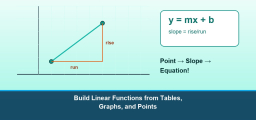
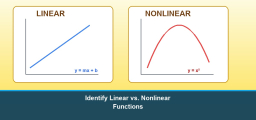
For a quick sketch, pick x values, compute y and plot the points. For f(x) = 2x + 1, the x values −1, 0 and 2 give y = −1, 1 and 5. The points lie on a straight line with slope 2 and y-intercept 1. For f(x) = x² − 3, the points (−2, 1), (0, −3) and (2, 1) lie on a U-shaped parabola with its lowest point at (0, −3).
Function transformations
- f(x) + k moves the graph up k units (down if k is negative).
- f(x − h) moves it right h units; f(x + h) moves it left.
- −f(x) reflects it across the x-axis; f(−x) reflects it across the y-axis.
- a·f(x) stretches it vertically when a > 1 and compresses it when 0 < a < 1.
Example: y = (x − 2)² + 1 is y = x² moved 2 units right and 1 unit up, so its vertex is (2, 1). Type both into the grapher (the second one as g(x)) to see the shift.
Common mistakes to avoid
- Connecting across an asymptote. 1/x has two separate branches; the graph never crosses x = 0.
- Calling every critical point a maximum or minimum. For x³, f′(0) = 0 but the graph keeps rising, so there is no turning point.
- Using degrees for trig functions. The grapher uses radians, so sin(x) has zeros at multiples of π ≈ 3.14159, not at 180.
- Trusting a window too much. Features outside the x range are not visible. Zoom out if the graph seems to stop changing.
Graphing functions practice quiz: 10 questions
Test yourself with 10 multiple-choice questions. Choose an answer and press Submit to see if you are right and why. Your score appears at the end.
The degrees are equal, so the asymptote is the ratio of the leading coefficients: 6/2 = 3.
The expression under the root must be at least 0: x + 2 ≥ 0, so x ≥ −2.
The factor x − 1 cancels, leaving x + 1, so the graph is the line y = x + 1 with the point (1, 2) missing.
f(x + 4) moves the graph left 4, and −1 moves it down 1. The vertex is (−4, −1).
The leading term −2x³ has odd degree and a negative coefficient, so the graph rises on the left and falls on the right.
Quiz complete
Frequently asked questions
What is a function graph?
It is the set of all points (x, f(x)). For f(x) = x² − 3, the points (−2, 1), (0, −3) and (2, 1) are on the graph, which is a U-shaped parabola.
How do you graph a function?
Find the domain, the intercepts and any asymptotes, make a short table of values, plot the points and join them smoothly. For f(x) = 2x + 1, the x values −1, 0 and 2 give y = −1, 1 and 5, which lie on a straight line.
How do you graph function transformations?
Start from the basic graph and apply the shifts, reflections and stretches. y = (x − 2)² + 1 is the parabola y = x² moved 2 right and 1 up.
How can you tell if a graph is a function?
Use the vertical line test: if any vertical line meets the graph more than once, it is not the graph of a function. y = x² passes. The circle x² + y² = 9 fails, because the line x = 0 meets it at y = 3 and y = −3.
How do you find the domain and range of a function from its graph?
The domain is the set of x values the graph covers from left to right; the range is the set of y values from bottom to top. For y = x² − 3, the domain is all real numbers and the range is y ≥ −3, because the lowest point is (0, −3). The domain and range calculator works this out with steps.
How do you graph a function with a square root?
Find where the expression under the root is at least 0, then plot points from there. For y = √(x − 1), the domain is x ≥ 1. The graph starts at (1, 0) and passes through (2, 1) and (5, 2), rising more and more slowly.
Related calculators
- Graphing calculator (several functions)
- Domain and range calculator
- Derivative calculator
- Function composition calculator
- Slope calculator
More algebra calculators

Related to This Article
More math articles
- Fundamentals of Geometry: The Concept of Lines, Rays, and Angles
- TOEFL Score Scale and Rounding: Read Your Report (2027 Prep)
- What Is a Monomial?
- PSAT 10 Math Practice: Answers to 48 Legacy Questions
- PSAT/NMSQT Math Flashcards (Free Online: Formulas, Terms & Concepts)
- 7th Grade Math Worksheets for Arizona (AASA): 95 Free Printable PDFs
- Graph Points on a Coordinate Plane
- How to Find Integers Equivalent Quotients
- The Best Grade 8 Math Book for Arkansas Students
- How Is the HiSET Test Scored?








What people say about "Function Grapher: Online Graphing Calculator for Functions"?
No one replied yet.