From Cells to Organisms: Levels of Organization
A single cell is small and simple, but living things are large and complicated. How do you get from one to the other? Through levels of organization — a ladder that starts at the cell and builds up, step by step, to a whole organism. Knowing this ladder helps you answer questions about how the body is put together.
Climbing the Ladder
Each level is built from the level below it. It goes like this: cells group together to form tissues; different tissues combine into organs; organs that work together form an organ system; and all the organ systems together make an organism.
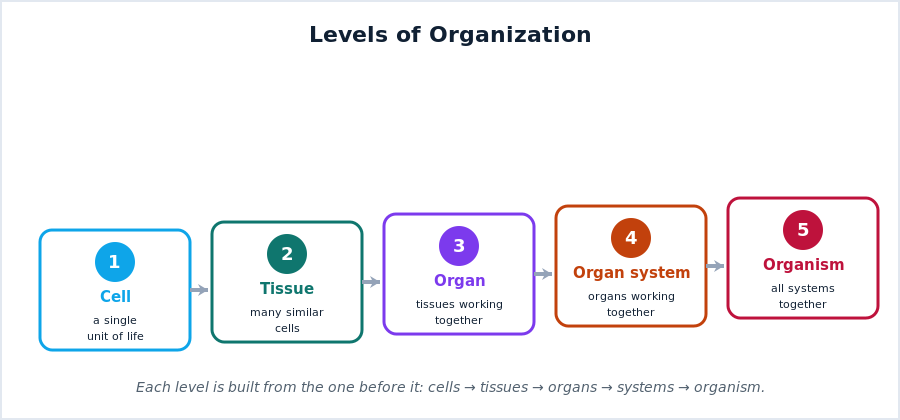
A concrete example makes it click. A muscle cell is one unit. Many muscle cells form muscle tissue. The heart is an organ made largely of muscle tissue. The heart works with blood vessels as the circulatory system. And all your systems together make you, the organism.
Why Each Level Matters
The point of this organization is teamwork. A single cell cannot pump blood, but organized into tissue, then an organ, then a system, cells accomplish something no single cell could. Each level lets specialized parts cooperate. When a question asks which level a structure belongs to, trace it up the ladder: is it one cell, a group of similar cells (tissue), a structure of several tissues (organ), or a group of organs (system)?
Keeping the Levels Straight
The most common mix-up is between tissue and organ. Remember: a tissue is many similar cells doing one job; an organ is several tissues working together for a bigger job. The stomach is an organ because it contains muscle tissue, lining tissue, and more, all cooperating to digest food. If a structure is made of just one kind of cell, it is a tissue; if it combines different tissues, it is an organ.
Watch: A Short Video Lesson
Zahidul Islam walks through this skill clearly in a few minutes. It is a helpful companion to the reading above:
A Routine for These Questions
- Remember the order: cell → tissue → organ → organ system → organism.
- Tissue = many similar cells; organ = several tissues together.
- Organ system = organs cooperating; organism = all systems together.
- To place a structure, ask how many cells and tissues it involves.
Practice
- What comes right after “tissue” on the ladder?
- Is the heart a tissue or an organ?
- What is a tissue made of?
- What is the difference between a tissue and an organ?
- What level is made of all the organ systems together?
- Put these in order: organ, cell, organism, tissue.
Answers
- Organ.
- An organ.
- Many similar cells.
- A tissue is similar cells doing one job; an organ combines several tissues.
- The organism.
- Cell, tissue, organ, organism.
Where This Fits in Your Science Prep
Levels of organization build on the cell and lead directly into the human body systems. See all topics on the Science Topics Hub.

Related to This Article
More math articles
- Narrative-Driven Slot Seasons Turning New Releases Into Episodic Content Rather Than Isolated Games
- Teamwork and Triumph: How to Solve Percent Equations
- Press freedom
- How is the ACT Test Scored?
- How to Solve Scale Drawings Word Problems
- Tax revenue is a rectangle
- The Baby Boom, Marriage, Family Ideals, and Women’s Paid Work
- Introduction to Sets
- CPA ISC Access Controls: Preventive, Detective and Corrective (2027 Prep)
- Market supply adds quantities at each price






















What people say about "From Cells to Organisms: Levels of Organization"?
No one replied yet.