The Cell: Life’s Basic Unit
Every living thing — a redwood, a mushroom, a whale, you — is built from cells. The cell is the smallest unit that counts as alive, and understanding a few of its main parts unlocks a large share of the life-science questions on the test. You do not need to memorize dozens of structures; a handful of key parts and their jobs will carry you a long way.
This lesson tours the cell and the parts you are most likely to be asked about.
The Main Parts of a Cell
Most cells share a few essential structures. The cell membrane is the outer boundary that controls what enters and leaves. The cytoplasm is the jelly-like fluid inside where the cell’s activities happen. The nucleus is the control center, holding the cell’s DNA — its instructions. And the mitochondria are the structures that release energy the cell can use, which is why they are often called the powerhouse of the cell.
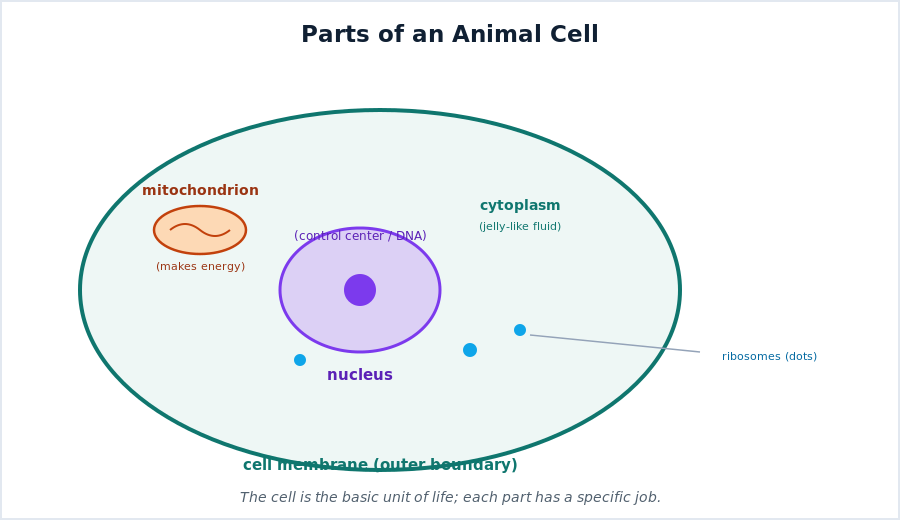
A helpful way to remember the jobs: the membrane is the gatekeeper, the nucleus is the manager holding the plans, the mitochondria are the power plant, and the cytoplasm is the space where everything gets done.
Plant Cells vs. Animal Cells
Plant cells have everything animal cells have, plus a few extras. A cell wall surrounds the membrane and gives the plant support and shape. Chloroplasts capture sunlight to make food through photosynthesis. And a large central vacuole stores water. Animal cells lack the cell wall and chloroplasts. If a question mentions a cell wall or chloroplasts, it is describing a plant cell.
Why Cells Matter
The idea that all living things are made of cells is one of the foundations of biology, known as cell theory. It also states that cells come from other cells. Because every organism is built from these units, the test often frames life-science questions in terms of what cells do — how they get energy, how they divide, how they specialize. Knowing the basic parts gives you a foothold on all of it.
Watch: A Short Video Lesson
Amoeba Sisters walks through this skill clearly in a few minutes. It is a helpful companion to the reading above:
A Routine for Cell Questions
- Match each part to its job: membrane (boundary), nucleus (DNA/control), mitochondria (energy), cytoplasm (fluid).
- Look for a cell wall or chloroplasts — these mean a plant cell.
- Remember cell theory: living things are made of cells, and cells come from cells.
Practice
- Which part controls what enters and leaves the cell?
- Which part holds the cell’s DNA?
- Which part releases energy for the cell?
- Name one structure found in plant cells but not animal cells.
- What is the jelly-like fluid inside the cell called?
- What does cell theory say about where cells come from?
Answers
- The cell membrane.
- The nucleus.
- The mitochondria.
- A cell wall, chloroplasts, or a large central vacuole.
- The cytoplasm.
- Cells come from other cells.
Where This Fits in Your Science Prep
The cell is the starting point for life science. Next, see how cells get energy in photosynthesis and cellular respiration, then how cells build living things in levels of organization. See all topics on the Science Topics Hub.

Related to This Article
More math articles
- Math Exploration: A Journey into Graphs, Tables, and Fractional Word Problems
- Order of Operations Calculator (PEMDAS) with Steps
- How to Graph Radical Functions
- Blackjack Insurance Sounds Smart Until You Do the Probability
- FREE 5th Grade NYSE Math Practice Test
- Sequence Calculator (Arithmetic & Geometric — nth Term & Sum)
- Midterm elections
- Head of state
- TExES Core Math Practice Test Questions
- Reference Angle Calculator (with Coterminal Angles)






















What people say about "The Cell: Life's Basic Unit"?
No one replied yet.