Photosynthesis and Cellular Respiration

A leaf can gain dry mass from carbon dioxide in the air. Where does the carbon go? Photosynthesis incorporates it into organic molecules, using energy captured from light. An animal that eats plant material can then transfer some of that stored chemical energy into ATP through cellular respiration.
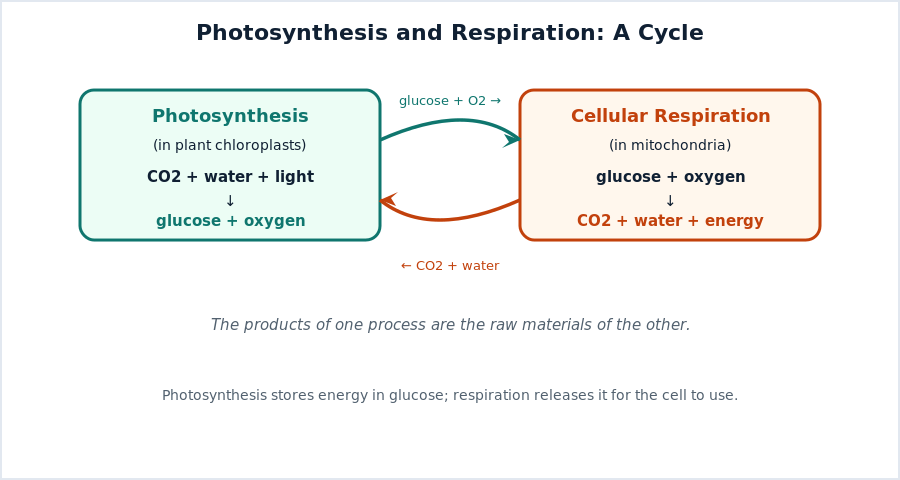
Photosynthesis uses light-driven reactions to help build organic molecules from carbon dioxide. Cellular respiration transfers energy from fuel molecules through a series of reactions, producing ATP. Their overall inputs and outputs connect the cycling of matter, while energy enters ecosystems and eventually dissipates as heat.
What does photosynthesis accomplish?
In plants and algae, photosynthesis occurs in chloroplasts. Light reactions use light energy, split water, release oxygen, and help produce ATP and NADPH. Carbon-fixation reactions use carbon dioxide and those energy carriers to produce three-carbon sugars. Cells can use these products to build glucose, starch, cellulose, and other molecules.
The familiar summary “carbon dioxide + water + light → sugar + oxygen” is useful for tracking overall inputs and outputs. It does not show every reaction. The oxygen released by oxygen-producing photosynthesis comes from water, not from carbon dioxide. Photosynthetic bacteria also exist. Cyanobacteria carry out oxygen-producing photosynthesis without chloroplasts.
Where does cellular respiration happen?
For a typical eukaryotic cell using oxygen, glycolysis begins in the cytosol. Further fuel processing and the citric acid cycle occur in mitochondria, while the respiratory electron-transport chain operates in the inner mitochondrial membrane. Oxygen accepts electrons at the end of that chain and contributes to water formation.
ATP production is coupled to these reactions. Some energy is transferred into ATP, and some disperses as heat. Carbon dioxide is released during stages that remove carbon from fuel-derived molecules. It is not a direct product of glycolysis. Bacteria can also respire, using their cell membrane for respiratory electron transport instead of mitochondria.
Are the two processes exact reverses?
The simplified overall equations have complementary inputs and outputs, but the pathways are not the same sequence running backward. They use different enzymes, membrane arrangements, and intermediate molecules. Plants carry out cellular respiration as well as photosynthesis: they need ATP for transport, synthesis, repair, and growth, including when light is absent.
| Comparison | Photosynthesis | Aerobic respiration |
|---|---|---|
| Main energy transfer | Light supports the production of organic matter. | Fuel oxidation supports ATP production. |
| Carbon in the overall process | Carbon dioxide supplies carbon for organic molecules. | Oxidized organic carbon can leave as carbon dioxide. |
| Oxygen | Oxygen-producing photosynthesis releases it from water. | It accepts electrons at the end of the respiratory chain. |
What happens to a plant in darkness?
Consider a healthy plant placed in darkness for several hours. Its light reactions cannot continue without light, but its cells can still respire using available fuel and oxygen. Under these conditions, oxygen consumption and carbon-dioxide release may dominate its net gas exchange. In bright light, photosynthesis can exceed respiration, reversing the net pattern. A gas measurement reports the balance of simultaneous processes, not whether only one process exists.
Watch the processes together
As you watch, track carbon, oxygen, and energy separately. A loop in a matter diagram does not mean that usable energy cycles indefinitely.
Check your understanding
What supplies the oxygen released during oxygen-producing photosynthesis?
Water supplies that oxygen. Carbon dioxide supplies carbon for organic molecules.
Does glycolysis take place inside mitochondria?
No. In typical eukaryotic cells, glycolysis occurs in the cytosol.
Why can a plant release carbon dioxide in darkness?
Its cells can continue respiring with available fuel and oxygen while light reactions stop.
What is oxygen’s role in aerobic respiratory electron transport?
It is the final electron acceptor and contributes to water formation.
Does a carbon cycle imply an energy cycle?
No. Matter is reused, while energy enters and ultimately dissipates as heat.
Why are photosynthesis and respiration not exact reverse pathways?
Their overall equations are complementary, but their enzymes, intermediate reactions, and membrane processes differ.
Continue with cell structure and ecosystem energy flow. Return to the Biology learning hub for the complete lesson library.
For the AP course sequence and practice tests, use the AP Biology study hub.

Related to This Article
More math articles
- Family, Household, Kinship, and Family Position
- Balancing Probabilities: A Comprehensive Guide to the Expected Value of Random Variables
- CPA TCP Tax Planning Simulations: Organize Facts by Year (2027 Prep)
- The Best Grade 3 ELA Practice Tests for Colorado Students
- How to Solve Word Problems Involving Completing a Table and Making a Graph?
- Absolute Poverty, Relative Poverty, and Measurement
- AFOQT Math Practice Test Questions
- Sexuality, Identity, and Institutions
- How to Pass the STAAR Math Test (Texas): The 2026 Parent & Student Playbook
- Cells, Tissues, Organs, and Homeostasis






















What people say about "Photosynthesis and Cellular Respiration"?
No one replied yet.