Energy Flow and the Cycles of Matter
Energy enters most ecosystems as sunlight and then moves from one organism to the next as they eat each other. But energy does not pass along perfectly — most of it is lost at every step. Understanding this flow, and the way matter cycles separately from it, answers a big group of ecology questions.
Energy Flows One Way
Energy flow starts with producers capturing sunlight, then passes to consumers as they eat. A key fact: only about 10% of the energy at one level passes to the next. The other 90% is used up for living and lost as heat. This is why an energy pyramid is shaped the way it is — there is a huge base of producers, fewer plant-eaters above them, and only a small number of top predators at the peak.
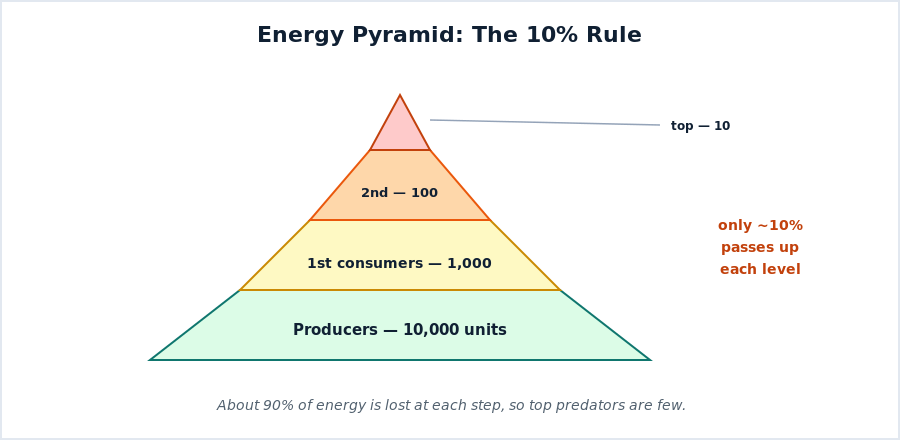
This 10% rule explains a common test answer: there are far more producers than top predators because so little energy reaches the top. Energy flows in one direction — it is not recycled.
Matter Cycles Around
Unlike energy, matter is recycled. Substances like carbon and water move in cycles, used over and over. In the carbon cycle, carbon moves between the air, living things, and the ground as organisms photosynthesize, eat, breathe, and decompose. In the water cycle, water evaporates, forms clouds, falls as rain, and returns to start again. The big contrast to remember: energy flows through and is lost, but matter cycles and is reused.
Food Chains vs. Food Webs
A food chain is a single path of who-eats-whom. A food web is many food chains linked together, showing that most organisms eat — and are eaten by — more than one kind of thing. Food webs are more realistic, and they show why removing one species can affect many others. When a question shows a web and removes an organism, trace the arrows to see which populations would rise or fall.
Watch: A Short Video Lesson
Amoeba Sisters walks through this skill clearly in a few minutes. It is a helpful companion to the reading above:
A Routine for Energy and Matter Questions
- Energy flows one way and about 90% is lost at each level (the 10% rule).
- An energy pyramid is wide at the bottom, narrow at the top.
- Matter (carbon, water) cycles and is reused; energy does not.
- In a food web, removing one species affects many others — follow the arrows.
Practice
- About what percent of energy passes to the next level?
- Why are there few top predators compared to producers?
- Does energy get recycled in an ecosystem?
- Name one thing that cycles through an ecosystem.
- What is the difference between a food chain and a food web?
- Why does removing one species affect many others in a food web?
Answers
- About 10%.
- So little energy reaches the top that few can be supported.
- No — energy flows one way and is lost as heat.
- Carbon or water (matter cycles).
- A chain is one path; a web is many chains linked together.
- Because organisms are connected to many others through feeding relationships.
Where This Fits in Your Science Prep
Energy flow builds on producers, consumers, and decomposers and connects to photosynthesis and respiration, which move carbon and energy. See all topics on the Science Topics Hub.

Related to This Article
More math articles
- Build surplus from a schedule before using a triangle
- SAT versus PSAT: What You Need to Know
- The AEF, the Armistice, and the Human Cost of War
- Ratio & Proportion Calculator (Solve for x)
- District of Columbia DC CAPE Grade 6 Math Free Worksheets: 72 Free Printable Math Practice PDFs
- 4th Grade STAAR Math Practice Test Questions
- What does TSI Test Stand for?
- Comparison and Number Ordering
- The Best Grade 3 Math Book for Louisiana Students
- Sex discrimination





















What people say about "Energy Flow and the Cycles of Matter"?
No one replied yet.