Ecosystems: Producers, Consumers, and Decomposers
An ecosystem is all the living things in an area plus the nonliving parts they depend on, like sunlight, water, and soil. Within it, every organism plays a role in moving energy and nutrients around. The three big roles — producers, consumers, and decomposers — are a favorite test topic, and they are easy to master.
The Three Roles
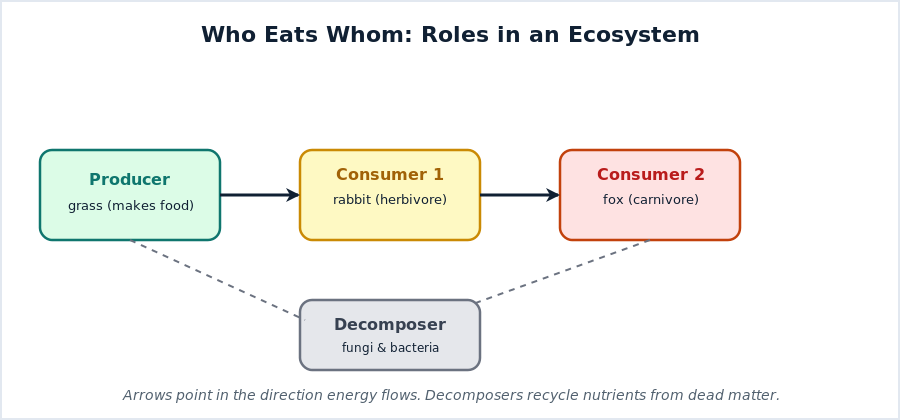
Producers make their own food, usually by photosynthesis. Plants are the classic example; they capture sunlight and form the base of nearly every food chain. Consumers cannot make their own food, so they eat other organisms. A consumer that eats plants is a herbivore; one that eats other animals is a carnivore. Decomposers, like fungi and many bacteria, break down dead organisms and waste, returning nutrients to the soil so producers can use them again.
Food Chains and the Direction of Energy
A food chain shows who eats whom, and its arrows are important: each arrow points from the organism being eaten to the one that eats it, because that is the direction energy flows. Grass → rabbit → fox means energy passes from grass to rabbit to fox. A common test mistake is reading the arrows backward, so always remember the arrow points toward the eater.
Why Decomposers Matter
It is tempting to overlook decomposers, but without them an ecosystem would run out of raw materials. When plants and animals die, decomposers break them down and release nutrients back into the soil and water, where producers pick them up again. This recycling is what keeps an ecosystem going year after year. If a question asks what returns nutrients to the environment, the answer is decomposers.
Watch: A Short Video Lesson
The Digital Classroom Experience walks through this skill clearly in a few minutes. It is a helpful companion to the reading above:
A Routine for Ecosystem Questions
- Producers make food (plants); consumers eat others; decomposers recycle dead matter.
- In a food chain, the arrow points toward the organism doing the eating.
- Producers are the base of nearly every food chain.
- Decomposers return nutrients to the soil for producers to reuse.
Practice
- What is a producer, and give an example.
- What is a consumer?
- What do decomposers do?
- In the food chain grass → rabbit → fox, which way does energy flow?
- Which organisms return nutrients to the soil?
- What is at the base of most food chains?
Answers
- An organism that makes its own food, such as a plant.
- An organism that eats other organisms.
- Break down dead organisms and return nutrients to the environment.
- From grass to rabbit to fox.
- Decomposers.
- Producers.
Where This Fits in Your Science Prep
Ecosystem roles lead directly into energy flow and the cycles of matter, and they connect to how organisms interact in symbiosis, disruption, and extinction. See all topics on the Science Topics Hub.

Related to This Article
More math articles
- Grade 3 Math: Graphs
- Long-Run Growth, Productivity, and Living Standards
- How to Solve Systems of Equations Graphically?
- A wage change creates substitution and income effects in labor supply
- Ohio OST Algebra 1 Free Worksheets: Printable OST-Ready Algebra 1 Worksheets with Step-by-Step Keys
- Pronoun Case
- Culture Wars and the AIDS Crisis
- How to Solve Linear Inequalities?
- The Best Grade 2 Math Worksheets for Florida Students
- Three-Hour Pacing and Marking Questions for Review




















What people say about "Ecosystems: Producers, Consumers, Decomposers"?
No one replied yet.