Chemical Bonds and Compound Names: Charges, Formulas, and Prefixes
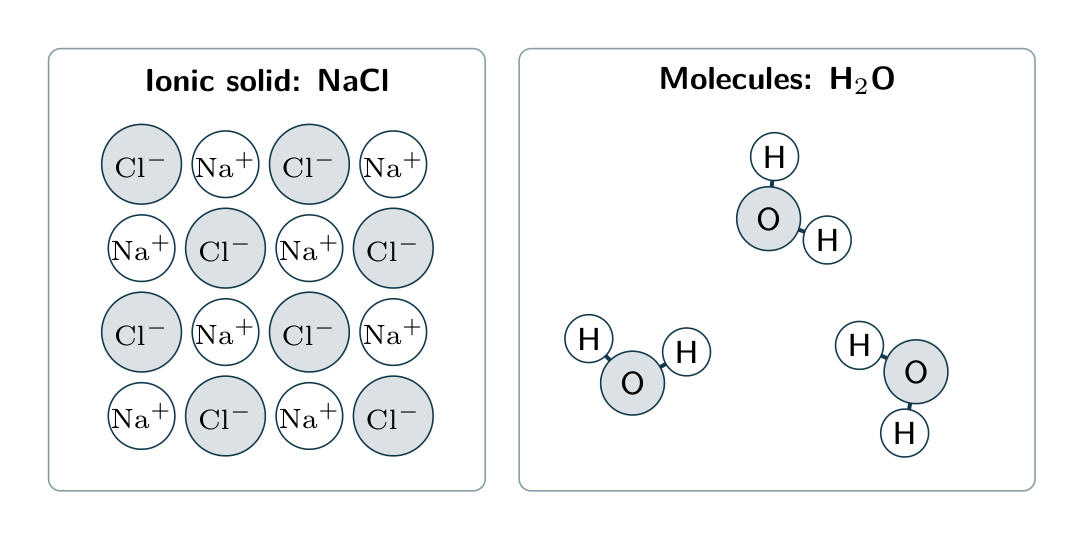
Calcium chloride has two chloride ions for every calcium ion. That ratio follows from charge balance. Carbon dioxide gets its two oxygens from the molecular formula and the prefix in its name. Decide which naming system applies before you start adding subscripts.
Chemical bonding describes interactions that hold atoms or ions together in stable arrangements. Ionic solids contain oppositely charged ions in extended structures. Covalent bonds involve shared electron density between atoms. Compound names and formulas communicate composition, with different conventions for ionic compounds and molecular compounds.
How do charges determine an ionic formula?
For an ordinary neutral ionic compound, the total positive and negative charges must balance. Calcium forms \(\mathrm{Ca}^{2+}\), while chloride is \(\mathrm{Cl}^{-}\). One calcium ion needs two chloride ions:
\[ (+2)+2(-1)=0. \]
The formula is \(\mathrm{CaCl_2}\). Its subscripts describe the simplest whole-number ratio in the solid. They do not identify a separate calcium chloride molecule in an ionic crystal.
Worked example: name and write iron(III) oxide
The Roman numeral tells you the iron ion’s charge: \(\mathrm{Fe}^{3+}\). Oxide is \(\mathrm{O}^{2-}\). The smallest common total charge is six, so two iron ions balance three oxide ions:
\[ 2(+3)+3(-2)=0. \]
The formula is \(\mathrm{Fe_2O_3}\). The III in the name gives charge, not a count of three iron atoms.
Keep a polyatomic ion together. Calcium nitrate is \(\mathrm{Ca(NO_3)_2}\): two nitrate ions balance one calcium ion. The outside subscript multiplies everything inside the parentheses.
When should you use molecular prefixes?
For many binary molecular compounds, prefixes indicate atom counts. Carbon monoxide is \(\mathrm{CO}\), and carbon dioxide is \(\mathrm{CO_2}\). Dinitrogen pentoxide is \(\mathrm{N_2O_5}\). Do not apply ionic charge-crossing rules to these molecular names.
| Name feature | What it tells you |
|---|---|
| Roman numeral in iron(III) | The metal ion has a 3+ charge. |
| Prefix di- in dioxide | There are two oxygen atoms per molecule. |
| Parentheses around nitrate | The outside subscript counts entire nitrate ions. |
What should you check before accepting a formula?
- Identify whether the name describes ions or a molecular compound.
- For ions, write the charges and balance them.
- For molecular prefixes, translate the named counts directly.
- Check parentheses, subscripts, and the compound’s full name.
Bonding models describe electron distributions. Real bonds can have varying degrees of ionic or covalent character, so the introductory categories are useful models.
Can you apply the idea?
-
Write the formula from \(\mathrm{Mg}^{2+}\) and \(\mathrm{Cl}^{-}\).
Check your answer
\(\mathrm{MgCl_2}\), because two chloride charges balance one magnesium charge.
-
Write aluminum oxide from \(\mathrm{Al}^{3+}\) and \(\mathrm{O}^{2-}\).
Check your answer
\(\mathrm{Al_2O_3}\). The charges total +6 and -6.
-
Name \(\mathrm{CO_2}\).
Check your answer
Carbon dioxide.
-
What does the II in copper(II) indicate?
Check your answer
A copper ion charge of 2+.
-
How many oxygen atoms are represented in \(\mathrm{Ca(NO_3)_2}\)?
Check your answer
Six. Two nitrate ions each contain three oxygens.
-
Why is an ionic crystal usually described with formula units?
Check your answer
It is an extended ion arrangement. The formula states the simplest ion ratio rather than a distinct molecule.
Watch the idea explained
How to Speak Chemistrian: Crash Course Chemistry #11, CrashCourse.
This selected excerpt runs from 4:03 to 5:35. Use the Roman numeral in a transition-metal compound name to identify the metal ion’s charge.
Where does this fit?
Use the chemistry learning hub to choose a lesson or practice test. Connect this topic with electrons and periodic trends, molecular shape and polarity, atoms, isotopes, and ions, the mole and molar mass.
Continue with a chemistry study guide


Related to This Article
More math articles
- The Best Grade 3 ELA Practice Tests for Mississippi Students
- Lynching, Ida B. Wells, Washington, Du Bois, and Black Institution Building
- How to Help Your 4th Grade Student Prepare for the District of Columbia DC CAPE Math Test
- Intelligent Math Puzzle – Challenge 84
- 49 Free Grade 5 Math Worksheets for Mississippi MAAP Prep, Built Around the Real Skill List
- How to Finding Range, Quartile and Interquartile Range
- New Hampshire Algebra 1 Free Worksheets: Printable Standards-Aligned Algebra 1 Practice with Answers
- SIFT Math Flashcards (Free Online: Formulas, Terms & Concepts)
- Summer Math Workbooks for Grades 3–8: How to Stop Learning Loss Before It Starts
- How to Help Your 4th Grade Student Prepare for the Florida FAST Math Test


















What people say about "Chemical Bonds and Compound Names: Examples and Practice"?
No one replied yet.