Electrons and Periodic Trends: Explaining Atomic Size and Ionization Energy
Sodium and chlorine sit in the same period, yet their chemistry differs sharply. To explain the difference, look at their electrons and the attraction from their nuclei. Arrows on a periodic-trend chart are useful only when you can explain what drives them.
Electron configurations describe how electrons occupy atomic orbitals. An orbital is a quantum description of an electron state, associated with a probability distribution in space. Periodic trends arise from changes in occupied shells, nuclear charge, shielding, and electron arrangement. These patterns help predict atomic size, ionization energy, and bonding behavior.
How are electrons placed in orbitals?
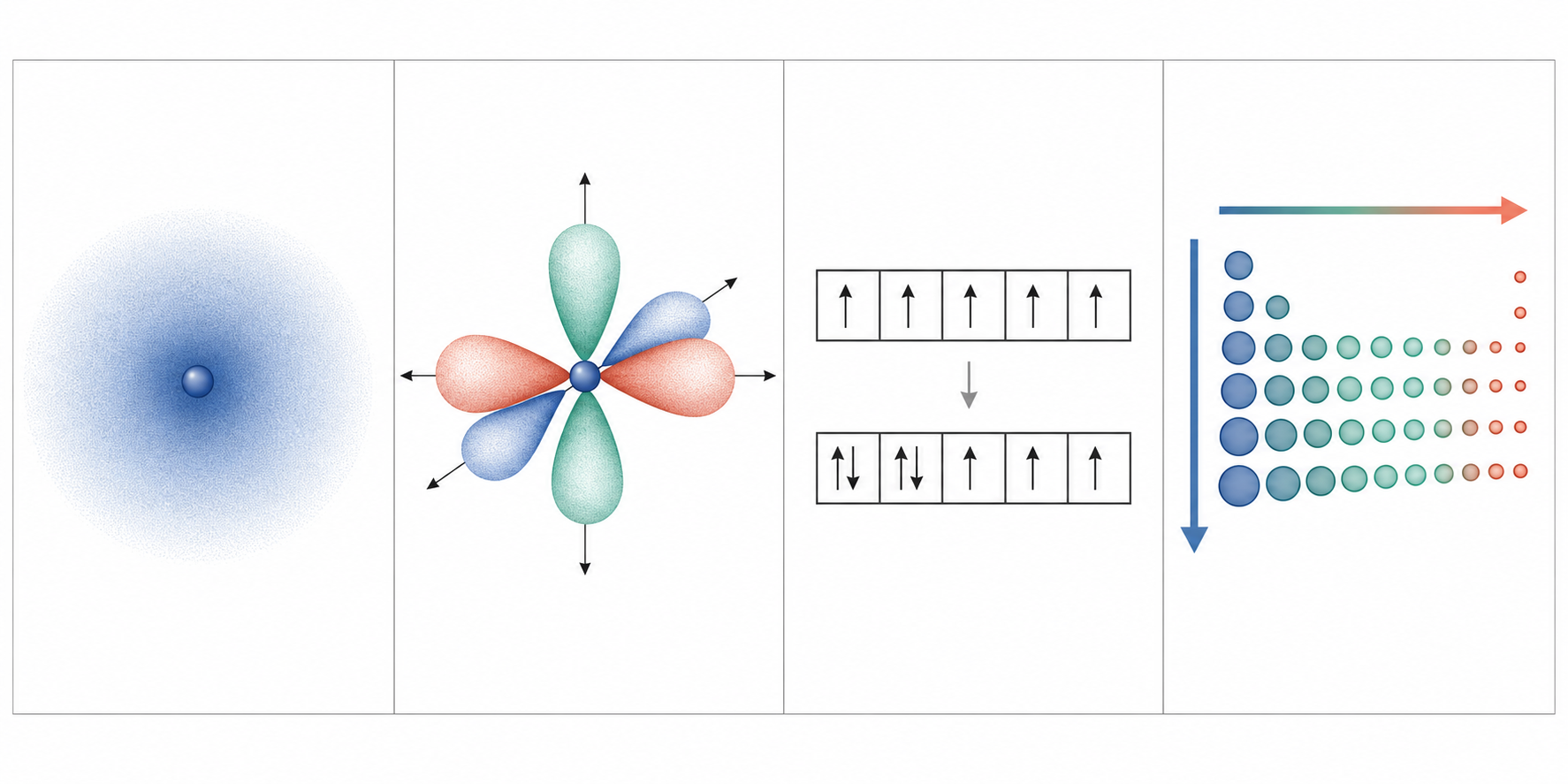
Each orbital holds at most two electrons with opposite spin quantum numbers. An s subshell has one orbital and holds two electrons. A p subshell has three orbitals and holds six. For a ground-state atom, electrons occupy available lower-energy states first.
Within equal-energy orbitals of one subshell, place electrons singly with parallel spins before pairing them. This is Hund’s rule. The ground-state configuration of nitrogen is \(1s^2 2s^2 2p^3\), with one electron in each of the three 2p orbitals.
Why does atomic size change across a period?
Across a main-group period, proton number rises while added electrons occupy the same principal shell. The effective attraction on the outer electrons generally increases, drawing the electron distribution inward. Down a group, the outer electrons occupy shells farther from the nucleus, so atomic radius generally increases.
Atomic radius depends on how it is defined and measured. Use a consistent radius convention when comparing data, and treat the classroom trend as a general pattern rather than a promise of a perfectly smooth sequence.
Worked example: compare sodium and potassium
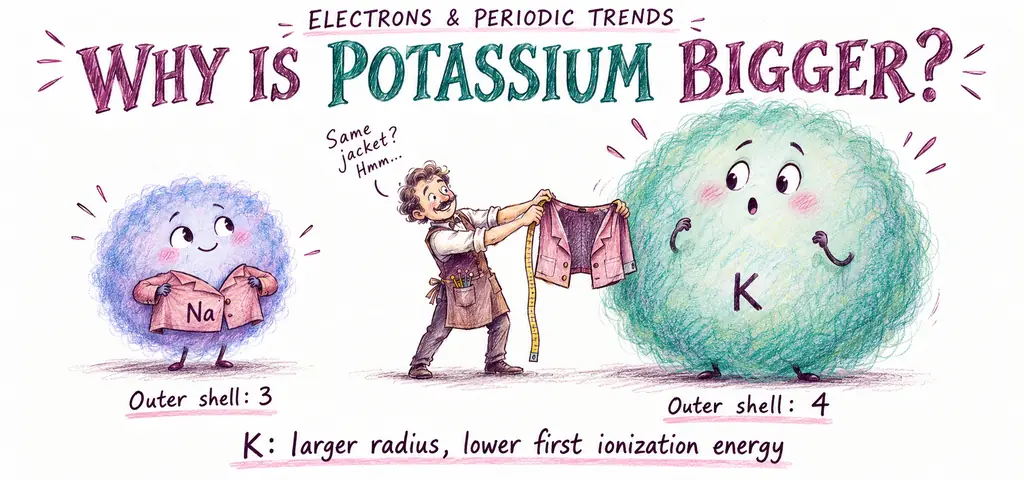
Potassium’s outer electron occupies the fourth principal shell, whereas sodium’s occupies the third. Potassium therefore has the larger atomic radius. Its outer electron is also less tightly held, so potassium has the lower first ionization energy.
First ionization energy is the energy required to remove an electron from a gaseous neutral atom. Removing an electron from an already positive ion is a different process, represented by a later ionization energy.
How do you reason through a trend question?
- Locate both elements and decide whether the comparison runs across a period or down a group.
- Identify their outer occupied shells.
- Consider nuclear attraction and shielding.
- State the predicted trend and its physical reason.
Electron configurations also explain exceptions. Pairing electrons in one orbital can make an electron easier to remove, so first ionization energy has local departures from the broad left-to-right rise.
Can you apply the idea?
-
How many electrons can one orbital hold?
Check your answer
Two, with opposite spin quantum numbers.
-
How many orbitals are in a p subshell?
Check your answer
Three, allowing a maximum of six electrons.
-
Which is generally larger, lithium or sodium?
Check your answer
Sodium, whose outer electron occupies a higher principal shell.
-
Which is generally smaller, sodium or chlorine?
Check your answer
Chlorine, because effective nuclear attraction increases across that period.
-
Does a large first ionization energy mean an electron is easy to remove?
Check your answer
No. It means substantial energy is needed to remove the electron.
-
Write the ground-state configuration of neon, which has 10 electrons.
Check your answer
\(1s^2 2s^2 2p^6\). The total superscripts add to 10.
Watch the idea explained
The Electron: Crash Course Chemistry #5, CrashCourse.
This selected excerpt runs from 5:54 to 7:15. Read an electron configuration. A subshell can contain several orbitals; each individual orbital holds at most two electrons.
Where does this fit?
Use the chemistry learning hub to choose a lesson or practice test. Connect this topic with atoms, isotopes, and ions, chemical bonds and compound names, matter and its changes, molecular shape and polarity.
Continue with a chemistry study guide


Related to This Article
More math articles
- Free Grade 3 English Worksheets for Washington State Students
- 10 Most Common 6th Grade NYSE Math Questions
- Cruel and unusual punishment
- 5th Grade IAR Math Worksheets: FREE & Printable
- The Crash and the Causes of the Great Depression
- The Ultimate 6th Grade TNReady Math Course (+FREE Worksheets)
- The Best Grade 8 Math Book for Iowa Students
- Presidential Communication and the Bully Pulpit
- FREE 4th Grade MEAP Math Practice Test
- Horse Racing Odds Explained: Probability & Expected Value






















What people say about "Electrons and Periodic Trends: Examples and Practice"?
No one replied yet.