The Crash and the Causes of the Great Depression
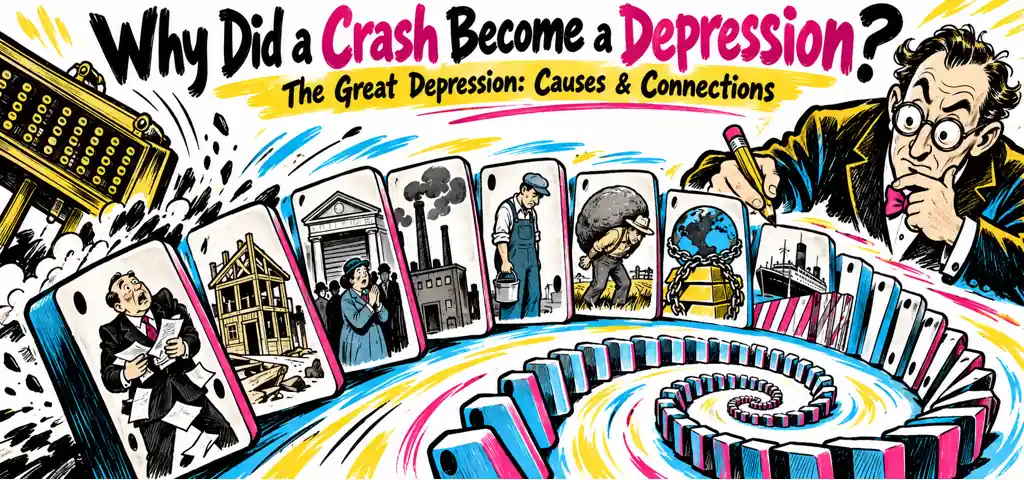
Chapter 9 of the CLEP History of the United States II study guide on Effortless Math covers The Crash and the Causes of the Great Depression: the key terms, the core ideas, and worked examples showing how this topic is tested on the exam.
CLEP History of the United States II, Chapter 9
The stock crash was a break, not a complete explanation
Share prices rose rapidly during the late 1920s and fell violently in October 1929. Black Tuesday, October 29, became the crisis's symbol. The crash destroyed paper wealth, weakened confidence, and damaged institutions that had lent against securities. Yet unemployment and output continued falling for years. A market break can trigger contraction without explaining why spending, banking, prices, and international trade entered a self-reinforcing collapse.
Margin purchases magnified gains and losses
Buying on margin meant paying part of a stock's price and borrowing the rest, usually through a broker. Rising prices made the buyer's small equity look profitable. Falling prices prompted margin calls: borrowers had to provide cash or securities were sold. Forced sales could drive prices lower. Margin debt worsened the crash, but most households did not own stocks. It is one transmission mechanism rather than a sufficient cause of nationwide depression.
Unequal purchasing power limited mass demand
Productivity and profits rose faster than purchasing power for many households. Farm families, coal communities, and workers in older industries had been weak before 1929. Installment credit sustained purchases of cars and appliances by moving demand forward. Once households became cautious or indebted, purchases of durable goods could be postponed. Factories making cars, furniture, and machinery then cut production sharply because consumers could live with existing goods.
Construction weakened before Wall Street collapsed
Residential construction peaked in the middle of the 1920s and declined before the crash. A housing slowdown reduced demand for lumber, glass, steel, appliances, transport, and building labor. The timing matters: not every weakness began on the stock exchange. Excess capacity in agriculture and older industries and a preexisting construction downturn made the economy less able to absorb a financial shock.
Bank failures destroyed money and local credit
Thousands of banks failed between 1930 and 1933. The United States had many small, geographically restricted banks with concentrated local loans and limited diversification. There was no federal deposit insurance. A failure erased uninsured deposits, frightened customers at other banks, and forced surviving banks to hold cash rather than lend. The money supply contracted as deposits disappeared. Bank panic therefore reduced both household spending and business credit.
Federal Reserve choices deepened monetary contraction
The Federal Reserve could lend to banks, purchase securities, and reduce interest pressure. It did not act aggressively enough to stop the collapse of banks and money. Officials feared speculation, defended the gold standard, disagreed across reserve banks, and sometimes interpreted falling rates as evidence that money was easy. Milton Friedman and Anna Schwartz later emphasized this failure. Their monetary explanation complements rather than automatically cancels accounts of weak demand, debt, or international structure.
The gold standard transmitted deflation across borders
Currencies tied to gold constrained central banks. A country losing gold often raised interest rates or reduced credit to defend convertibility, even during unemployment. Financial distress and policy tightening moved among nations. Countries that left gold generally gained more freedom to expand money and tended to recover earlier. The standard did not mechanically produce identical outcomes everywhere, but it linked national policy to international reserves when domestic expansion was urgently needed.
War debts and reparations made international finance fragile
American loans helped Germany make reparations payments, while Britain and France used receipts to service war debts to the United States. After American lending contracted, this payment circuit weakened. Defaults, bank strains, and political disputes spread. The depression was global because trade and finance connected national economies. A purely domestic story misses how American creditor policy and European obligations amplified one another.
Smoot-Hawley provoked retaliation and reduced trade
The Tariff Act of 1930 raised duties on thousands of imports. Other countries retaliated or imposed their own restrictions, and world trade fell severely. The tariff did not cause the October 1929 crash because it became law later. Nor did it cause every part of the Depression by itself. It aggravated an international contraction by narrowing markets when debtors needed export earnings and producers needed customers.
Deflation increased the real burden of debt
As prices and wages fell, fixed dollar debts did not shrink. Farmers, homeowners, firms, and governments had to repay with dollars worth more in purchasing power. Distressed borrowers cut spending or defaulted; foreclosures damaged banks and communities. Irving Fisher described this feedback as debt-deflation: liquidation pushed prices lower, which made remaining debts heavier, producing more liquidation. A lower price level was not automatically a benefit to people whose incomes and asset values were falling faster.
Common-pool extraction shows a sectoral collapse
East Texas oil discoveries produced a drilling rush in 1930 and 1931. Because underground petroleum moved across property lines, each owner had an incentive to pump before neighbors did. Output surged, prices collapsed, and waste increased. State proration and later federal-state cooperation tried to limit production. The episode illustrates a common-pool problem inside the Depression: individually rational extraction could produce collective oversupply and falling income.
rank causes by mechanism
A prompt lists margin buying, housing decline, bank failures, and the gold standard.
Recovery requires explaining persistence
By 1933 national output had fallen drastically and unemployment approached one quarter of the labor force. A normal inventory correction became a depression because falling spending, prices, bank credit, investment, and employment reinforced one another while international rules constrained response. Historians debate the weight of monetary, financial, demand, policy, and structural causes. They agree that the crash alone cannot explain four years of cumulative contraction.
Watch the history in motion
This short lesson adds voices, images, and chronology to the ideas you just studied.
Video: The GREAT DEPRESSION & the NEW DEAL [APUSH Unit 7 Topics 9-10] Period 7: 1898-1945, Heimler's History.
Try four CLEP-style questions
- Why could falling market interest rates during the contraction mislead Federal Reserve officials about monetary conditions?
- Deposit insurance pushed rates down even as federally insured banks stopped lending.
- Smoot-Hawley fixed domestic lending rates below those charged on foreign capital.
- Margin calls expanded broker credit while ordinary bank deposits disappeared.
- Collapsing loan demand could lower rates even while deposits and credit contracted.
- Gold convertibility required every reserve bank to publish one commercial lending rate.
- Which process best describes debt-deflation?
- Falling prices increase fixed debts' real burden and trigger cutbacks.
- Banks cancel debts when the money supply contracts.
- Falling prices reduce every loan's dollar principal.
- Tariffs convert private debts into public obligations.
- Gold outflows increase borrowers' nominal wages.
- Why did countries leaving the gold standard often gain greater room for monetary recovery?
- They could expand money without defending a fixed gold conversion rate.
- They could devalue only after receiving priority in Germany's reparations payments.
- They could guarantee insolvent banks without expanding currency or fiscal support.
- They eliminated exchange-rate risk, so trade conditions no longer constrained recovery.
- They obtained American Treasury gold equal to their outstanding war debts.
- Why did Texas authorities use proration in the East Texas oil fields?
- To raise extraction by rewarding the first owner to drain a shared reservoir
- To curb common-pool overproduction that depressed prices and increased physical waste
- To enforce Smoot-Hawley duties against oil imported from neighboring states
- To substitute federally guaranteed agricultural export payments for petroleum sales
- To convert private wells into Federal Reserve collateral during banking emergencies
Check your answers and reasoning
Independent preparation. CLEP is a registered trademark of the College Board, which does not endorse this lesson.

Related to This Article
More math articles
- Stratification, Life Chances, and Unequal Dimensions
- Understanding How to Use Debit and Credit Cards for Payments
- The Best Grade 4 ELA Practice Tests for Missouri Students
- 3rd Grade Georgia Milestones Assessment System Math Worksheets: FREE & Printable
- The National Labor Union and the Knights of Labor
- Meaning in Context: Using the Sentence as Evidence
- Everything You Need to Pass the GED Math Test
- Natural Rights and Social Contract Theory
- Indiana ILEARN Grade 6 Math Free Worksheets: Free Skill-Targeted Worksheets with Answer Keys
- What is the Relationship between Dilations and Angles in Geometry


















What people say about "The Crash and Causes of the Depression"?
No one replied yet.