Unemployment, Migration, Family Survival, and Depression Culture
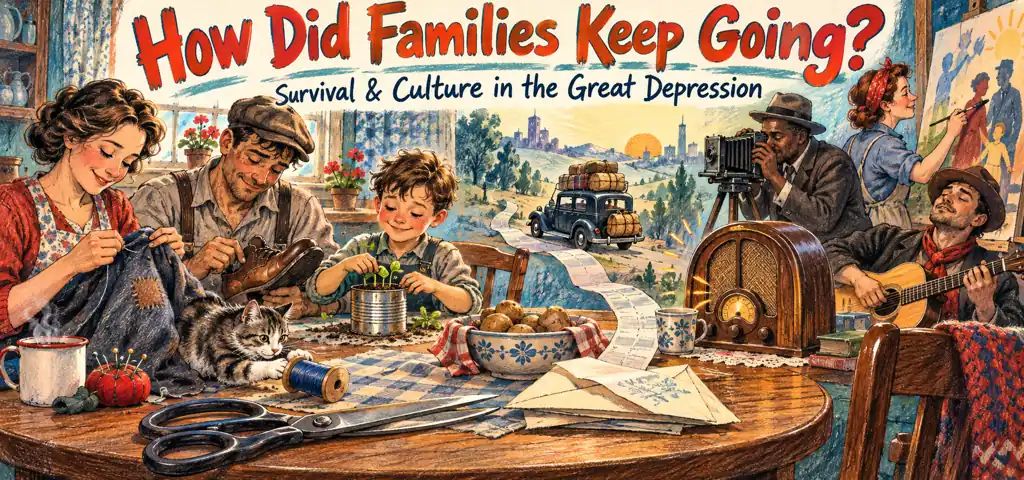
Chapter 9 of the CLEP History of the United States II study guide on Effortless Math covers Unemployment, Migration, Family Survival, and Depression Culture: the key terms, the core ideas, and worked examples showing how this topic is tested on the exam.
CLEP History of the United States II, Chapter 9
Unemployment changed status as well as income
By 1933 roughly one worker in four was unemployed. Many more worked shortened hours or intermittent jobs. Because the dominant ideal cast a male breadwinner as responsible for family support, job loss could produce shame and psychological strain alongside hunger. Families doubled up, delayed marriage, repaired goods, took in boarders, planted gardens, or relied on kin. Survival strategies redistributed labor within households; they did not make lost wages harmless.
Relief began locally and failed unevenly
Cities, counties, churches, ethnic associations, mutual-aid societies, and charities provided food, rent help, and work relief. Their tax bases and donations collapsed as need rose. Industrial cities with the greatest unemployment often had the least capacity. Waiting lines and intrusive eligibility investigations stigmatized recipients. The mismatch between national crisis and local revenue helped make federal relief politically conceivable.
Housing insecurity became visible in Hoovervilles
Evicted families constructed shacks on vacant land and in parks, forming settlements critics called "Hoovervilles." The label blamed the president, though settlements varied in size and organization. Breadlines and street vending made poverty public. Homelessness was not confined to these camps; families also moved between relatives, lodging houses, cars, and temporary work. A famous image represents a wider housing crisis without measuring it completely.
Race shaped access to scarce work
The saying "last hired, first fired" described how Black workers were displaced from industrial and service jobs. In some cities, white women hired Black domestic workers by the day at street-corner labor markets sometimes called "slave markets." Black relief applicants faced discrimination, segregated facilities, and lower payments. The Harlem disorder of 1935 began after a false rumor that police had killed a Black teenager and became a protest against unemployment, policing, and merchant relations rather than a white mob invasion.
Women faced contradictory demands
Families needed women's earnings, yet officials and employers often treated jobs as belonging first to men. Section 213 of the 1932 Economy Act required dismissal of one spouse from federal employment when both worked for the government, a rule applied disproportionately to wives. Married women's labor-force participation still rose over the decade, partly because women held service and clerical jobs less affected than heavy industry. Need and discrimination operated together.
Migration followed work, relief, race, and environment
People moved toward relatives, harvests, cities, or regions thought to offer work. Dust Bowl migrants from Oklahoma, Texas, Arkansas, and nearby states became "Okies" in California regardless of exact origin. Local residents and authorities met them with wage competition, roadside camps, health inspections, and sometimes police barriers. Migration was a household calculation shaped by information and networks, not aimless wandering by an undifferentiated poor.
Mexican repatriation mixed coercion and departure
During the 1930s, federal, state, and local officials promoted or conducted removals and "repatriation" campaigns affecting hundreds of thousands of people of Mexican descent, including United States citizens. Raids, public-charge pressure, relief discrimination, and transportation offers blurred voluntary departure and coercion. A 1930 instruction ordering consuls to apply the public-charge rule strictly also reduced lawful immigration. Citizenship did not consistently protect families from local removal campaigns.
The 1927 flood revealed an earlier racial relief pattern
After the Mississippi River flood, Black refugees were often confined in segregated camps and compelled to work under white supervision. Herbert Hoover directed national relief coordination and gained political prestige, but Black newspapers documented abuses. The episode preceded the Depression and helps explain why later Black voters judged relief through experience with local white control. It belongs to Hoover's administrative record as well as the history of disaster migration.
New Deal arts treated culture as work and evidence
Federal Project Number One under the Works Progress Administration supported the Federal Art, Music, Theatre, and Writers' Projects. Artists painted murals, actors staged plays, musicians performed, and writers produced state guides and interviewed formerly enslaved people. The program provided jobs and created public culture. It also raised questions about patronage, censorship, representation, and whether government should fund work whose value was not a road or building.
Documentary art selected a point of view
Photographers such as Dorothea Lange, Walker Evans, and Gordon Parks made poverty and migration visible. Their images were framed, captioned, commissioned, and circulated for particular audiences. Documentary form can provide evidence while still involving artistic and institutional choices. Regionalist painters such as Grant Wood and Thomas Hart Benton favored recognizable American scenes, while Charles Sheeler and Diego Rivera made machines and factories monumental subjects. Depression art did not speak in one style.
Stage and screen became political battlegrounds
The Federal Theatre Project employed theater workers and presented classical drama, children's plays, Black theatrical units, and "Living Newspapers" on public issues. Congress ended it in 1939 after accusations of radicalism and waste. Hollywood adopted the Motion Picture Production Code in 1930 and enforced it from 1934 through a required seal of approval. This industry self-regulation restricted screen content partly to forestall stronger government censorship and pressure from moral-reform campaigns. Gone with the Wind popularized a romantic plantation memory. Public and private institutions both set boundaries on what audiences saw.
Radio marked a chronology within mass culture
Roosevelt delivered the first presidential fireside chat during the banking crisis in March 1933. Orson Welles's 1938 War of the Worlds broadcast used simulated news bulletins in a radio drama, and reports exaggerated the scale of listener panic. Both followed KDKA's 1920 election broadcast and the 1927 release of The Jazz Singer. The order is KDKA, The Jazz Singer, Roosevelt's chat, and Welles's drama. Medium, genre, and political use changed within one technology.
Writers and musicians mapped displacement
John Steinbeck's The Grapes of Wrath followed dispossessed farm families toward California and exposed exploitation on the migrant road. Woody Guthrie's Dust Bowl Ballads joined environmental disaster to migration and labor. Richard Wright's Native Son placed Bigger Thomas within segregated Chicago and examined fear, violence, and constrained possibility. William Faulkner's Yoknapatawpha novels used several narrators and broken chronology rather than one linear reporter. Aaron Copland built concert music from hymns, cowboy songs, and other vernacular materials. Depression culture joined documentation to argument.
Religion and futurism offered rival communities
Dorothy Day and Peter Maurin's Catholic Worker movement joined houses of hospitality and aid to a critique of capitalism, war, and coercive state power. At the 1939 New York World's Fair, General Motors' Futurama promised high-speed highways, planned cities, and technological abundance. One vision built voluntary solidarity among the poor; the other offered corporate planning and consumption. Both answered insecurity with a picture of social order.
read culture as institution
A prompt compares a WPA mural, a studio film, and a migrant ballad.
Family adaptation did not distribute pain equally
Unemployment, gender rules, racial exclusion, citizenship status, local relief administration, and environmental migration shaped who could use each survival strategy. Some households preserved assets through kin networks; others lost land or housing. Cultural sources show experience and argument, but no single photograph, novel, or film gives a complete statistical portrait. Strong analysis joins demographic evidence to the voices and institutions that made hardship visible.
The 1920-1921 contraction joined lost orders to tight money
After World War I, military purchasing fell and European demand weakened. At the same time, the Federal Reserve raised discount rates to restrain inflation. Falling demand and tighter credit pushed prices and production downward, with especially severe effects in farming and manufacturing. The downturn was more than a return of soldiers to civilian jobs: the end of wartime markets and deliberate monetary restraint reinforced each other.
Watch the history in motion
This short lesson adds voices, images, and chronology to the ideas you just studied.
Video: The Great Depression: Crash Course US History #33, CrashCourse.
Try four CLEP-style questions
- Why did Section 213 of the Economy Act fall especially heavily on married women in federal employment?
- It reserved clerical posts for women but cut their wages below men's rates.
- Its one-spouse rule operated within hiring customs that usually treated the husband's job as the one to keep.
- It barred unmarried women from federal work whenever male unemployment exceeded ten percent.
- Its seniority rule dismissed the spouse who had entered federal service first, regardless of sex.
- It applied only to women whose husbands worked for private industrial firms.
- Which evidence would best show that Depression migration often followed information networks rather than aimless wandering?
- Letters directing relatives toward named harvest crews, housing, and trusted contacts
- A census showing households moved independently of relatives and prior community ties
- A wage table listing county pay rates without identifying migrants' origins or contacts
- A police order excluding destitute newcomers from one city's limits
- An undated roadside-camp photograph with no information about the families shown
- How did the Federal Theatre Project and the Production Code face different institutional controls?
- Both were federal agencies whose budgets depended on annual congressional appropriations.
- Theater owners imposed the Code, while studios funded Living Newspapers through taxes.
- Congress ended a public theater program; film studios enforced an industry code.
- Federal courts closed both programs after finding their productions unconstitutional.
- Both operated without political criticism because neither addressed controversial subjects.
- Why should a government-sponsored documentary photograph be treated as both evidence and interpretation?
- Cameras in the 1930s could not record outdoor scenes.
- Federal employment made every image legally classified.
- Documentary photographers used no captions or commissions.
- Selection, framing, captioning, and circulation shaped what viewers understood.
- Only paintings can express an institutional point of view.
Check your answers and reasoning
Independent preparation. CLEP is a registered trademark of the College Board, which does not endorse this lesson.

Related to This Article
More math articles
- Age
- Separation of church and state
- Order of Operations for 5th Grade: PEMDAS Made Easy
- DC CAPE Grade 8 Math Worksheets: 72 Free PDF Links
- George H. W. Bush, the Persian Gulf War, and the Post-Cold War Order
- Rational and Irrational Numbers: Complete Guide with Video and Examples
- 5th Grade PSSA Math Practice Test Questions
- How to Multiply and Divide Complex Numbers? (+FREE Worksheet!)
- A Comprehensive Collection of Free ATI TEAS 7 Math Practice Tests
- Free Grade 8 English Worksheets for Delaware Students




















What people say about "Unemployment, Migration and Depression Culture"?
No one replied yet.