The Dust Bowl and the Environment of Crisis
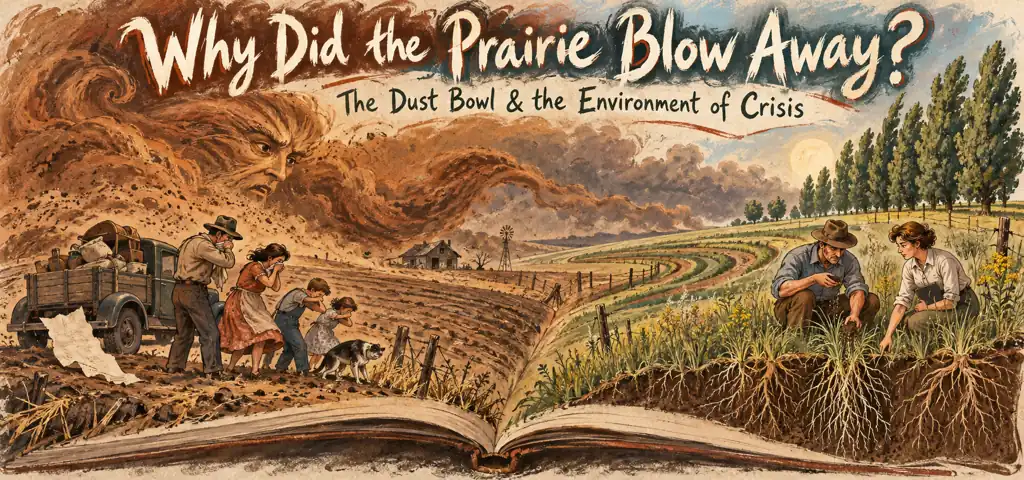
Chapter 9 of the CLEP History of the United States II study guide on Effortless Math covers The Dust Bowl and the Environment of Crisis: the key terms, the core ideas, and worked examples showing how this topic is tested on the exam.
CLEP History of the United States II, Chapter 9
The Dust Bowl joined drought to land use
Severe drought struck the Great Plains during the 1930s. Drought alone did not determine the scale of erosion. Farmers had plowed native grasslands during years of high wheat prices and favorable rainfall, leaving loose topsoil exposed when crops failed. Strong winds lifted soil into "black blizzards." Climate supplied the stress; economic incentives, technology, settlement, and farming practices shaped the vulnerability.
Grass had performed hidden ecological work
Deep-rooted prairie grasses held soil, slowed runoff, stored moisture, and survived variable rainfall. Tractors and combines made it possible to break large areas quickly. When wheat prices collapsed, farmers planted more acreage to maintain income, increasing exposure. A landscape that appeared empty or underused had been providing erosion control. Removing that service turned ordinary wind into a vehicle for regional soil loss.
The southern plains were a core, not the entire drought region
The most famous Dust Bowl counties lay in the Oklahoma and Texas panhandles and adjoining parts of Kansas, Colorado, and New Mexico. Drought affected a broader western and central area. Not every migrant from Oklahoma had lost a farm to dust, and not every Dust Bowl resident moved to California. The label organizes a concentrated ecological disaster without describing all western poverty or migration.
Debt and tenancy converted weather into displacement
Falling crop prices, mortgages, taxes, equipment debts, and landlord decisions determined whether a failed harvest became foreclosure or eviction. Tenant farmers possessed fewer reserves and less control over land management. Banks and landowners consolidated holdings. Environmental crisis therefore operated through property and credit relations. The same dust storm could mean a temporary loss to an owner with savings and permanent removal to a tenant family.
Science changed the diagnosis
Soil scientist Hugh Hammond Bennett argued that erosion was a national problem caused by misuse rather than an unavoidable act of nature. A dramatic 1935 dust storm reached Washington as he testified before Congress. The Soil Conservation Service, renamed and made permanent that year, promoted contour plowing, strip cropping, terracing, shelterbelts, crop rotation, and reseeding. Technical knowledge required incentives and local adoption to change practice.
Conservation districts linked federal expertise to local farms
The federal government encouraged states to create soil-conservation districts through which landowners could plan and receive technical aid. The arrangement aimed to make watershed and erosion measures operate across property lines. Local control could increase cooperation and leave tenants or marginalized farmers with less voice. Institutional design mattered because wind and water did not stop at a deed boundary.
The AAA connected scarcity, income, and conservation
The Agricultural Adjustment Administration paid producers to reduce acreage to raise farm prices. Destruction of crops and livestock while people were hungry drew criticism, and landlords often kept payments while displacing tenants. After the Supreme Court invalidated the original processing-tax system, federal policy used soil-conserving payments and later a revised farm program. Conservation language could serve ecological goals and a constitutionally redesigned income policy at the same time.
Shelterbelts treated wind as a regional problem
The Prairie States Forestry Project planted long belts of trees from the northern plains toward Texas. Trees slowed wind near fields, trapped snow, and reduced erosion. Shelterbelts did not end drought or restore every farm, but they show how federal planning addressed a process larger than one property. Their effectiveness depended on placement, maintenance, and the surrounding land.
The Taylor Grazing Act reversed public-land disposal
Overgrazing damaged remaining federal range across the West. The Taylor Grazing Act of 1934 retained much of the unappropriated public domain in federal ownership, authorized grazing districts, and regulated use through paid permits. This reversed the older assumption that the principal goal was to transfer public land into private homesteads. It did not distribute new free farms or abolish livestock grazing; it made continued use conditional and administratively managed.
Grazing regulation addressed a common-resource incentive
On open public range, each stock owner benefited from adding animals while erosion and depleted forage were shared. Unregulated use encouraged overstocking. Permits, fees, seasons, and carrying-capacity decisions attempted to align individual access with long-run range health. Established ranchers often gained influence over districts, so conservation did not remove power conflicts. The mechanism was controlled access, not simple closure.
Migration became an environmental and labor story
Families leaving the southern plains and nearby states followed Route 66 and other roads toward California. There they encountered low wages, private labor camps, local hostility, and competition for seasonal work. Federal camps administered by the Resettlement Administration and Farm Security Administration offered sanitation and limited self-government. Migration transferred the crisis into western labor and housing markets rather than ending it at the state line.
separate trigger, vulnerability, and response
A prompt lists drought, plowing, mortgages, and contour farming.
The environmental state grew through the crisis
Soil conservation, public range management, tree planting, farm payments, and resettlement expanded federal responsibility for land use. Programs mixed science, relief, production control, and property policy. They reduced some damage and created durable institutions, but benefits and burdens varied among owners, tenants, ranchers, migrants, and Native communities. The Dust Bowl made ecology answerable to public policy while keeping distributional conflict inside conservation.
Watch the history in motion
This short lesson adds voices, images, and chronology to the ideas you just studied.
Video: The Dust Bowl and the Depression, NBC News Learn.
Try four CLEP-style questions
- Why could falling wheat prices increase soil exposure on struggling Plains farms?
- Farmers could plant more acreage to maintain income, breaking additional protective grassland.
- Lower prices increased the cash available for restoring native grass on marginal acreage.
- Railroads charged prohibitive rates on crops grown beyond a family's original acreage.
- Conservation districts based payments on the amount of additional soil a farmer plowed.
- Federal acreage policy required indebted wheat farmers to substitute cotton on newly plowed land.
- Why could conservation districts address erosion more effectively than isolated action by one farmer?
- They eliminated private property throughout a watershed.
- Erosion crossed property lines, requiring coordinated conservation.
- They prohibited agricultural production during dry years.
- They transferred every mortgage to the federal government.
- They confined assistance to urban landowners.
- How were Prairie States shelterbelts intended to reduce erosion?
- By draining groundwater so dry fields could support deeper mechanical plowing
- By replacing private farms with one continuous federally owned forest reserve
- By slowing near-surface winds and trapping moisture and soil around fields
- By preventing rain from reaching cropland during the most damaging seasons
- By raising wheat prices through compulsory destruction of harvested grain
- What did federally administered migrant camps attempt to provide in California?
- Permanent farm ownership for every family arriving from the southern Plains
- A federal wage identical across all agricultural crops and counties
- Immediate transportation back to each migrant's state of legal residence
- Exemption from local health rules and all seasonal employment contracts
- Sanitation and limited self-government amid insecure migrant labor and housing
Check your answers and reasoning
Independent preparation. CLEP is a registered trademark of the College Board, which does not endorse this lesson.

Related to This Article
More math articles
- How to Graph an Equation in Point-Slope Form?
- The Math Adventure: The Quest for Probability and Predictions
- What Kind of Math Is on the HSPT Test?
- Free Grade 4 English Worksheets for Montana Students
- Free Grade 8 English Worksheets for Rhode Island Students
- Unity and Relevance: Every Sentence Earns Its Place
- Free Grade 4 English Worksheets for Kentucky Students
- 6th Grade RISE Math Worksheets: FREE & Printable
- The Best Grade 8 ELA Practice Tests for Washington Students
- Double Consciousness and Intersectionality




















What people say about "The Dust Bowl and the Environment of Crisis"?
No one replied yet.