Hoover, the RFC, and the Bonus Army
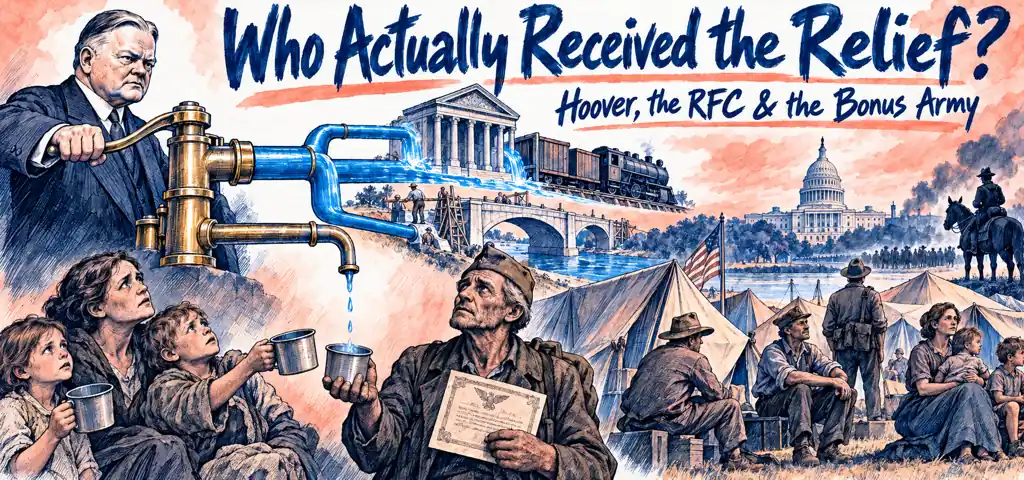
Chapter 9 of the CLEP History of the United States II study guide on Effortless Math covers Hoover, the RFC, and the Bonus Army: the key terms, the core ideas, and worked examples showing how this topic is tested on the exam.
CLEP History of the United States II, Chapter 9
Hoover was an activist constrained by his governing theory
Herbert Hoover had used voluntary coordination energetically as commerce secretary. As president, he rejected both pure inaction and routine federal cash relief to individuals. He believed businesses, states, localities, and charities should act first, with Washington supporting credit and public works. This approach produced more federal intervention than earlier depressions had seen, but it remained indirect when collapsing local revenue demanded direct aid.
Voluntary wage promises weakened under pressure
After the 1929 crash, Hoover asked business leaders to maintain wages and investment and urged labor to avoid strikes. Many firms initially agreed. As sales fell, employers cut hours, jobs, and eventually wages. Voluntary cooperation could slow adjustment but could not make firms sustain payrolls without revenue. The failure exposed the difference between convening actors in a growing economy and overcoming incentives during cumulative contraction.
Public works were too small and slow to fill the gap
Hoover supported accelerated federal construction and projects such as Boulder Dam, later named Hoover Dam. Public works required surveys, authorization, and time, while unemployment grew immediately. State and local governments also cut spending as tax receipts fell. The federal effort increased, but not enough to offset private investment collapse and balanced-budget pressure.
The RFC supplied credit from the top of the system
Congress created the Reconstruction Finance Corporation in 1932. It lent to banks, railroads, insurance companies, and other institutions judged important to the credit structure. Hoover expected strengthened institutions to resume lending and preserve jobs. Critics called the policy relief for bankers because aid did not reach unemployed families directly. The RFC later became a major New Deal and wartime financing instrument, showing that institutional machinery can outlive its original theory.
Credit support and direct relief solve different problems
A solvent bank short of cash may benefit from a federal loan. A household with no job cannot repay one. Hoover resisted grants to individuals partly because he feared dependency, patronage, and weakened local responsibility. The distinction is central: liquidity assistance tries to restore circulation of credit, whereas relief transfers resources to people without current market income. A policy can succeed at the first and remain inadequate to the second.
The Federal Home Loan Bank system aided mortgage lenders
The 1932 Federal Home Loan Bank Act created regional banks to provide liquidity to savings and loan institutions and other mortgage lenders. It did not create the later Federal Housing Administration's mortgage insurance or the 1937 public-housing program. Hoover's measure again worked through institutions. Later New Deal housing programs used different tools to support construction, insure loans, refinance owners, or build public housing.
Emergency legislation widened but did not transform relief
The Emergency Relief and Construction Act of 1932 authorized RFC loans for public works and loans to states for relief. Federal money entered more directly, but as loans rather than general grants. The act acknowledged that local capacity had failed while preserving Hoover's preference for repayable assistance. Timing and scale limited its effect before the election.
Norris-LaGuardia narrowed federal labor injunctions
Hoover signed the Norris-LaGuardia Act in 1932. It restricted federal courts' use of injunctions in nonviolent labor disputes and made yellow-dog contracts unenforceable in federal courts. The statute belongs primarily to labor's legal history, not to Hoover's relief strategy. Its presence in the same presidency cautions against reducing an administration to one policy label.
Veterans demanded early payment of deferred certificates
The Adjusted Compensation Act of 1924 gave eligible World War I veterans certificates generally payable in 1945. Depression made the delay unbearable for many. In 1932 thousands formed the Bonus Expeditionary Force and came to Washington seeking immediate payment. They were asking Congress to accelerate a promised benefit, not to create a new military pension for future service.
The Bonus Army built an organized petitioning community
Veterans and families occupied abandoned buildings and a large camp at Anacostia Flats. Walter Waters helped organize the movement. The House passed an immediate-payment bill, but the Senate rejected it. Many marchers accepted transportation home; others remained. Their camps were disciplined enough to challenge portrayals of the unemployed as disorderly, though officials feared radical infiltration and unrest.
Force turned a policy dispute into political disaster
After clashes during removal from downtown buildings killed two veterans, Hoover ordered the Army to clear federal property but expected it not to pursue marchers across the Anacostia River. General Douglas MacArthur used cavalry, infantry, tear gas, and fire to destroy the main camp. Images of troops attacking veterans and families devastated Hoover politically. Command responsibility and operational excess both matter: the president initiated removal, while MacArthur exceeded the stated geographic limit.
identify the channel of aid
A prompt compares an RFC loan, a state relief loan, and payment of a veteran's certificate.
Hoover's record became the baseline for the New Deal
Hoover expanded public works, credit institutions, mortgage liquidity, and limited state relief lending. He did not provide federal work or cash relief at the scale later associated with Roosevelt. The Depression outran measures designed to preserve institutions until private recovery resumed. Evaluating him requires both comparisons: he moved beyond nineteenth-century precedent and remained far short of the direct federal responsibility voters demanded by 1932.
Watch the history in motion
This short lesson adds voices, images, and chronology to the ideas you just studied.
Video: American Pageant Chapter 32 APUSH Review, Jocz Productions.
Try four CLEP-style questions
- Which Hoover-era housing measure supplied liquidity to mortgage lenders rather than insuring new mortgages?
- The Federal Housing Administration
- Federal Home Loan Banks
- The Home Owners' Loan Corporation
- The Civil Works Administration
- The United States Housing Authority
- Why did voluntary wage maintenance become difficult to sustain after 1929?
- Congress criminalized wage agreements among major firms.
- The Federal Reserve fixed all industrial wages.
- Falling sales pushed individual firms to cut payroll costs.
- Unions required employers to discharge members.
- Tariff law prohibited domestic investment.
- How did the Emergency Relief and Construction Act widen federal involvement without abandoning Hoover's preferred instrument?
- It established a permanent universal cash benefit administered in Washington.
- It financed state relief through federal loans rather than general grants.
- It transferred all city charities into a cabinet-level relief department.
- It required banks to forgive every mortgage held by an unemployed borrower.
- It nationalized railroads and used their profits for local unemployment aid.
- Which interpretation best accounts for the political damage caused by the Bonus Army removal?
- The marchers had already received the payment and then attacked Congress.
- The Senate ordered the Army to protect the Anacostia camp.
- MacArthur refused any military role in the clearance.
- The incident occurred after Roosevelt entered office.
- Force against veterans undermined Hoover's claim of humane order.
Check your answers and reasoning
Independent preparation. CLEP is a registered trademark of the College Board, which does not endorse this lesson.

Related to This Article
More math articles
- Resource Mobilization
- 10 Most Common ParaPro Math Questions
- The Ultimate MCAS Algebra 1 Course (+FREE Worksheets)
- George H. W. Bush, the Persian Gulf War, and the Post-Cold War Order
- Surface Defects, Rust, and Finish Preparation
- New Mexico NM-MSSA Third-Grade Math: 49 Free Printable Worksheets, Chapter by Chapter
- Demography, Urbanization, Community, and Environment
- The Ultimate 7th Grade RICAS Math Course (+FREE Worksheets)
- Nixon’s Domestic Record, New Federalism, and the Southern Strategy
- The Agency’s Math Problem: How to Balance Costs and Revenue on OnlyFans



















What people say about "Hoover, the RFC, and the Bonus Army"?
No one replied yet.