George H. W. Bush, the Persian Gulf War, and the Post-Cold War Order
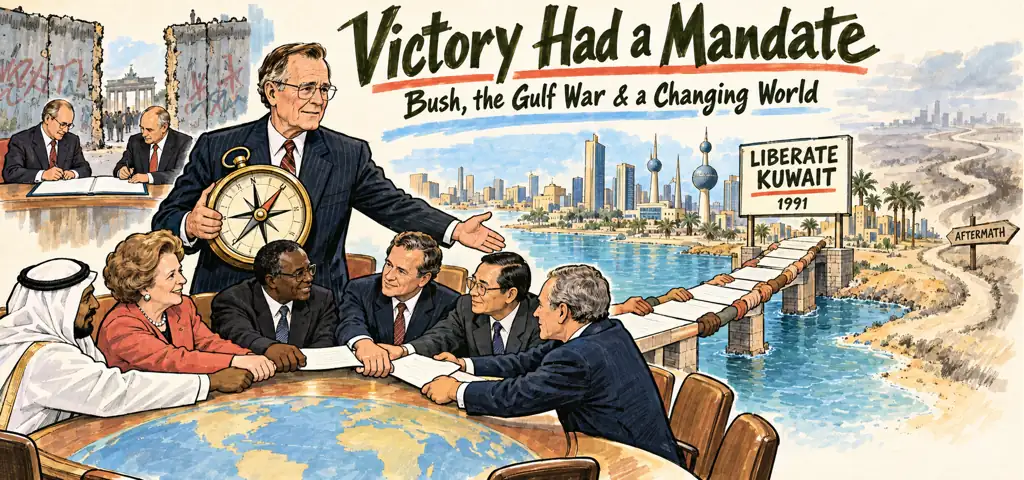
Chapter 16 of the CLEP History of the United States II study guide on Effortless Math covers George H. W. Bush, the Persian Gulf War, and the Post-Cold War Order: the key terms, the core ideas, and worked examples showing how this topic is tested on the exam.
CLEP History of the United States II, Chapter 16
Bush managed the Soviet collapse cautiously
George H. W. Bush entered office as communist governments fell across Eastern Europe. He avoided triumphal rhetoric, supported German reunification within NATO, and worked with Mikhail Gorbachev on arms reductions. The Berlin Wall's opening did not itself dissolve the Soviet Union; internal republican movements, economic crisis, reform, and the failed 1991 coup drove that process.
Panama displayed post-Cold War intervention
In December 1989, American forces invaded Panama, removed Manuel Noriega, and installed the elected government whose victory Noriega had nullified. The administration cited protection of Americans, treaty obligations, democracy, and drug trafficking. Critics challenged sovereignty, civilian casualties, and the breadth of force. The operation was not authorized by a new declaration of war or a United Nations coalition.
Panama and Grenada ended with different treatment of the displaced ruler
American forces captured Noriega and flew him to the United States for trial on drug-trafficking charges. In Grenada in 1983, American intervention removed a revolutionary government after its leaders had killed Prime Minister Maurice Bishop, but it did not bring a comparable foreign ruler to an American criminal trial. Both operations installed friendly political orders; the Noriega prosecution made the Panama case distinct.
Iraq's invasion created a collective-security test
Saddam Hussein's Iraq invaded Kuwait in August 1990. Bush built a multinational coalition and obtained United Nations resolutions, sanctions, and congressional authorization. Operation Desert Shield defended Saudi Arabia; Operation Desert Storm expelled Iraqi forces from Kuwait in 1991. The coalition's stated mandate was liberation of Kuwait, not occupation of Baghdad and regime change.
The war displayed new military and media arrangements
Air power, precision-guided weapons, satellite navigation, and rapid ground maneuver produced a short conventional campaign. The Pentagon used press pools and controlled access, contrasting with the freer but still imperfect reporting associated with Vietnam. Televised briefings highlighted precise strikes while leaving civilian effects and infrastructure damage harder to assess. Victory in a bounded campaign did not prove every future intervention would be quick.
The aftermath exposed the limits of the mandate
Bush encouraged Iraqis to rise but did not send coalition forces to protect Kurdish and Shiite rebellions initially. Iraqi forces crushed uprisings; later no-fly zones protected parts of the population. Sanctions and inspections sought to contain weapons programs. Leaving Saddam in power followed the coalition mandate and fear of occupation, but it created a continuing security problem.
A new world order remained contested
Bush described an order in which aggression met collective response through international institutions. The United States possessed unmatched military power, yet civil war, ethnic cleansing, failed states, and humanitarian crises did not fit a simple interstate model. Somalia, Bosnia, and Rwanda would show the difficulty of choosing when sovereignty, human rights, alliance interests, and domestic support justified action.
Base closings redistributed the peace dividend
The Base Realignment and Closure process closed or reduced installations after the Cold War. National savings and military restructuring imposed concentrated costs on towns dependent on payroll, contracts, and housing demand. Communities converted some bases to civilian uses, but adjustment varied. The same policy could be efficient nationally and disruptive locally.
The Gulf mobilization made the Reserve visible at home
Johnson avoided a large Reserve call-up when he escalated in Vietnam, relying instead on conscription and the active force; a call-up would have made the war's social cost more visible. After the draft ended, planners placed important transport, medical, supply, and other capabilities in the Guard and Reserve so a major operation would require their activation. More than a quarter-million reservists and Guard members were called for the 1990-1991 Gulf crisis. The contrast helps explain why Gulf mobilization reached civilian employers and communities differently from Vietnam-era draft calls.
Arms control survived the end of superpower rivalry
The first Strategic Arms Reduction Treaty, signed in 1991, required deep reductions and verification of deployed strategic weapons. After the Soviet Union dissolved, Russia, Belarus, Kazakhstan, and Ukraine had to address weapons and treaty obligations inherited from one state. Cooperative threat-reduction programs helped secure and dismantle materials. Verification made reductions observable enough to sustain cooperation during political upheaval. The post-Cold War settlement therefore required inspections, finance, and diplomacy as well as declarations that the rivalry had ended.
War powers operated through overlapping forms of authority
Bush first deployed forces to defend Saudi Arabia, then sought and received a January 1991 congressional authorization to use force after United Nations deadlines expired. The vote was not a formal declaration of war, yet it supplied specific statutory support beyond the president's claim of commander-in-chief power. That sequence matters when comparing the Gulf War with Panama or later interventions. International authorization, congressional authorization, and presidential command answer different legal and political questions. A coalition can possess a United Nations mandate without settling domestic constitutional debate, just as a congressional vote does not require every ally to accept the operation.
Fukuyama described an ideological endpoint, not the end of events
In "The End of History?" Francis Fukuyama argued that liberal democracy had outlasted its major ideological competitors as Soviet power receded. He did not claim wars, elections, or political conflict would cease. His thesis concerned the absence of a more compelling universal ideology, a claim soon challenged by nationalism, religion, authoritarian resilience, and later conflict.
The oil shock briefly joined foreign policy to recession politics
Iraq's invasion pushed oil prices upward and weakened consumer confidence while the American economy was already slowing. The 1990-1991 recession also reflected tight credit, overbuilding, and the savings-and-loan crisis; it cannot be reduced to the Gulf emergency alone. By the 1992 election, recovery had begun, but employment and household confidence lagged. Bush's high approval after the war therefore did not guarantee reelection. Voters could approve a bounded military campaign while judging domestic economic management more harshly. This is a useful check against explanations that treat presidential popularity as one permanent score rather than a response to changing issues and time horizons.
measure success against the authorized objective
A coalition liberates an invaded country but leaves the aggressor's regime in place.
Watch the history in motion
This short lesson adds voices, images, and chronology to the ideas you just studied.
Video: George HW Bush and the End of the Cold War: Crash Course US History #44, CrashCourse.
Try four CLEP-style questions
- Why did coalition forces stop short of occupying Baghdad in 1991?
- The coalition understood its authorization to include replacing Iraq's government but lacked a postwar timetable.
- Iraq had offered to leave Kuwait if coalition troops supervised a political transition in Baghdad.
- Congress and the coalition treated economic sanctions as the preferred instrument for removing Saddam Hussein.
- The mandate centered on liberating Kuwait, and occupation threatened coalition unity and high costs.
- United Nations resolutions required disarmament and reparations but also directed coalition troops to install a successor government.
- What did press pools in the Gulf War do?
- They gave selected reporters controlled access rather than unrestricted movement across the battlefield.
- They gave network correspondents independent access while limiting print reporters to Pentagon briefings.
- They allowed reporters to travel with units but left release timing to participating news organizations rather than military review.
- They assigned accredited civilian reporters to military public-affairs units that could direct their published conclusions.
- They replaced battlefield access with daily briefings and military video for the campaign's duration.
- Why could base closure be nationally efficient but locally damaging?
- Property conversion usually required a separate local process, delaying replacement of lost payroll and contracts.
- Federal conversion assistance commonly replaced most lost military employment before a closure took effect.
- Savings were dispersed nationally while job, contract, and property losses concentrated near a base.
- Base towns had generally diversified before closure, so payroll losses were smaller than national savings.
- The process concentrated defense activity at selected installations, spreading both savings and local losses evenly.
- Which statement best describes Bush's handling of German reunification?
- He favored reunification only after a new European security organization replaced NATO.
- He delayed support until Soviet forces had withdrawn and the two German states had formed a loose confederation.
- He accepted a neutral unified Germany as the principal concession needed for Soviet consent.
- He treated continued division as the safer outcome while the Soviet Union remained intact.
- He supported reunification within NATO while negotiating carefully with European and Soviet leaders.
Check your answers and reasoning
Independent preparation. CLEP is a registered trademark of the College Board, which does not endorse this lesson.

Related to This Article
More math articles
- Convert Between Improper Fractions and Mixed Numbers
- FREE ASVAB Math Practice Test
- How to Find the Number of Solutions to a System of Equations by Graphing
- Full-Length Accuplacer Math Practice Test-Answers and Explanations
- CLEP U.S. History I 076: Popular Print, Minstrelsy, and Contested Mass Culture
- Nebraska Algebra 1 Free Worksheets: Printable Algebra 1 Practice, No Login Needed
- The Best Grade 2 Reading Worksheets for Virginia Kids
- Ultimate Guide to Proving Angles Congruent: Techniques and Tips
- Montana MAST Grade 8 Math Free Worksheets: Free Printable PDF Worksheets with Full Solutions
- What Kind of Math Is Used in Medicine?




















What people say about "Bush, the Gulf War and the Post-Cold War Order"?
No one replied yet.