Clinton, NAFTA, Globalization, and the Third Way
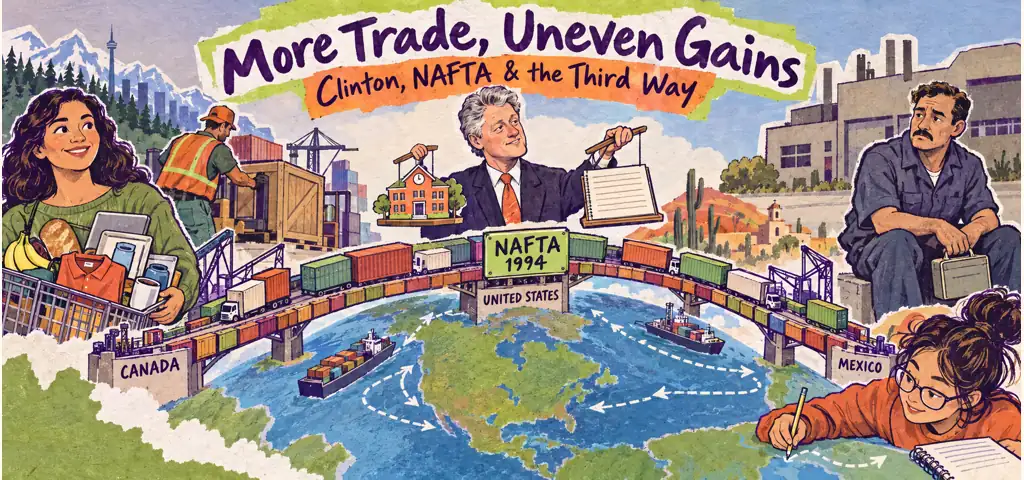
Chapter 16 of the CLEP History of the United States II study guide on Effortless Math covers Clinton, NAFTA, Globalization, and the Third Way: the key terms, the core ideas, and worked examples showing how this topic is tested on the exam.
CLEP History of the United States II, Chapter 16
The 1992 election mixed recession and globalization
Bill Clinton defeated Bush and Ross Perot after a weak recovery, voter concern about deficits, and frustration with established politics. Perot attacked the deficit and predicted a "giant sucking sound" of jobs moving under NAFTA. Clinton presented a New Democrat approach combining public investment, fiscal discipline, market competition, and targeted social policy.
NAFTA changed rules across an existing production region
The 1994 agreement reduced trade barriers among the United States, Canada, and Mexico and created rules for investment and dispute resolution. Supporters expected exports, efficiency, and integrated supply chains; critics feared relocation, wage pressure, and weak labor and environmental enforcement. Trade expanded, but gains and losses differed by industry, skill, region, and household.
Globalization was broader than one treaty
Container shipping, telecommunications, finance, migration, multinational production, China's growth, and the World Trade Organization reorganized markets. Firms could split design, components, assembly, and services across borders. Consumers often gained variety and lower prices, while particular workers and towns bore adjustment costs. An average national gain does not show distribution or bargaining power.
The 1993 budget chose deficit reduction with distributional changes
Clinton's package raised top individual income-tax rates, expanded the Earned Income Tax Credit, and restrained spending. It passed without Republican votes. Combined with growth, later spending bargains, and capital-gains revenue, deficits became surpluses by the end of the decade. The package did not enact a national sales tax or the later welfare law.
The Third Way revised rather than abandoned liberalism
Clinton accepted market tools, deficit reduction, free trade, and some conservative critiques while supporting education, worker training, health reform, and targeted assistance. The failed 1993-1994 health plan showed the difficulty of broad reform. The 1996 welfare law replaced AFDC with TANF, adding time limits and work requirements through block grants. Supporters cited employment; critics cited hardship and vulnerability in recessions.
Public investment emphasized skills and access
The administration expanded the EITC, created AmeriCorps, backed college aid, and signed the Family and Medical Leave Act, guaranteeing eligible workers unpaid job-protected leave. The Motor Voter Act expanded registration opportunities through motor-vehicle and public-assistance offices. These policies relied on tax credits, service, leave rules, or administrative access rather than one universal benefit.
Growth was strong but uneven
Information technology, productivity, low inflation, employment growth, and rising stock values powered the 1990s expansion. Manufacturing communities continued facing import competition and relocation. Offshoring affected production and some services. The boom reduced unemployment and poverty, but wealth gains concentrated among asset owners and the late-1990s technology bubble eventually burst.
Trade politics cut across ordinary party lines
Clinton secured NAFTA with more Republican than Democratic support in Congress, while organized labor and many House Democrats opposed it. Business groups generally favored the agreement; environmental and labor organizations pressed for stronger standards and adjustment aid. That coalition matters because it prevents a misleading party-only explanation. Side agreements on labor and the environment addressed criticism without creating the enforcement many opponents wanted. The central dispute concerned how much national growth, consumer benefit, worker bargaining power, and local disruption should count in judging an integrated market. Later debates over China and offshoring reopened the same distributional questions under different legal arrangements.
Financial policy encouraged integration and also created new exposure
The administration supported freer capital movement and signed the 1999 law that removed barriers separating commercial banking, securities, and insurance affiliations. Supporters argued that diversified firms could compete globally and offer integrated services. Critics warned that scale, complexity, and common ownership could make oversight harder. The decade's emerging-markets crises also showed how quickly investment could enter and leave national economies. These developments were not caused by NAFTA, although they belonged to the same wider turn toward cross-border markets. A careful answer separates trade in goods, foreign production, currency flows, and financial regulation instead of treating globalization as one policy.
Measures of prosperity captured different parts of the boom
Low unemployment, rising productivity, higher median household income, and federal surpluses describe important gains. Stock ownership, capital gains, wage growth, health coverage, and job security were distributed less evenly. The technology sector created firms and occupations while the bubble rewarded projections that later proved unsustainable. A national average can rise even as a manufacturing county loses population or a worker accepts a lower-paid service job. Conversely, a local closure does not prove the entire expansion was fictitious. The strongest historical judgment asks which indicator is being measured, over what dates, and for which population.
separate aggregate gain from local incidence
Trade expands and consumer prices fall while one factory town loses its main employer.
China's market integration altered the scale of the trade debate
Congress granted China permanent normal trade relations in 2000, clearing a major obstacle to its entry into the World Trade Organization. Supporters expected exports, reform, and a rules-based relationship; critics warned that low labor costs, state direction, and weak rights protections would accelerate factory relocation. The resulting import growth affected regions and industries unevenly while American firms and consumers also benefited from supply chains and lower prices. This development was separate from NAFTA even though both became symbols of the same argument over trade, adjustment, and bargaining power.
The Seattle protests joined labor, environmental, and global-justice criticism
Demonstrators disrupted the 1999 WTO ministerial meeting, while delegates also disagreed over agriculture, labor standards, developing-country interests, and negotiating procedure. Organized labor feared job and wage pressure; environmental and human-rights groups questioned rules that privileged commerce; some poorer countries resisted standards they viewed as protectionist. Street conflict drew attention but did not alone cause the talks to fail. Seattle matters because it made the governing rules of globalization visible and revealed that opponents did not share one alternative. Their common claim was that trade policy allocated social costs as well as commercial opportunities.
Watch the history in motion
This short lesson adds voices, images, and chronology to the ideas you just studied.
Video: How GLOBALIZATION Transformed the U.S. Economy [APUSH Review], Heimler's History.
Try four CLEP-style questions
- What made Clinton's Third Way distinct?
- It treated trade liberalization and fiscal restraint as incompatible with targeted social investment.
- It shifted stabilization policy from the Federal Reserve toward state-level balanced-budget rules.
- It returned cash assistance to an open-ended federal entitlement while reducing work requirements.
- It combined market-oriented policies and fiscal discipline with targeted public investment and social protection.
- It relied on courts rather than legislation to redesign welfare, education, and health policy.
- Which conclusion about NAFTA is strongest?
- The treaty limited cross-border supply chains by requiring design and final assembly in one country.
- The agreement sharply reduced North American trade with Europe and Asia through a common external tariff.
- Employment and wage gains followed a similar pattern across American industries and regions.
- Trade and supply chains expanded, while effects differed across consumers, workers, industries, and regions.
- NAFTA coordinated trade rules through a shared currency and a supranational North American legislature.
- What did the 1996 welfare law change?
- It paired a federal employment guarantee with continued cash assistance after time limits expired.
- It replaced AFDC with time-limited TANF block grants emphasizing work.
- It folded Medicaid financing into TANF cash grants administered without eligibility categories.
- It extended Social Security's contributory retirement model to recipients of family assistance.
- It converted cash welfare into a federally administered program with uniform national benefits.
- What did the Family and Medical Leave Act provide to eligible workers?
- Partially paid leave financed through a national payroll contribution
- Retirement credits replacing wages during childbirth or family illness
- Public childcare operated through covered employers and state agencies
- Job protection after leave without regard to employee eligibility or employer size
- Unpaid, job-protected leave for specified family and medical needs
Check your answers and reasoning
Independent preparation. CLEP is a registered trademark of the College Board, which does not endorse this lesson.

Related to This Article
More math articles
- 8th Grade ILEARN Math Worksheets: FREE & Printable
- Half-Angle Identities
- How to Analyze Cross Sections of 3D Solids: A Step-by-Step Guide
- How to Prepare for the PSAT 8/9 Math Test?
- Middle-Range Theory and Evidence
- Question wording
- Free Grade 3 English Worksheets for Washington State Students
- Complete Guide to Inverse Trigonometric Ratios
- Best Calculators for High School Algebra II
- Maryland Algebra 1 Free Worksheets: 65 Free Printable Algebra 1 Worksheets with Worked Answers





















What people say about "Clinton, NAFTA, and the Third Way"?
No one replied yet.