Maryland Algebra 1 Free Worksheets: 65 Free Printable Algebra 1 Worksheets with Worked Answers
Algebra 1 has a reputation for being hard, but the difficulty is rarely where students expect it. The arithmetic underneath is mostly familiar; the new piece is how the ideas connect. A linear equation is not just a thing to solve. It is also a line on a graph, a function in a table, and the answer to a word problem about a phone plan. The work of the year is learning to hear all four of those at once and recognize that they are the same object wearing different clothes.
That is also why the course feels like a turning point. Once a student gets fluent in moving between an equation, a graph, a table, and a real situation, the rest of high school math opens up. Quadratics become readable curves instead of mysterious formulas. Exponential functions feel like a logical extension of multiplication. Systems show up everywhere, in chemistry, economics, even history class. Algebra 1 is the year a student stops doing math problems and starts using math, and the practice that makes that shift stick is small, careful, and consistent.
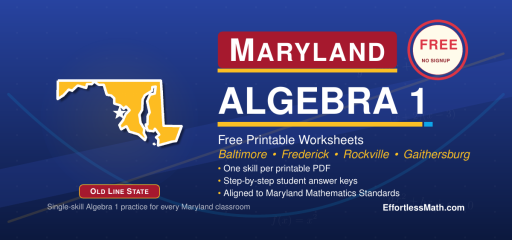
For students in Baltimore, Frederick, Rockville, and Gaithersburg, and in every Maryland district in between, this is what these 65 worksheets exist for. They give a ninth grader one skill at a time, with enough practice to actually own it before moving on.
What’s on this page
Sixty-five single-skill PDFs aligned to the Maryland Algebra 1 standards. Each file is tightly scoped, solving compound inequalities, writing a function rule, factoring a quadratic, and stays inside that single skill from the first problem to the last. Your student will not be sneak-tested on a topic the page never claimed to cover.
Each PDF opens with a one-page Quick Review: the skill defined in plain language, plus one fully worked example showing every step. Then twelve practice problems that walk a student from gentle openers to the kind of harder item a real test will hit them with. The final page is a student-facing answer key with brief, tutoring-style explanations, written so a fourteen-year-old can grade their own page and learn from the mistakes without needing an adult standing over their shoulder.
Foundations of Algebra
This chapter lays the groundwork, moving from numbers to letters and putting properties and order-of-operations to work on real problems. In Baltimore classrooms it tends to separate confident students from hesitant ones.
- Variables, Expressions, and Properties
- Order of Operations and Evaluating Expressions
- Simplifying Algebraic Expressions
- Introduction to Equations and Solutions
- Personal Financial Literacy
Solving Linear Equations
Now the central skill of the course: isolating a variable, from one clean step through multi-step solves and rearranging formulas. Steady practice now makes the Maryland Algebra 1 course feel far more manageable later.
- Solving One-Step Equations
- Solving Two-Step Equations
- Solving Multi-Step Equations
- Equations with Variables on Both Sides
- Literal Equations and Formulas
Inequalities and Absolute Value
Here a single answer becomes a set: solving and graphing inequalities, handling the sign-flip rule, and unpacking absolute value. Master it early and the rest of the Maryland course leans on it with ease.
- Solving One-Step Inequalities
- Solving Multi-Step Inequalities
- Compound Inequalities
- Absolute Value Equations
Relations, Functions, and Sequences
This unit introduces function thinking: notation, inputs and outputs, and the patterns that arithmetic and geometric sequences follow. It’s a frequent early hurdle for learners in Baltimore and across the state.
- Relations and Functions
- Function Notation and Evaluating Functions
- Domain and Range
- Graphing Functions and Transformations
- Arithmetic Sequences as Linear Functions
- Geometric Sequences
- Comparing Functions
- Piecewise Functions
- Combining Functions
- Inverse Functions
Linear Functions and Their Graphs
Linear graphs take focus: slope, intercepts, point-slope and slope-intercept forms, and special line relationships. These worksheets give Maryland students focused, low-pressure practice.
- Slope and Rate of Change
- Slope-Intercept Form
- Point-Slope Form
- Standard Form of a Linear Equation
- Writing Linear Equations from Graphs and Tables
- Parallel and Perpendicular Lines
- Inverse Variation
- Understanding Graphs as Solution Sets
Systems of Equations and Inequalities
Here several equations are solved together, and systems of inequalities mark out whole regions of valid solutions. For Maryland students, fluency here shows up directly on the Maryland Algebra 1 course.
- Solving Systems by Graphing
- Solving Systems by Substitution
- Solving Systems by Elimination
- Applications of Systems of Equations
- Systems of Linear Inequalities
- Solving Linear-Quadratic Systems
Exponents, Polynomials, and Real Numbers
The algebra of powers and polynomials: exponent rules, adding and multiplying polynomials, special products, and real numbers. Getting comfortable here pays off all the way through the Maryland Algebra 1 course.
- Adding and Subtracting Polynomials
- Multiplying Polynomials
- Special Products of Polynomials
- Rational and Irrational Numbers
Factoring
Students learn to rewrite polynomials as products: greatest common factor, trinomial factoring, and recognizable special forms. Time spent here is time saved when the Maryland Algebra 1 course rolls around.
- Greatest Common Factor and GCF Factoring
- Factoring Trinomials: \(x^2 + bx + c\)
- Factoring Trinomials: \(ax^2 + bx + c\)
- Factoring Special Products
Quadratic Functions and Equations
The chapter covers parabolas and three solution paths for quadratics, plus what the discriminant reveals. Across Maryland, this is one of the skills that rewards regular reps.
- Graphing Quadratic Functions
- Characteristics of Quadratic Functions
- Solving Quadratics by Factoring
- Solving Quadratics by Completing the Square
- Solving Quadratics by Square Roots
- The Discriminant
- The Quadratic Formula
Statistics and Probability
Data analysis and probability close out the core, from box plots and histograms to counting principles. It is worth the extra reps for Maryland learners aiming for a strong score on the Maryland Algebra 1 course.
Exponential Functions and Modeling
Here change compounds: exponential growth and decay, their graphs, and comparisons among model families. Baltimore families can use these pages to lock the skill in before it’s tested.
- Graphing Exponential Functions
- Comparing Linear, Quadratic, and Exponential Models
- Exponential Growth
- Interpreting Functions and Parameters
More Topics
- Absolute Value Inequalities
- Direct Variation
- Exponential Decay
- Graphing Cube Root Functions
- Graphing Square Root Functions
How to use these worksheets at home
Aim for two short sittings a week, not one long one. Algebra 1 is a course the brain consolidates between sessions, which means a fifteen-minute page on a Tuesday and another on a Friday will outperform an hour on a Sunday almost every time. Keep the sittings short enough that your student can finish without burning out, and long enough that they get past the warm-up problems and into the harder material near the bottom of the page.
Use the natural pairings between skills. Solving Two-Step Equations should be solid before Solving Multi-Step Equations, once the basic move is automatic, the multi-step version is just more of the same. Slope and Rate of Change comes before Slope-Intercept Form, because slope-intercept is slope with a starting point added on. Factoring Trinomials goes before Solving Quadratics by Factoring; once the factoring is clean, the solving is one short line. Treating the worksheets as a deliberately ordered set, rather than a random pile, is what makes the practice actually compound.
Finally, hand the answer key over. Maryland teenagers are old enough to grade their own work, and the act of catching a mistake, reading the explanation, and trying the problem again from a clean start is where most of the real learning lives. Parents who do the corrections themselves often discover, weeks later, that their student still cannot do the problem alone. Parents who hand over the key and step back usually find the opposite, quiet, steady improvement, and a student who is genuinely more independent by the time geometry begins.
A note about Algebra 1 in Maryland
Maryland does not give a separately named statewide end-of-course test specifically titled “Algebra 1” in every district, but Algebra 1 content is foundational to the high school mathematics assessments Maryland students take as part of the state’s broader testing program. Within the course itself, classroom assessments, unit tests, and district benchmarks are built directly on Maryland’s Algebra 1 standards, a framework closely aligned with the Common Core for high school mathematics.
Because each worksheet here targets a single Maryland standard, the set works well as a running map of the course. After every unit, run through the matching PDFs and you will know in a single sitting which ideas are solid and which still need work. That kind of standard-by-standard review is what turns a vague “math is going okay” into a real, concrete answer, and it is what most reliably keeps a final exam in May from turning into a panic.
A short closing
Algebra 1 is too long a year to be won in any one evening, and too important to ignore for any long stretch of weeks. Bookmark this page, print a single PDF tonight, and let your Maryland student take one careful step. By the time spring comes, the small accumulating habit of one focused page at a time will have done quietly what no cram session ever could.
New to Algebra? Start with the basics


Related to This Article
More math articles
- The Best Grade 6 ELA Practice Tests for Wisconsin Students
- White Counterrevolution, Judicial Retreat, and the Compromise of 1877
- Free Grade 7 English Worksheets for Kansas Students
- OAR Math FREE Sample Practice Questions
- Massachusetts MCAS Grade 8 Math Free Worksheets: Printable PDF Practice with Student-Friendly Keys
- The Best Grade 3 ELA Practice Tests for Massachusetts Students
- The Best Grade 4 Math Book for Washington Students
- Investigations, Variables, and Controls
- The Ultimate 7th Grade STAAR Math Course (+FREE Worksheets)
- Reproduction and Variation











What people say about "Maryland Algebra 1: Free Worksheets"?
No one replied yet.