Polarization, the 1994 Realignment, and Impeachment
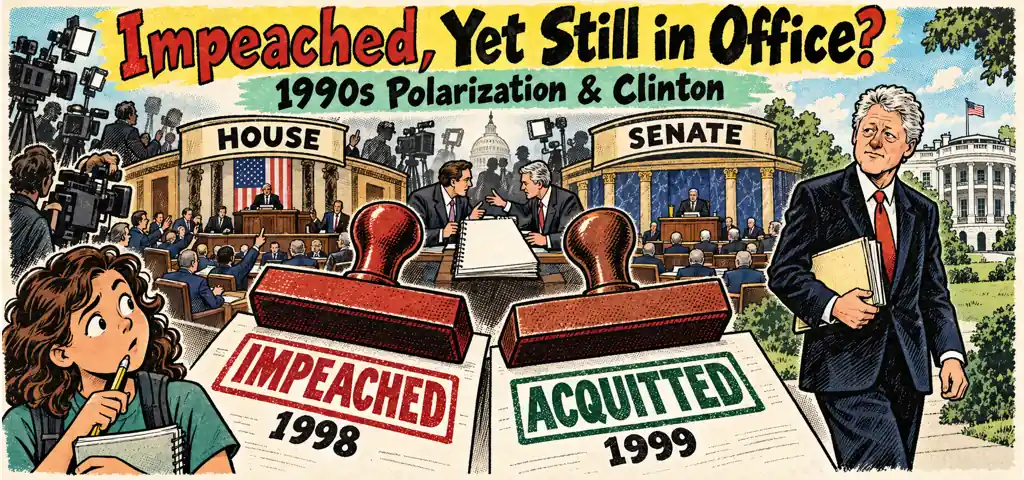
Chapter 16 of the CLEP History of the United States II study guide on Effortless Math covers Polarization, the 1994 Realignment, and Impeachment: the key terms, the core ideas, and worked examples showing how this topic is tested on the exam.
CLEP History of the United States II, Chapter 16
The 1994 election nationalized congressional opposition
Newt Gingrich and House Republicans promoted the Contract with America, promising votes on tax, welfare, crime, term-limit, and procedural measures. Republicans won both houses for the first time in forty years. Redistricting, southern realignment, conservative media, reaction to Clinton, and candidate recruitment mattered. The result was not simply a referendum on one bill.
Divided government produced confrontation and bargains
Clinton and Congress fought over spending, leading to government shutdowns in 1995-1996. Public reaction hurt Republicans, and Clinton defended selected programs while accepting balanced-budget goals. The 1997 agreement cut taxes, restrained spending, and created the Children's Health Insurance Program. Polarization did not prevent every bargain; it raised the political cost and strategic use of conflict.
Crime and guns crossed party lines
The 1994 crime law funded police, prisons, prevention, and a temporary assault-weapons ban while expanding federal crimes and penalties. Many Democrats supported punitive policy amid high crime, while later critics connected it to mass incarceration. The Brady Act required background checks through federal firearms dealers after an interim waiting period. These laws combined public-safety claims with long-term civil-rights and federalism disputes.
Impeachment arose from a civil suit and testimony
Independent counsel Kenneth Starr investigated Clinton's relationship with Monica Lewinsky and statements under oath. The House impeached Clinton in 1998 for perjury and obstruction of justice. The Senate acquitted him in 1999 because neither article received the required two-thirds vote. Impeachment is a House accusation; removal requires Senate conviction. High job approval showed that legal and electoral judgments could diverge.
The line-item veto failed under the Presentment Clause
The Line Item Veto Act let the president cancel selected spending and tax provisions after signing a bill. In Clinton v. City of New York (1998), the Supreme Court held that this procedure effectively allowed the president to amend statutes outside the Constitution's required process of passage by both houses and presentment of the same text. The holding concerned lawmaking procedure, not a general ban on presidential budget proposals or ordinary vetoes.
The 2000 election tested institutions
The presidential result turned on disputed Florida ballots, recount standards, and deadlines. In Bush v. Gore, the Supreme Court held that differing recount standards violated equal protection and stopped the recount under the timing circumstances. The decision effectively secured George W. Bush's victory. It did not establish a general constitutional right to have the national popular-vote winner become president.
Polarization involved sorting as well as ideological movement
Conservative southern Democrats and liberal northeastern Republicans became rarer. Voters increasingly aligned party identity with ideology, religion, race, geography, and culture. Cable news, talk radio, advocacy groups, donor networks, and later digital media reinforced national conflict. Close party competition made procedural control and judicial appointments especially valuable.
Congress changed its own incentives and procedures
The new House majority strengthened party leadership, used national messages to coordinate campaigns, and treated committee assignments and floor scheduling as tools of collective strategy. Fundraising and candidate recruitment increasingly operated through national party networks. Televised conflict also rewarded members who could frame a dispute for a national audience. These changes did not eliminate constituency interests or bipartisan votes, but they made members more accountable to party goals. Institutional organization can therefore intensify polarization even when public opinion on a particular policy remains mixed.
Investigations blurred legal, constitutional, and electoral standards
A criminal inquiry asks whether evidence proves a statutory offense; impeachment asks whether the House considers conduct an impeachable abuse and whether two-thirds of senators will remove. Voters may instead judge policy performance, credibility, or proportionality. Clinton's case moved through all three arenas. Treating acquittal as proof that nothing wrongful occurred, or impeachment as automatic removal, confuses standards that the Constitution deliberately separates.
The independent-counsel system shaped the investigation and its aftermath
Congress had created a mechanism for appointing prosecutors outside ordinary Justice Department supervision after Watergate. Kenneth Starr inherited a financial investigation and later examined Clinton's testimony in the Paula Jones civil case. Supporters argued that insulation reduced conflicts of interest; critics said a prosecutor with a broad mandate could extend an investigation until finding a different offense. The statute expired in 1999 and was not renewed. That institutional outcome differs from the Senate verdict: lawmakers could acquit Clinton yet still conclude that the investigative design needed revision.
Campaign finance and district geography reinforced national conflict
Parties and outside groups raised larger sums, used issue advertising, and targeted a shrinking number of competitive districts and states. Many House seats became safer for one party because of residential sorting, incumbency, and district design, so primary voters could matter more than swing voters. The Bipartisan Campaign Reform Act of 2002 later restricted national-party soft money and certain election-season advertisements, leading to new court disputes and organizational workarounds. Polarization therefore grew through voters, institutions, and strategic adaptation; it was not produced by a single election or media technology.
The Twenty-seventh Amendment delayed congressional pay changes
James Madison proposed the congressional-compensation amendment in 1789, but the states did not complete ratification until 1992. It provides that a law changing congressional pay cannot take effect until after the next House election. The delay lets voters respond before sitting members benefit from their own pay decision. The unusual two-century ratification history is memorable, but the institutional principle is more important: an intervening election separates the lawmakers' vote from the change in compensation.
identify each constitutional stage
The House approves articles, but the Senate vote falls short of two-thirds.
Judicial appointments became a long-term measure of partisan control
Presidents and senators increasingly treated lower-court and Supreme Court nominations as decisions that could shape policy after an election ended. Interest groups publicized nominees' records, while senators used hearings, holds, and confirmation votes to signal positions on abortion, regulation, criminal justice, and executive power. The conflict did not begin in the 1990s, but close party competition made each vacancy more consequential. A judicial appointment is neither ordinary legislation nor an immediate election promise: life tenure converts temporary control of elected institutions into longer influence over legal interpretation.
Census data and district lines linked demography to representation
The decennial census reallocates House seats among states, and states then draw congressional and legislative districts under constitutional and statutory constraints. Population movement toward the South and West shifted seats, while majority-minority districts increased opportunities for minority voters to elect preferred candidates. Litigation asked when race could be considered and when its use became constitutionally excessive. Redistricting could protect incumbents, concentrate voters, or alter competition, but it did not manufacture every ideological change. The evidence requires attention to population, legal rules, map design, and voter behavior together.
Polling and strategic communication changed how leaders read public judgment
Frequent national polls allowed presidents, legislators, parties, and news organizations to track approval by issue and demographic group. Consultants tested messages, scheduled announcements, and targeted narrow audiences through cable programs and direct mail. These tools supplied information but could also reward short-term positioning and make a temporary response appear more precise than it was. A poll result depends on wording, sample, timing, and whether respondents are judging conduct, policy, or party. Clinton's high job approval during impeachment, for example, did not mean respondents believed every statement or rejected every sanction. It showed that many separated job performance from removal.
A balanced-budget era still involved choices about what government financed
The late-1990s surplus grew from economic expansion, tax revenue, spending restraint, and earlier budget decisions. It did not mean the federal government had stopped borrowing for all purposes or that long-term commitments had vanished. Debates turned to debt reduction, Social Security, tax cuts, and public investment. A unified budget figure could also include Social Security surpluses, so competing speakers used different measures. Fiscal evidence is strongest when it specifies year, accounting convention, economic conditions, and whether the question concerns the annual deficit or accumulated public debt.
Watch the history in motion
This short lesson adds voices, images, and chronology to the ideas you just studied.
Video: America in the Post, Cold War World | Chapter 39, The American Pageant (17th), Last Minute Lecture.
Try four CLEP-style questions
- What was the Contract with America?
- A trade agreement that joined congressional approval to a Canadian legislative vote
- A court-approved plan for uniform congressional redistricting after the 1990 census
- A national Republican agenda promising House votes on specified proposals
- A presidential legislative program conditioned on resolution of government shutdowns
- A bipartisan rules agreement limiting committee investigations of the executive branch
- Why did Clinton remain in office after impeachment?
- The independent counsel withdrew the referral before the Senate completed its trial.
- The Supreme Court held that the charged conduct could not support impeachment.
- The House transmitted only a censure resolution after approving articles of impeachment.
- A national election held between impeachment and trial superseded the House vote.
- The Senate did not reach the two-thirds vote required to convict and remove.
- What was the constitutional basis stated in Bush v. Gore?
- Federal law required Congress to administer disputed recounts rather than state election officials.
- Unequal recount standards created an equal-protection problem under the circumstances.
- State legislatures lacked authority to prescribe procedures for choosing presidential electors.
- The national popular-vote result controlled the allocation of disputed electoral votes.
- Due process required recounts to continue beyond the statutory date for selecting electors.
- What best describes partisan sorting?
- Ideology, region, religion, race, and party identity became more consistently aligned.
- The parties retained overlapping coalitions while their congressional voting records converged.
- Southern conservative voters increasingly reinforced the region's older Democratic alignment.
- National media and advocacy networks weakened the connection between issues and party identity.
- Judicial appointments became less politically salient as ideological differences narrowed.
Check your answers and reasoning
Independent preparation. CLEP is a registered trademark of the College Board, which does not endorse this lesson.

Related to This Article
More math articles
- 3rd Grade MEAP Math Worksheets: FREE & Printable
- The Best Grade 3 ELA Practice Tests for Iowa Students
- Free Grade 5 English Worksheets for Idaho Students
- How to Evaluate Logarithm? (+FREE Worksheet!)
- The Best Grade 8 ELA Practice Tests for Mississippi Students
- 8th Grade RICAS Math Worksheets: FREE & Printable
- Best Cheap Laptops for College Students
- Homeschool Math Curriculum: How to Build the Perfect Plan
- Package Integrity and Method Verification
- Choosing Bitcoin Casino Games: Dice, Slots, Live Dealer and What Fits Different Session Goals



















What people say about "Polarization, 1994, and Impeachment"?
No one replied yet.