Calorimetry and Heat: Calculate q and Choose Its Sign
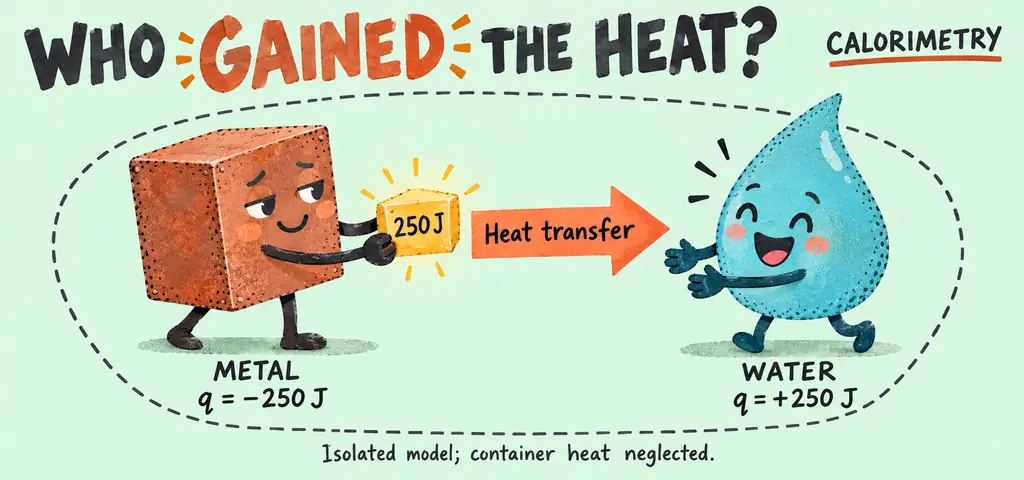
Calorimetry estimates transferred heat from measurable temperature changes and heat capacities. For a sample with no phase change and approximately constant specific heat, heat is calculated from mass, specific heat capacity, and temperature change. Energy accounting connects heat gained by one part of an isolated setup with heat lost by another.
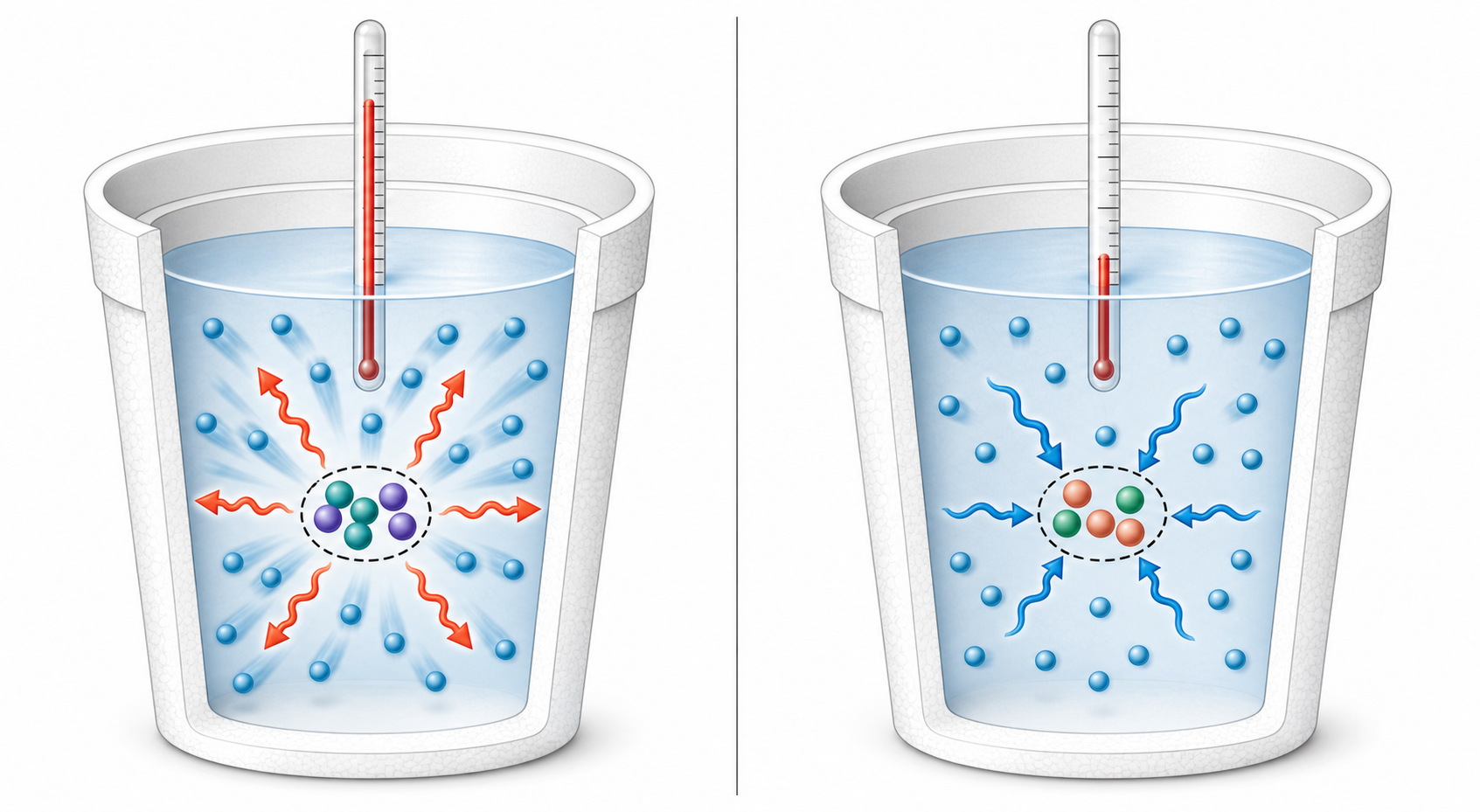
A solution becomes warmer after a reaction begins. The solution gained thermal energy. To describe the reaction’s energy change, you must first decide whether the reaction or the surrounding solution is your system.
What do the terms in the heat equation mean?
Use
Here \(m\) is mass, \(c\) is specific heat capacity, and \(\Delta T\) is final temperature minus initial temperature. Choose units that cancel to the desired energy unit. If mass is in grams and \(c\) is in joules per gram per degree Celsius, the heat is in joules.
A Celsius temperature difference has the same numerical size as a kelvin temperature difference. This does not make Celsius and kelvin absolute temperatures interchangeable in gas laws.
Worked example: follow the heat
A 50.0 g water sample warms from 20.0 to 25.0 degrees Celsius. Use \(c=4.184\,\mathrm{J/(g\,^{\circ}C)}\) and assume no phase change:
The reported heat has two significant figures because the temperature change has two. It is positive for the water, which gained heat. If the reaction supplied all that heat and other heat transfers are negligible, the reaction’s heat is approximately negative one kilojoule.
Which assumptions can affect the result?
A simple calculation may neglect heat absorbed by the cup, thermometer, and air. A more complete model includes their heat capacities or a calibrated calorimeter constant. Heat loss during transfer can also change the measured final temperature.
The equation for sensible heating does not describe a phase change by itself. During melting or boiling, energy can change phase while the temperature remains approximately constant under fixed conditions.
How should you handle signs?
- Name the system.
- Compute final minus initial temperature for the measured sample.
- Calculate that sample’s heat.
- Use the energy balance to relate it to the other parts of the setup.
- State which heat transfers were neglected.
Exothermic means the specified system releases heat. Endothermic means it absorbs heat. A warm thermometer reading must be connected to the system definition before either label is assigned.
Can you apply the idea?
-
A sample cools from 30.0 to 24.0 degrees Celsius. Find its temperature change.
Check your answer
-6.0 degrees Celsius.
-
For a positive mass and specific heat, what sign does q have when the sample warms?
Check your answer
Positive: the sample gains heat.
-
What happens to calculated heat if mass doubles while specific heat and temperature change stay fixed?
Check your answer
It doubles.
-
Why might neglecting the cup underestimate the heat released by a reaction?
Check your answer
Some released heat warms the cup as well as the measured solution.
-
Can q = mcΔT alone calculate the heat needed to melt a sample at its melting point?
Check your answer
No. A phase-change energy term is needed.
-
If an isolated hot metal-water system has q for water = +250 J and negligible container heat, what is q for the metal?
Check your answer
-250 J, from energy conservation.
Watch the idea explained
Calorimetry: Crash Course Chemistry #19, CrashCourse.
This selected excerpt runs from 2:30 to 3:07. Hess law: enthalpy change depends on initial and final states.
Where does this fit?
Use the chemistry learning hub to choose a lesson or practice test. Connect this topic with stoichiometry and limiting reactants, reaction rates, reaction types and redox, chemical equilibrium.
Sources for Further Study
OpenStax Chemistry 2e explains heat, specific heat capacity, and temperature change and calorimetry calculations and system–surroundings energy balances.
Continue with a chemistry study guide


Related to This Article
More math articles
- Free Grade 4 English Worksheets for Smarter Balanced Students
- How to Prepare for the Next-Generation ACCUPLACER Math Test?
- How Sudoku Helps Improve Logical Thinking and Mathematical Reasoning
- The Ultimate ILTS Elementary Education Math (Grades 1–6) (305) Course
- The Best Grade 3 ELA Practice Tests for Arkansas Students
- With two shifts, separate what is certain
- Group Types, Boundaries, Dyads, and Triads
- AP Cybersecurity Network Segmentation: Explain the Security Benefit (2027 Prep)
- Individual contributions
- Using Properties to Convert Traditional and Metric Units










What people say about "Calorimetry and Heat: Calculate q and Choose Its Sign"?
No one replied yet.