Reaction Types and Redox: Oxidation, Reduction and Agents
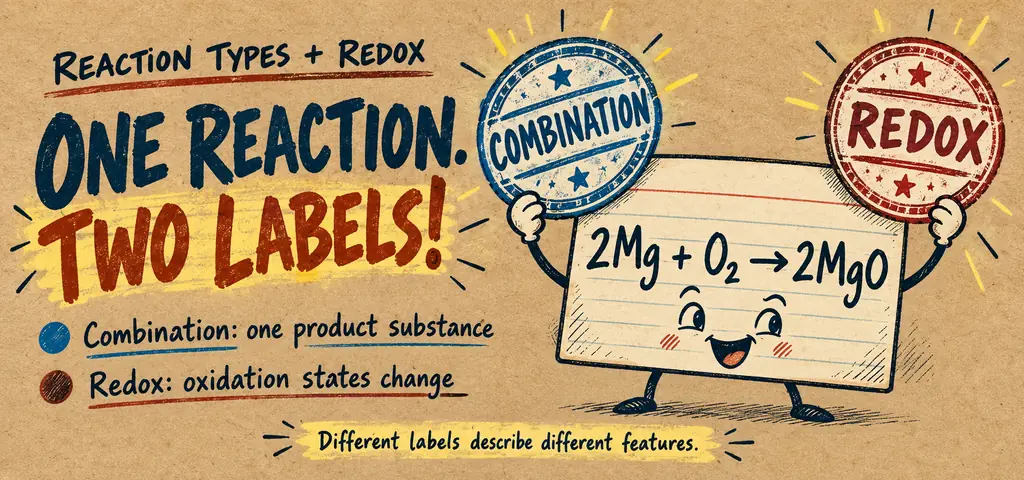
Reaction classifications highlight different features of chemical change. Combination and decomposition describe reactant-product patterns. Precipitation identifies formation of an insoluble solid from solution. Acid-base reactions involve acid-base behavior. Redox reactions involve oxidation-state changes, with oxidation and reduction occurring together as electrons are transferred or redistributed.
A reaction can fit more than one useful description. Magnesium burning is a combination reaction and a redox reaction. One label describes the formula pattern, while the other tracks changes in electron accounting.
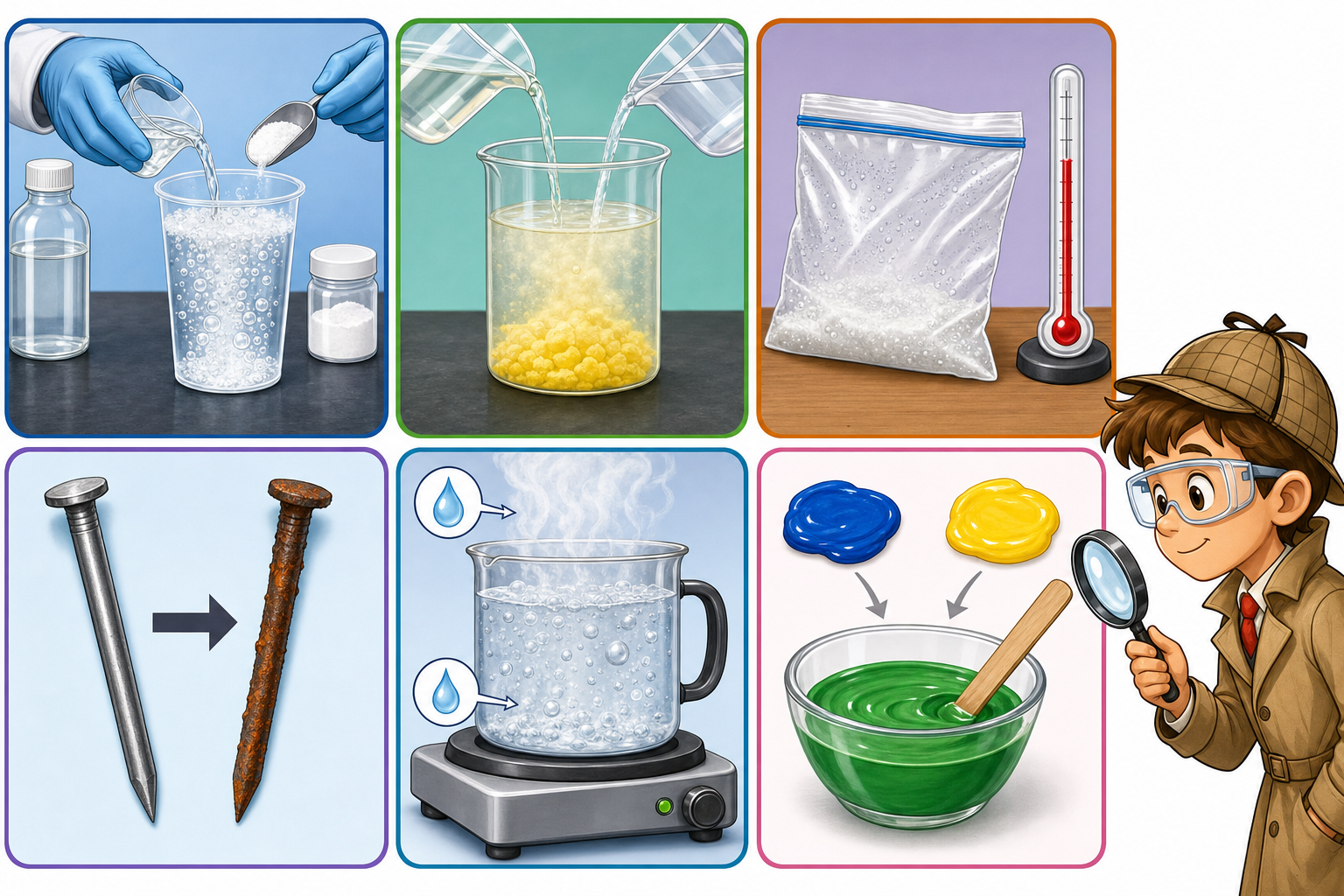
Which patterns are useful to recognize?
| Pattern | What to look for |
|---|---|
| Combination | Reactants form one product substance. |
| Decomposition | One reactant forms multiple product substances. |
| Precipitation | Dissolved ions form a solid. |
| Redox | At least one oxidation state rises and another falls. |
Do not choose a label from a visible effect alone. Bubbles can come from boiling, and a color change can have several causes. Use the identities of the substances and the equation.
Worked example: identify oxidation and reduction
Consider
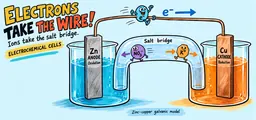
Zinc changes from oxidation state 0 to +2. It is oxidized, corresponding to loss of two electrons. Copper changes from +2 to 0. It is reduced, corresponding to gain of two electrons.
The two electrons cancel when the half-reactions are added. Zinc is the reducing agent because it supplies electrons and reduces copper ions. The copper ions are the oxidizing agent.
How are oxidation states assigned?
An element in its uncombined form has oxidation state zero. A monatomic ion has an oxidation state equal to its charge. The sum of oxidation states equals the total charge of the species.
Oxygen is assigned -2 in many familiar compounds, but peroxides and some other compounds are exceptions. Hydrogen is assigned +1 in many compounds and -1 in metal hydrides. Check the applicable rules instead of treating these common values as universal.
How do you avoid reversing the agent labels?
- Assign oxidation states before and after reaction.
- Find the species whose oxidation state rises: it is oxidized.
- Find the species whose oxidation state falls: it is reduced.
- Name each agent by what it causes the other species to do.
The reducing agent is itself oxidized. The oxidizing agent is itself reduced. Keeping the half-reactions visible helps anchor those names.
Can you apply the idea?
-
What oxidation state does elemental oxygen have?
Check your answer
Zero, including oxygen in an oxygen molecule.
-
What is the oxidation state of \(\mathrm{Na}^{+}\)?
Check your answer
+1, equal to its monatomic ion charge.
-
An atom changes from oxidation state +2 to +3. Is it oxidized or reduced?
Check your answer
Oxidized. Its oxidation state rises.
-
Does an oxidizing agent gain or lose electrons in electron-transfer accounting?
Check your answer
It gains electrons and is reduced.
-
Can one reaction be both combination and redox?
Check your answer
Yes. The classifications describe different aspects of the same reaction.
-
Why must electrons cancel when redox half-reactions are combined?
Check your answer
The electrons lost by the oxidized species must equal the electrons gained by the reduced species.
Watch the idea explained
Redox Reactions: Crash Course Chemistry #10, CrashCourse.
This selected excerpt runs from 3:06 to 4:00. Oxidation states as electron bookkeeping, with covalent sharing distinguished from formal assignment.
Where does this fit?
Use the chemistry learning hub to choose a lesson or practice test. Connect this topic with balancing chemical equations, stoichiometry and limiting reactants, empirical and molecular formulas, calorimetry and heat.
Sources for Further Study
OpenStax Chemistry 2e explains reaction classification, oxidation states, and oxidizing and reducing agents.
Continue with a chemistry study guide

Related to This Article
More math articles
- Algebra Puzzle – Challenge 48
- Grade 2 English Worksheets for Hawaii Students — Free PDFs
- The Best Grade 5 ELA Practice Tests for Kentucky Students
- How to Solve Permutations and Combinations? (+FREE Worksheet!)
- 5 Tips to Help You Learn Math Faster
- The Best Grade 4 Math Book for Connecticut Students
- Nutrients and Digestion
- The Application of The Squeeze Theorem: Limit Problems Made Easy
- What is the Highest ASVAB Score?
- The Ultimate 6th Grade OST Math Course (+FREE Worksheets)


What people say about "Reaction Types and Redox: Oxidation, Reduction and Agents"?
No one replied yet.