Balancing Chemical Equations: Coefficients and Conservation
A reaction equation must account for every atom. When you balance it, adjust how many units of each substance take part. Changing a formula’s subscripts would change the substance itself.
A balanced chemical equation uses coefficients to give equal numbers of each element’s atoms on the reactant and product sides. For ionic equations, total charge must also balance. The coefficients express relative numbers of particles or amounts in moles. They do not directly express equal masses or reaction speed.
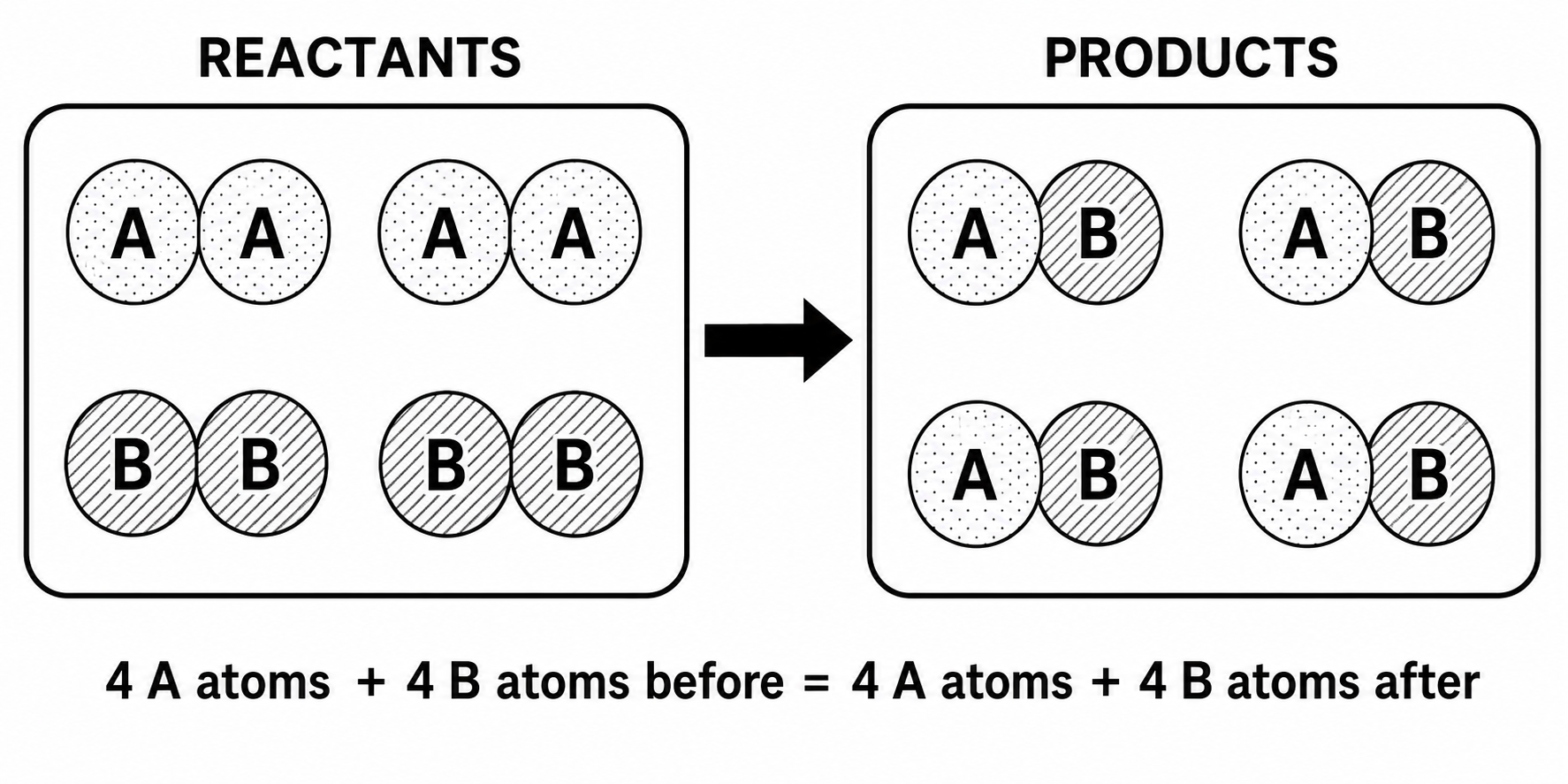
What can you change while balancing?
In \(\mathrm{H_2+O_2\rightarrow H_2O}\), the formulas identify hydrogen, oxygen, and water. Keep them fixed. Coefficients multiply the entire formula: \(2\mathrm{H_2O}\) represents four hydrogen atoms and two oxygen atoms.
Writing \(\mathrm{H_2O_2}\) would describe hydrogen peroxide instead of water. It would solve a different chemical problem.
Worked example: balance propane combustion
For complete combustion of propane, start with
\[ \mathrm{C_3H_8+O_2\rightarrow CO_2+H_2O}. \]
Three carbon atoms require three carbon dioxide molecules. Eight hydrogen atoms require four water molecules. Those products contain ten oxygen atoms altogether, requiring five oxygen molecules:
\[ \mathrm{C_3H_8+5O_2\rightarrow3CO_2+4H_2O}. \]
Check carbon, hydrogen, and oxygen independently. The counts are 3, 8, and 10 on both sides.
What do the coefficients tell you?
The equation says one mole of propane reacts with five moles of oxygen to form three moles of carbon dioxide and four moles of water when combustion is complete. These are mole ratios. One gram of propane does not react with five grams of oxygen.
State symbols provide another kind of information: (s) means solid, (l) liquid, (g) gas, and (aq) dissolved in water. They can be essential when deciding which ions participate in an aqueous reaction.
How can you check an unfamiliar equation?
- Write chemically correct formulas for the stated substances.
- Count atoms of each element on both sides.
- Adjust coefficients and recount after each change.
- Reduce coefficients to the smallest whole-number ratio when requested.
- For an ionic equation, verify the total charge too.
A balanced equation accounts for atoms and charge. Additional evidence is needed to establish whether the proposed reaction occurs under the conditions given.
Can you apply the idea?
-
Balance \(\mathrm{H_2+O_2\rightarrow H_2O}\).
Check your answer
\(\mathrm{2H_2+O_2\rightarrow2H_2O}\).
-
Balance \(\mathrm{N_2+H_2\rightarrow NH_3}\).
Check your answer
\(\mathrm{N_2+3H_2\rightarrow2NH_3}\).
-
How many oxygen atoms does \(3\mathrm{CO_2}\) represent?
Check your answer
Six. The coefficient multiplies the two oxygens in each molecule.
-
Why must subscripts stay fixed during balancing?
Check your answer
They specify chemical composition. Changing them changes the substance.
-
What does (aq) mean?
Check your answer
The substance is dissolved in water. It does not mean the substance is a pure liquid.
-
Does balancing alone show that a reaction is fast?
Check your answer
No. It supplies stoichiometric relationships, not a reaction rate.
Watch the idea explained
Introduction to Balancing Chemical Equations, Tyler DeWitt.
Where does this fit?
Use the chemistry learning hub to choose a lesson or practice test. Connect this topic with empirical and molecular formulas, reaction types and redox, the mole and molar mass, stoichiometry and limiting reactants.
Continue with a chemistry study guide

Related to This Article
More math articles
- Contrast, Cause, and Effect Clues
- Number Properties Puzzle – Challenge 21
- How to Find the Measures of Central Tendency? (+FREE Worksheet!)
- How to Mastering Rational Expressions: A Comprehensive Guide to Multiplication and Division Techniques
- Cutting Wordiness and Fixing Order
- How to Scale a Function Horizontally?
- How to Get ALEKS Done Fast?
- Advanced Vocabulary Words: Gauche to Illustrious
- Maclaurin Series Fundamentals: Efficient Approximations for Common Functions
- Changes produce marginal values





















What people say about "Balancing Chemical Equations: Examples and Practice"?
No one replied yet.