Stoichiometry and Limiting Reactants: Calculate Yield
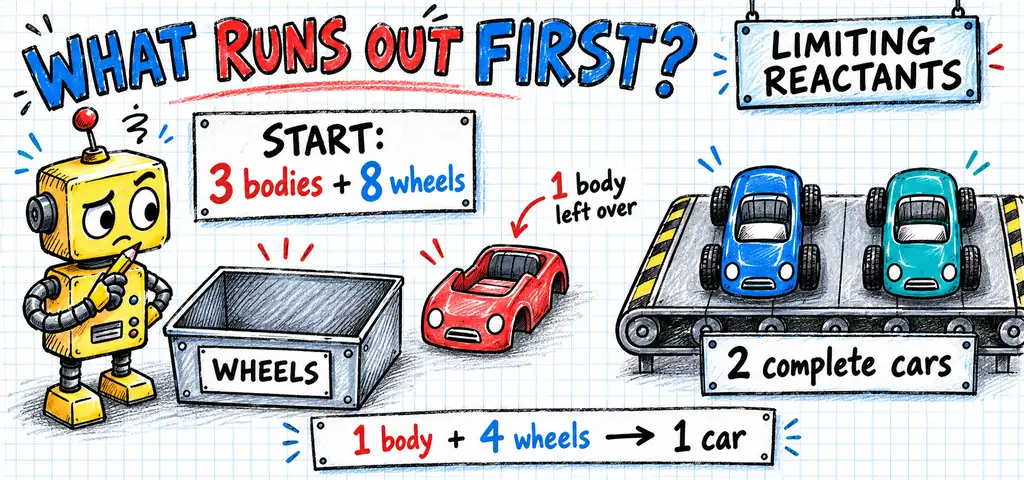
Stoichiometry uses a balanced chemical equation to relate amounts of reactants and products. The limiting reactant permits the smallest theoretical product amount under the stated reaction model. Theoretical yield is that calculated maximum. Percent yield compares the measured amount of desired product with the theoretical yield on the same basis.
A reaction can stop producing product while one reactant remains. The limiting reactant determines the maximum amount of product. Comparing the starting masses alone will not identify it, because the equation requires specific mole ratios.
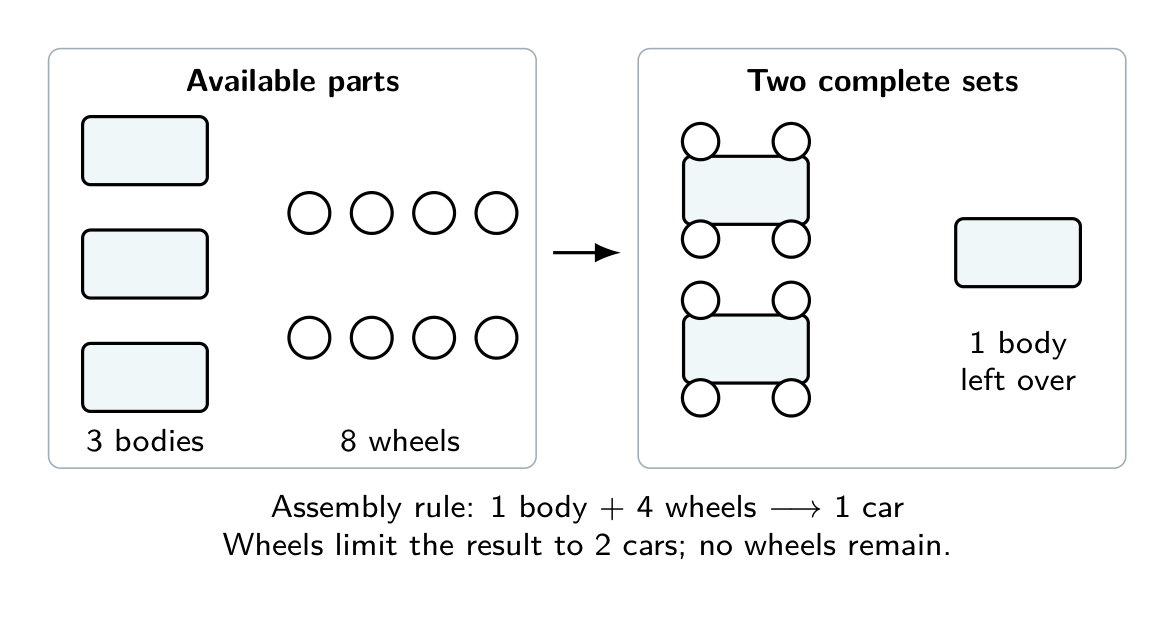
Which ratio comes from the equation?
For
one mole of nitrogen requires three moles of hydrogen and can form two moles of ammonia. Convert any starting masses into moles before applying those ratios.
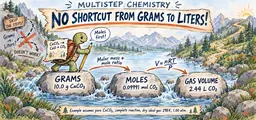
A useful path is mass of starting substance, moles of that substance, moles of product, then mass of product. Write each unit so you can see the cancellations.
Worked example: which reactant limits?
Suppose 2.00 mol of nitrogen and 3.00 mol of hydrogen are available. Assume the stated reaction proceeds to the stoichiometric limit, with no competing reactions.
Nitrogen could support
Hydrogen could support
Hydrogen limits the product to 2.00 mol of ammonia. That consumes 1.00 mol of nitrogen, leaving 1.00 mol of nitrogen. Real ammonia production is equilibrium-limited, so this calculation is an ideal stoichiometric maximum.
How do you calculate percent yield?
If a different reaction has a theoretical yield of 12.5 g and gives 10.0 g of dry, purified product, then
A value above 100% suggests that the measured mass may include solvent or impurities, or that the calculation or measurements need checking. It does not mean extra atoms were created.
What should the final check include?
- Confirm the equation is balanced.
- Calculate the same product amount from every potentially limiting reactant.
- Use the smallest supported product amount.
- Calculate leftovers from the amount actually consumed.
- Keep actual and theoretical yields separate.
Can you apply the idea?
-
Can the reactant with the smallest mass be assumed to limit?
Check your answer
No. Compare available amounts using the balanced mole ratios.
-
For \(\mathrm{2H_2+O_2\rightarrow2H_2O}\), how much water can 1.00 mol of oxygen support with excess hydrogen?
Check your answer
\(2.00\,\mathrm{mol}\) of water.
-
In the ammonia example, why is nitrogen in excess?
Check your answer
Only 1.00 of the available 2.00 mol is needed to react with all 3.00 mol of hydrogen.
-
A theoretical yield is 20.0 g and actual yield is 15.0 g. Find percent yield.
Check your answer
75.0%, from actual divided by theoretical times 100%.
-
Why should product be dry before a mass-based yield is interpreted?
Check your answer
Retained solvent adds mass that does not belong to the desired product.
-
What does theoretical yield assume about competing reactions?
Check your answer
The calculation attributes the limiting reactant to the stated product-forming reaction. Side reactions can reduce the actual desired yield.
Watch the idea explained
Introduction to Limiting Reactant and Excess Reactant, Tyler DeWitt.
Where does this fit?
Use the chemistry learning hub to choose a lesson or practice test. Connect this topic with reaction types and redox, calorimetry and heat, balancing chemical equations, reaction rates.
Sources for Further Study
OpenStax Chemistry 2e explains balanced-equation mole ratios and mass conversions and limiting reactants, theoretical yield, and percent yield.
Continue with a chemistry study guide

Related to This Article
More math articles
- DC CAPE Grade 7 Math Worksheets: 95 Free Printable PDFs with Step-by-Step Answer Keys
- Patient-Care Equipment Basics
- TOEFL Speaking Practice: Match Your Routine to the Current Tasks (2027 Prep)
- How Presidential Power Has Expanded
- Best Noise-Cancelling Headphones for Online Teaching
- How to Find Rational and Irrational Numbers?
- Grade 7 Vocabulary and Word Study: Roots, Context Clues, and Academic Language That Sticks
- Lightning Roulette’s 500x Multipliers Don’t Help the Math
- District of Columbia DC CAPE Grade 3 Math at Home — 49 Free Single-Skill PDF Worksheets
- The Ultimate GED Math Course [Updated for 2026]



What people say about "Stoichiometry and Limiting Reactants: Calculate Yield"?
No one replied yet.