Lightning Roulette’s 500x Multipliers Don’t Help the Math
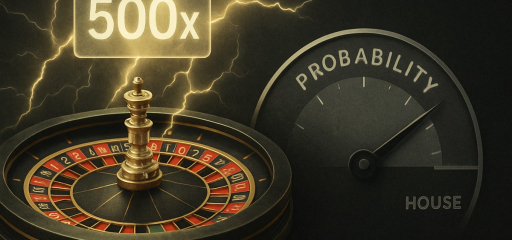
Lightning Roulette looks like roulette’s flashy cousin who showed up to the family reunion with a light show and a smoke machine. Numbers get zapped by glowing bolts, multipliers up to 500x land on the felt, and the host keeps reminding you that any spin could pay 500 times your bet. I’ve watched friends play it for the first time and walk away convinced they’d found a smarter version of the wheel. They hadn’t. The math underneath is the same European wheel you’ve always played, just rearranged so the wins feel bigger and the losses pile up a bit faster on the straight-ups that don’t get struck.
What Lightning Roulette Actually Changes
Evolution Gaming’s Lightning Roulette runs on a standard European single-zero wheel, 37 pockets, numbers 0 through 36. So far, nothing unusual. The twist comes after betting closes and before the ball drops: somewhere between 1 and 5 numbers get “struck” by lightning and assigned a random multiplier of 50x, 100x, 150x, 200x, 250x, 300x, 400x, or 500x.
Here’s the catch that most players miss. Straight-up bets on Lightning Roulette pay 29 to 1, not the 35 to 1 you’d get on a regular European table. You only collect the giant multiplier if your number got struck and the ball lands on it. Otherwise, your straight-up win pays the diminished 29x.
The multipliers aren’t a gift from Evolution. They’re funded by chopping six units off every straight-up payout. The house didn’t add value. It just moved value around.
The RTP Numbers Side by Side
Both games share the same single-zero wheel and the same 2.70% house edge on straight-up bets. The published RTP is 97.30% on both, and that’s not a coincidence. It’s the entire point. Lightning Roulette redistributes the existing 97.30% rather than adding fresh money to the pot.
| Feature | European Roulette | Lightning Roulette |
|---|---|---|
| Wheel | Single zero (37 pockets) | Single zero (37 pockets) |
| Straight-up base payout | 35 to 1 | 29 to 1 |
| Multipliers | None | 50x, 100x, 150x, 200x, 250x, 300x, 400x, 500x |
| Struck numbers per spin | , | 1 to 5 |
| Straight-up RTP | 97.30% | 97.30% |
| House edge | 2.70% | 2.70% |
| Outside bet RTP (red/black, odd/even) | 97.30% | 97.30% (no multiplier eligibility) |
| Variance on straight-up | Moderate | Much higher |
Working the Math on a $1 Straight-Up
Let’s bet a single dollar on number 17 and walk through the expected return. P(17 hits) = 1/37, the same as any roulette wheel. The Wizard of Odds breakdown of Lightning Roulette (see wizardofodds.com/games/lightning-roulette) gives the probability weights for each multiplier and for the “not struck” case, and the arithmetic shakes out cleanly.
When 17 isn’t a struck number, by far the most common outcome, and the ball lands there anyway, you collect 29x your bet. When 17 is struck, you collect whatever multiplier got assigned to it: anywhere from 50x to 500x. Average it out across the multiplier distribution Evolution publishes, and the expected payout when you hit a lightning-struck number lands around 130-ish times your stake, weighted by how often each multiplier shows up.
Run the full expectation:
E[return per $1] = P(hit) × E[payout | hit] = (1/37) × ~36.0 ≈ 0.973.
That’s 97.30%. Exactly the European wheel’s RTP. The flashy multiplier didn’t move the long-run number by a single basis point. It just chopped a tall, narrow probability spike into a wider, jaggeder one.
Why the Multipliers Feel Like a Bonus
I’ll be honest, I get the appeal. When a 500x bolt lands on your number, you’re not thinking about expected value. You’re thinking about the $500 that just appeared from a $1 bet. The brain doesn’t average across thousands of spins. It anchors on the spike.
And that’s the whole product design. Lightning Roulette is engineered to make the wins look enormous and the losses look ordinary. The 29-to-1 base payout is the price of admission to the multiplier lottery. You pay it on every non-struck win, whether you notice or not. Most players don’t, because losing 6 units of payout on a win you weren’t expecting anyway doesn’t feel like a loss. It feels like winning less than the regular table would’ve paid, which is exactly what it is.
There’s something almost magician-like about the misdirection. The light show points your eye at the 500x corner while the 29-versus-35 swap happens in plain sight on every other straight-up win.
Variance: The Real Difference
Same RTP, very different ride. That’s the honest summary. Here’s what changes when you switch from European to Lightning:
- Most straight-up wins pay 29x instead of 35x, a 17% reduction on the typical winning spin.
- A small fraction of straight-up wins pay 50x to 500x, anywhere from 43% more to 1,329% more than the standard payout.
- Your bankroll swings get larger in both directions, even though the long-run drain is identical.
- To survive the longer dry spells between big hits, you need more cushion. Same edge, wider distribution.
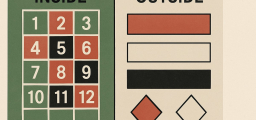
- Outside bets (red/black, odd/even, dozens, columns) are not eligible for multipliers, and they still pay the standard 1:1 or 2:1. Same RTP as European, but no compensating fireworks.
If you’re a small-stakes player chasing a moonshot, the higher variance might be exactly what you want. You’d rather have a tiny shot at $500 than a slightly better shot at $35. If you’re trying to grind out playing time on a modest bankroll, Lightning is the wrong table. The bigger swings will bust you faster on average, even though the edge is the same.
The Outside-Bet Trap
This is the part that bugs me. Outside bets on Lightning Roulette pay exactly what they pay on European, red/black at 1:1, dozens at 2:1, and so on. No multipliers, no bolts, no nothing. You’re playing a normal European table at that point, and the table minimum on Lightning is usually higher than on a regular European stream.
So if you’re betting red/black on Lightning, you’re paying a higher minimum for the privilege of sitting at a flashier table that offers you literally nothing extra on your bet type. Same math, fewer chips in your stack at the end. I’ve seen players park themselves on red/black at Lightning tables for hours, convinced the “atmosphere” was somehow different. The atmosphere is different. The math is European roulette at a markup on table minimums.
Lightning is a straight-up game. If you’re not betting straight-ups (or splits and corners, which also get multiplier eligibility at scaled-down payouts), there’s no reason to play it over a cheaper European stream.
What the Multipliers Actually Cost You Per Spin
Here’s a way to think about it that I haven’t seen explained well anywhere. Imagine 37 players each cover one number with a $1 straight-up. On a European wheel, the winner gets $35 and the other 36 lose $1, house collects $1 per spin out of $37 wagered, which is the 2.70% edge.
On Lightning, all 37 still lose $1 each except the winner. The winner gets paid either 29x (if their number wasn’t struck) or some multiplier between 50x and 500x (if it was). Average those payouts weighted by how often each happens, and the math has to come out to $36 for the wheel to maintain a 97.30% RTP, which it does, almost exactly. The “almost” is the rounding Evolution uses on its multiplier weights, and the discrepancy is small enough that the published RTP rounds cleanly to 97.30%.
The mechanism is just probability laundering. Same dollars in, same dollars out on average, different shape on the way back. Licensing bodies like the UK Gambling Commission (gamblingcommission.gov.uk) require operators to publish accurate RTPs, and Evolution’s numbers match the theoretical RTPs. There’s no scam here, just a re-skinning that exploits how humans evaluate variance.
If you want to brush up on how house edge and expected value actually behave over long sessions, the math curriculum at Effortless Math has clean explainers on probability and expectation that translate directly to game analysis.
Should You Play It?
If you enjoy the show, sure. It’s a legitimately fun product and Evolution’s hosts are good at their job. Just don’t tell yourself the multipliers are giving you anything the regular wheel doesn’t. They’re trading boring 35x wins for occasional huge ones funded by trimming the boring wins.
My personal take after watching a lot of streams and playing a fair amount myself: Lightning is a recreational variance product, not a smarter version of roulette. If you’re betting straight-ups for entertainment and the lightning bolts make the session more fun, great. If you’re betting outside bets on a Lightning table, you’re paying inflated minimums for cosmetics. And if you’re betting straight-ups with any expectation of a long-run edge over standard European. There isn’t one. The wheel has the same zero, the math has the same edge, and the bolts are just a louder way to lose at the same rate.
FAQ
Is Lightning Roulette rigged?
No. It’s a regulated Evolution Gaming product on a real European wheel. The straight-up RTP is 97.30%, matching the underlying probability of any single-zero roulette table. Licensed operators are audited by gambling commissions in the jurisdictions they serve.
Does the 500x multiplier mean I can win more on Lightning than on regular roulette?
On any single hit, yes, a struck number paying 500x dwarfs the standard 35x payout. Over the long run, no. The reduced 29-to-1 base payout on non-struck wins funds the multipliers exactly, so the average return per dollar is identical.
Are outside bets worth playing on Lightning?
Not really. Outside bets don’t get multipliers and pay the same as a standard European wheel, while Lightning tables often carry higher minimums. You’re paying more to play the same bet without any compensating upside.
How many numbers get struck per spin?
Between 1 and 5, randomly. Evolution publishes the distribution; the average works out to roughly 3 per spin, with multipliers also drawn randomly from the published table.
Can I improve my odds by only betting on numbers I think will get struck?
You can’t, the strikes are revealed after betting closes. There’s no pattern to exploit, and the strikes are independent of the wheel result. Strategy doesn’t change the 2.70% house edge.
Does Lightning Roulette have a worse house edge than European?
No, it’s the same 2.70% on straight-ups. The variance is much higher, but the long-run edge is identical.
The Real Takeaway
Lightning Roulette is a clever piece of game design that uses the same RTP as a standard European wheel and dresses it up with a high-variance multiplier layer. You’re not getting better math, you’re getting a different shape of the same math, taller spikes, deeper troughs, identical long-run drain.
The 500x multiplier is real. The reduced 29-to-1 base payout is also real. Both are needed for the table to balance, and once you see how they fit together, the “bonus” framing falls apart. It’s a redistribution, not a giveaway. Play it because you like the format, not because you think you found an angle. There isn’t one, the bolts are doing exactly what casino bolts always do, which is making the same edge feel a lot more exciting on the way down.

Related to This Article
More math articles
- Top Calculators for the SAT 2026: Quick Review
- South Dakota Smarter Balanced Grade 7 Math Worksheets: 95 Free Printable PDFs
- How to Prepare for the Praxis Core Math Test?
- Dollars and Sense: How to Tackle Money Word Problems with Confidence
- Eliminate, Flag, and Review
- How to Solve Word Problems with Four-digit Dividends and Two-digit Divisors
- Merton’s Strain Theory and Adaptations
- Electromagnetic Induction, Generators, and Transformers
- Introduction to Matrix Inverse
- Free Grade 6 English Worksheets for Missouri Students





What people say about "Lightning Roulette’s 500x Multipliers Don’t Help the Math - Effortless Math"?
No one replied yet.