Mini Baccarat Is Faster — Which Quietly Costs You More
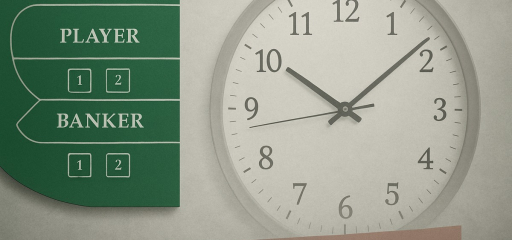
Mini baccarat looks like a friendlier version of the high-roller game. Lower minimums, a single dealer doing all the work, no tuxedos, no card-squeezing theater. Players sit down thinking they’ve found the casual cousin of the big-table game, and in a way they have. The rules are identical, the house edge is identical, and the math on any single hand is exactly the same. What changes is the clock. Mini tables run hot, sometimes more than twice as many hands per hour, and that pace is where the real money quietly leaks out.
The rules don’t change, the speed does
Let’s get the easy part out of the way. Mini baccarat uses the same drawing rules, the same eight-deck shoe, and the same three core bets as the full-size game. The Banker bet carries a house edge of about 1.06%, the Player bet sits at 1.24%, and the Tie hovers around 14.36%, numbers you can verify on Wizard of Odds. None of that shifts when you move to a mini table. The deck doesn’t care about the table size.
What does shift is everything around the cards. On a traditional baccarat table, players take turns acting as the “banker,” squeezing cards slowly, peeking at corners, sometimes ripping a card in half if the draw went badly. There’s ritual, there’s superstition, and there’s a pit boss watching it all unfold at a leisurely pace. On a mini table, none of that happens. The dealer flips the cards, announces the result, pays the winners, and starts the next hand. The whole production is stripped down to its mechanical core.
The pace gap is bigger than people realize
I’ve watched pit-side surveys and timed enough sessions myself to feel comfortable with these numbers. A full-size baccarat table, especially one with six or eight players and the cards being passed around, usually runs somewhere between 40 and 60 hands per hour. Sometimes slower, if the table is full of regulars who like to draw out the moment.
A mini table is a different animal. With one dealer, no squeezing, and typically two to four players, you’ll see 90 to 150 hands per hour. I once sat at a near-empty mini table in Reno where the dealer and I were the only people involved, and we cleared more than 160 hands in an hour before I tapped out. It didn’t feel fast in the moment, that’s the trick, but the chip rack told a different story.
The formula that explains everything
There’s one equation you need to internalize if you want to understand why mini baccarat costs more even though the per-hand edge is the same:
Expected hourly loss = average bet × house edge × hands per hour
Three numbers, multiplied together. Most players obsess over the second one, the house edge, and ignore the third. But the third number is where the casino quietly makes up the difference between a slow, civilized table and a churning mini setup. Doubling the hands per hour doubles your expected loss. Doesn’t matter how good the edge looks.
A worked example with real numbers
Let’s put a $25 Banker bet under the microscope. The house edge is 1.06%. On a traditional table running 60 hands per hour, your expected loss looks like this:
$25 × 0.0106 × 60 = $15.90 per hour
Not bad. You could nurse a $300 bankroll through several hours of play, statistically speaking, and walk out with most of it. Now move the same player and the same bet to a mini table averaging 130 hands per hour:
$25 × 0.0106 × 130 = $34.45 per hour
Same bet. Same edge. More than double the bleed. Your $300 bankroll, in expectation, drains in less than nine hours instead of nineteen. The casino didn’t change anything about the game. They just removed the friction that was slowing you down.
Hands per hour vs. Expected hourly loss
Here’s how the math plays out across different pace levels and bet sizes. All numbers assume you’re betting Banker at the standard 1.06% edge:
| Bet size | 40 hands/hr (slow full table) | 60 hands/hr (typical full table) | 100 hands/hr (busy mini) | 130 hands/hr (fast mini) | 150 hands/hr (heads-up mini) |
|---|---|---|---|---|---|
| $10 | $4.24 | $6.36 | $10.60 | $13.78 | $15.90 |
| $25 | $10.60 | $15.90 | $26.50 | $34.45 | $39.75 |
| $50 | $21.20 | $31.80 | $53.00 | $68.90 | $79.50 |
| $100 | $42.40 | $63.60 | $106.00 | $137.80 | $159.00 |
Read across any row. The leftmost column and the rightmost column represent the same bet at the same edge, and the cost is nearly 4x higher on the right. That’s not a different game. That’s the same game with the brakes off.
Variance scales with hands too, and it feels worse
Expected loss is only half the story. The other half is variance, the size of the swings around that average. Standard deviation in baccarat scales with the square root of hands played, which means that doubling your hands per hour doesn’t double your swing size, but it does multiply it by roughly √2 ≈ 1.41. Over a session, your bankroll graph looks jaggier on a mini table. Bigger uphill stretches, bigger downhill drops, and they come at you faster.
The psychological effect is brutal. On a slow table, a losing streak gives you time to breathe between hands, time to reset, time to second-guess your bet sizing, time to remember you came here to enjoy yourself. On a mini table, the dealer is already shuffling for the next hand while you’re still processing the last one. Tilt arrives faster, and so does the urge to chase. I’ve seen players who’d never raise their bets at a $100 minimum table happily double up on a mini after three quick losses, because the pacing made every individual hand feel small.
Why casinos love mini baccarat (and don’t hide it)
From the operator’s side, the math here isn’t a secret. A pit manager once told me, half-joking, half-bragging, that the mini tables were the most profitable square footage in the room outside of slots. He wasn’t wrong. The casino is paying one dealer instead of three, using less floor space, and processing roughly 2.5x the hands per hour. Their hourly take per table goes up by about that same multiple, even though the house edge on the felt is unchanged.
A few things to keep in mind if you’re planning to play:
- Bet size matters more on mini tables, not less. The pace amplifies whatever stake you choose. A $25 mini bet costs more per hour than a $50 full-table bet at typical speeds.
- Banker is still the best bet. The 1.06% edge (after the 5% commission) beats Player’s 1.24%. Don’t let the faster pace tempt you into the Tie bet. That 14.36% edge will obliterate you at 130 hands per hour.
- Session length is your real lever. If you want to play mini baccarat, plan shorter sessions. Two hours of mini equals roughly four hours of full-size in terms of expected loss.
- Watch the dealer’s rhythm. Some dealers run noticeably faster than others. A 90-hands-per-hour dealer and a 140-hands-per-hour dealer can be working the same table on different shifts.
- Skip the side bets entirely. Dragon Bonus, Pairs, and other proposition bets carry edges in the 4-12% range. At mini-table speed, they’re financial suicide.
If you want a deeper read on how house-edge math compounds across different games and table conditions, I’ve put together other breakdowns at Effortless Math that walk through the same kind of expected-value reasoning applied to blackjack, roulette, and craps.
One more honest observation about the experience
I’ll admit something: I actually like mini baccarat as a game. The ritual on the big table is fun once or twice, but it gets tedious. The mini version is brisk, the dealers are usually friendlier, and you can drop in for thirty minutes without feeling like you’ve committed to a full evening. None of that changes the math, though. Every time I sit down at one of these tables, I have to remind myself, out loud sometimes, which probably looks weird, that I’m playing a game that’s two or three times faster than it feels. The cards come and go, the chips slide back and forth, and an hour disappears in what feels like twenty minutes. That’s the trick of it.
FAQ
Is the house edge actually the same on mini baccarat?
Yes. Banker is 1.06%, Player is 1.24%, Tie is 14.36%, identical to the full-size game. The drawing rules, the eight-deck shoe, and the 5% Banker commission are all unchanged.
How many hands per hour should I expect on a mini table?
Somewhere between 90 and 150, depending on how many players are seated and how fast the dealer works. A heads-up game can push 160+. A traditional full-size table is usually 40-60 hands per hour.
Does the lower minimum on mini tables make up for the faster pace?
It can, but only if you actually bet the minimum. A $10 mini bet at 130 hands per hour costs $13.78 per hour. A $25 full-table bet at 60 hands per hour costs $15.90. Pretty close. The problem is most players don’t stick to the minimum, the smaller chips encourage bigger bets.
Why does variance feel worse on mini tables?
Standard deviation grows with the square root of the number of hands played. Doubling hands per hour multiplies your swing size by about 1.41x. Combined with the faster pace, losing streaks compress and tilt arrives quicker.
Should I just play the full-size table instead?
If you’re cost-sensitive and want to stretch your bankroll, yes, assuming the minimums work for you. If you want a quick session and you’re disciplined about bet sizing and time at the table, mini is fine. Just don’t pretend the games are equivalent at the bankroll level.
Is card counting useful in mini baccarat?
Not really. Baccarat counts can theoretically nudge a few hands toward player advantage, but the gains are tiny, fractions of a percent over thousands of hands. At mini-table speed, the increased exposure to the house edge swamps any counting benefit.
Pulling it together
Mini baccarat isn’t a worse game than the full-size version on a per-hand basis. It’s literally the same game. The house edge hasn’t moved an inch. What’s moved is the throughput. You’re playing two or three times as many hands per hour, which means you’re exposed to the edge two or three times as often. Multiply your bet by your edge by your pace and you’ve got your expected loss, and the third number is doing more damage than most players ever notice.
If you enjoy the game, and a lot of people do, play it with your eyes open. Smaller bets, shorter sessions, no side bets, and a clock you actually look at. The math is honest. The pace is the part that lies to you.

Related to This Article
More math articles
- Unfunded mandates
- Measuring Angles with a Protractor for 4th Grade
- West Virginia Algebra 1 Free Worksheets: Printable Algebra 1 Practice with Answer Keys
- A Comprehensive Collection of Free ALEKS Math Practice Tests
- The Warren Court and the Rights Revolution
- The Grocery Store Challenge: How to Use Unit Rates to Solve Word Problems
- How the Supreme Court Chooses and Decides Cases
- Freedom of Information Act
- Product Predictions: How to Estimate Multiplication in Word Problems
- How to Perform Vector Addition and Subtraction





What people say about "Mini Baccarat Is Faster — Which Quietly Costs You More - Effortless Math"?
No one replied yet.