Empirical and Molecular Formulas: Calculate Atom Ratios
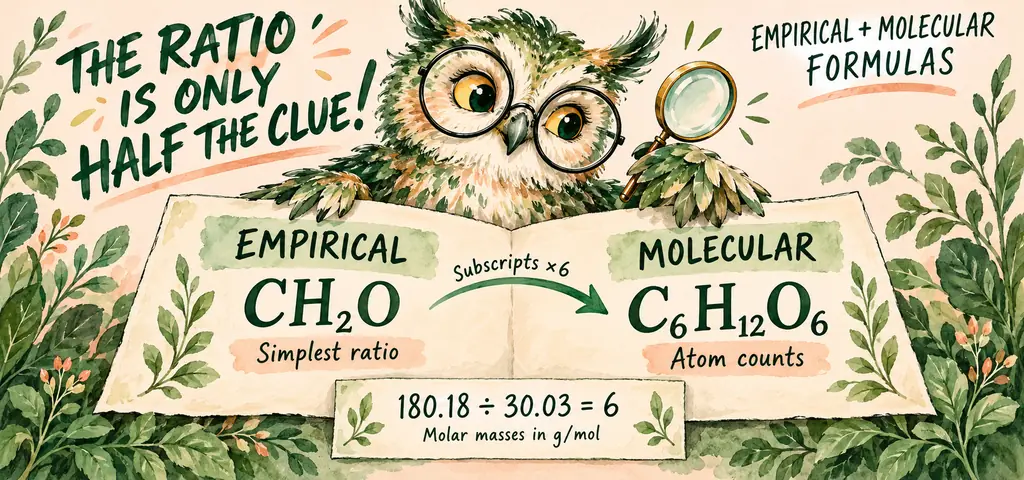
An empirical formula states the simplest whole-number ratio of atoms in a compound. A molecular formula states the actual atom counts in one molecule. Composition data provide mass relationships, which must be converted to mole ratios. A measured molar mass can then determine the whole-number multiplier relating the two formulas.
Equal masses of two elements do not imply equal numbers of atoms. Their atoms have different masses. Finding an empirical formula therefore begins by converting each element’s mass into moles.
Why must masses become moles?
A formula compares atom counts. Dividing each element’s mass by its molar mass puts the data on a particle-count basis. Dividing the resulting mole amounts by the smallest gives the relative atom ratio.
When only percentages are supplied, assume a 100 g sample for the calculation. A 52.2% carbon composition then corresponds to 52.2 g of carbon in that hypothetical sample. This choice simplifies the arithmetic without changing the ratio.
Worked example: find the empirical formula
A hypothetical compound contains 52.2% carbon, 13.1% hydrogen, and 34.7% oxygen by mass. For a 100 g sample, use 12.01, 1.008, and 16.00 g/mol:
Divide each by approximately 2.17. The ratio is about 2.00:6.00:1.00, so the empirical formula is \(\mathrm{C_2H_6O}\). Small deviations arise from rounded composition data.
A ratio near 1:1.5 should not be rounded to 1:2. Multiply all ratios by two to obtain 2:3. Other recognizable fractions may require a different common multiplier.
How does molar mass determine the molecular formula?
The empirical-formula mass of \(\mathrm{CH_2O}\) is approximately 30.03 g/mol. If a molecular compound with that empirical formula has a molar mass of approximately 180.18 g/mol, the multiplier is
Multiply every subscript by six to obtain \(\mathrm{C_6H_{12}O_6}\). The composition alone does not establish that multiplier.
How does the same reasoning apply to hydrates?
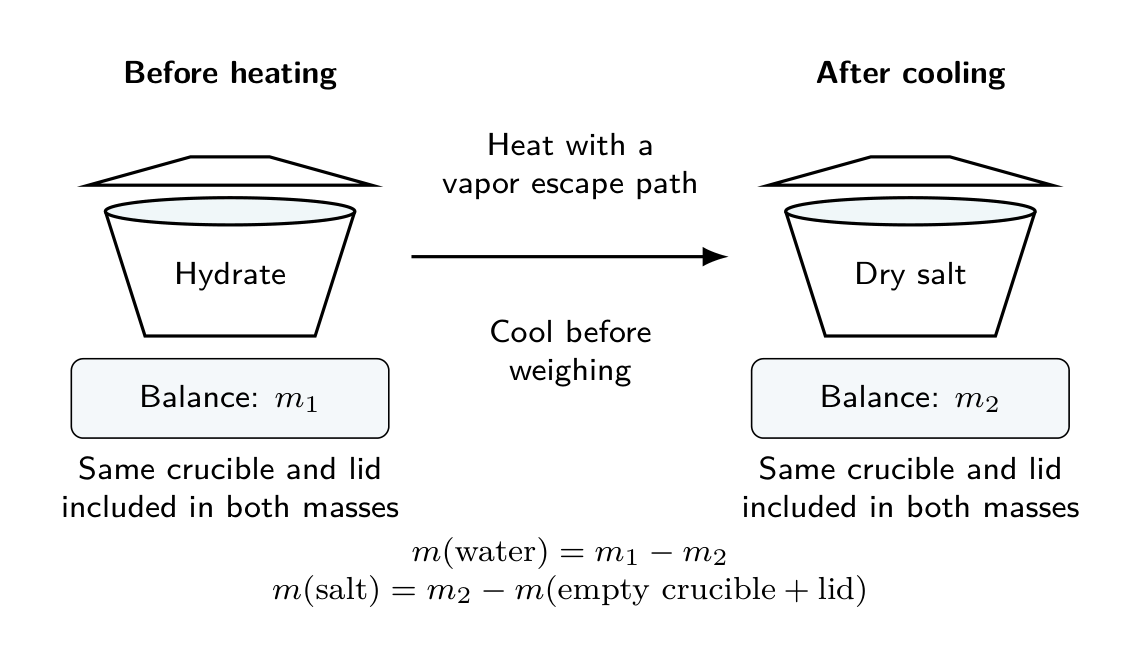
A hydrate contains a definite ratio of water to an anhydrous compound. In an appropriate supervised analysis, the mass lost on heating may be attributed to water if the method establishes that the solid dehydrates without decomposing or losing other material.
- Find the water mass and the anhydrous-solid mass.
- Convert both to moles.
- Divide water moles by anhydrous-compound moles.
- Check whether the ratio supports a whole-number hydrate formula within the measurement uncertainty.
Can you apply the idea?
-
Why not divide element masses directly to obtain formula subscripts?
Check your answer
Formula subscripts compare atom counts, and different elements have different molar masses.
-
What sample mass is convenient when composition is given only in percentages?
Check your answer
100 g, because each percentage then equals that element’s mass in grams.
-
A mole ratio is 1:1.5. What whole-number ratio should you test?
Check your answer
2:3, multiplying both values by two.
-
What is the empirical formula of \(\mathrm{C_4H_8}\)?
Check your answer
\(\mathrm{CH_2}\), dividing both subscripts by four.
-
An empirical-formula mass is 46 g/mol and the molecular molar mass is 92 g/mol. What is the multiplier?
Check your answer
Two. Every empirical subscript is multiplied by two.
-
Why can mass lost during heating fail to equal water mass?
Check your answer
The solid could decompose, spatter, or lose another volatile substance. The method must address those possibilities.
Watch the idea explained
Empirical, molecular, and structural formulas | AP Chemistry | Khan Academy, Khan Academy.
Compare empirical ratios, actual molecular atom counts, and structural formulas. The benzene drawing is one resonance form; its electrons are delocalized.
Where does this fit?
Use the chemistry learning hub to choose a lesson or practice test. Connect this topic with the mole and molar mass, balancing chemical equations, molecular shape and polarity, reaction types and redox.
Sources for Further Study
OpenStax Chemistry 2e explains percent composition, empirical mole ratios, and molecular-formula multipliers.
Continue with a chemistry study guide

Related to This Article
More math articles
- How to Measures of Dispersion?
- ACT Aspire Grade 8 Math Free Worksheets: Free Printable Practice Worksheets with Worked Keys
- Illinois Algebra 1 Free Worksheets: Printable Algebra 1 Practice, Answers Included
- Life Course, New Roles, and Resocialization
- Commonly Confused Words and Contractions
- How to Graph Transformation on the Coordinate Plane: Reflection?
- 3rd Grade MAP Math Practice Test Questions
- Unlocking the Secrets of Inscribed Polygons
- The Best Grade 8 Math Book for Indiana Students
- Grade 3 Math: Fractions on a Number Line




What people say about "Empirical and Molecular Formulas: Calculate Atom Ratios"?
No one replied yet.