Molecular Shape and Polarity: Why Bond Dipoles May Cancel
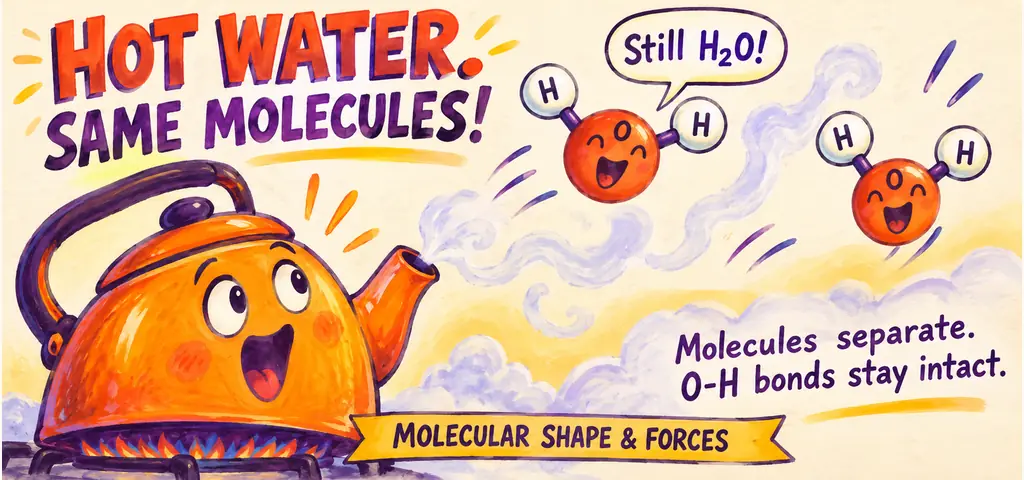
Carbon dioxide contains polar bonds, yet the molecule has no permanent net dipole. Water also contains polar bonds and has a permanent net dipole. Their shapes explain the difference. Looking only at the bond types leaves out part of the molecule.
Molecular geometry describes the arrangement of atoms around a central atom. In introductory VSEPR reasoning, regions of electron density arrange to reduce repulsion. Molecular polarity depends on both bond polarity and geometry. Intermolecular forces describe attractions between separate particles and help explain physical properties such as boiling behavior.
How do you predict a basic molecular shape?
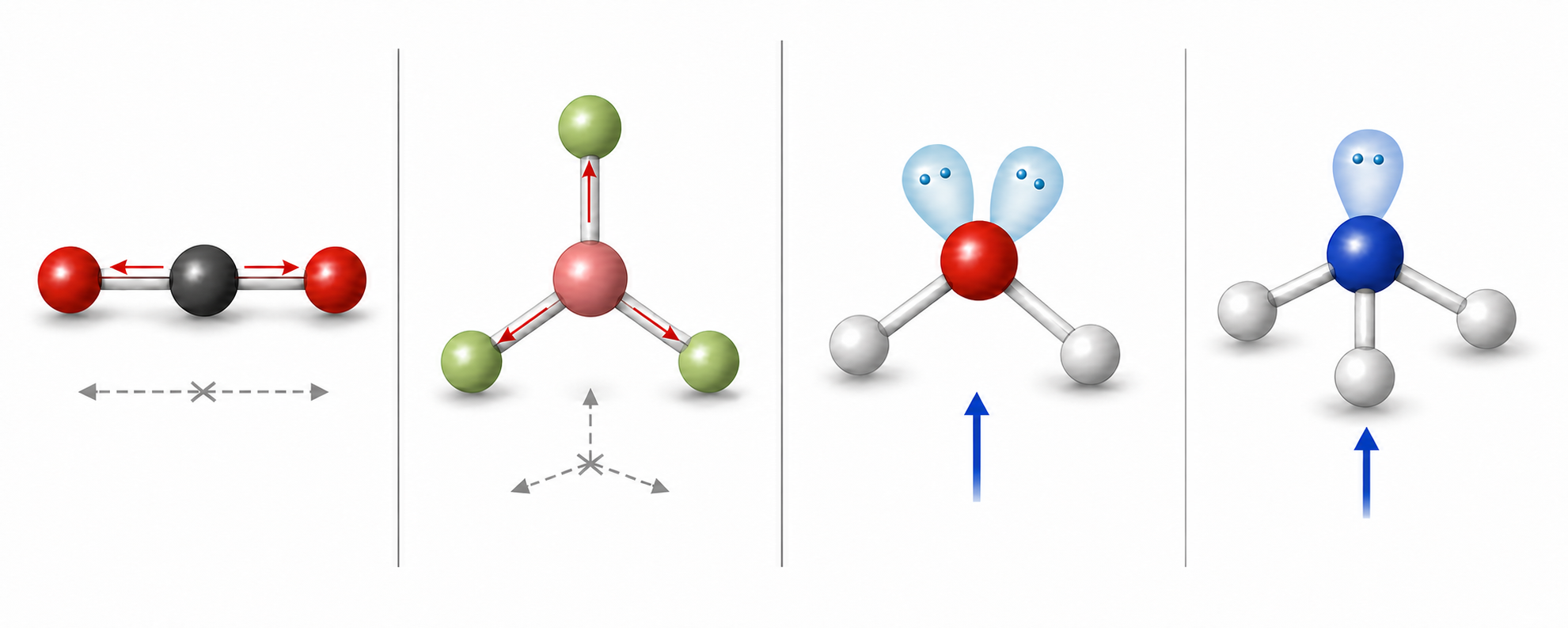
Begin with a valid Lewis structure. Count the bonding regions and lone pairs around the central atom. A single, double, or triple bond each counts as one region for the basic electron-domain geometry.
Two regions give a linear arrangement. Three give trigonal planar. Four give tetrahedral electron-domain geometry. When lone pairs occupy some positions, the molecular shape describes the atom positions only. Four regions with one lone pair give a trigonal-pyramidal molecular shape, while four regions with two lone pairs give a bent shape.
Worked example: compare carbon dioxide and water
In \(\mathrm{CO_2}\), the central carbon has two bonding regions and no lone pairs. The molecule is linear. Its two equal carbon-oxygen bond dipoles point in opposite directions and cancel.
In \(\mathrm{H_2O}\), oxygen has two bonding regions and two lone pairs. The molecular shape is bent. The oxygen-hydrogen bond dipoles do not cancel, giving water a permanent net dipole.
A drawing can flatten a three-dimensional molecule, so use its geometry labels or wedge-and-dash conventions when needed.
Which attractions act between molecules?
London dispersion forces act between all atoms and molecules. Polar molecules also experience dipole-dipole attractions. Hydrogen bonding occurs when a suitable hydrogen donor interacts with an electron-pair acceptor. In familiar introductory examples, hydrogen bonded to nitrogen, oxygen, or fluorine can serve as the donor.
A molecule can accept hydrogen bonds from water even when it cannot donate them itself. Also consider molecular size and shape before ranking boiling points: a large nonpolar molecule can have substantial dispersion attractions.
What changes when water boils?
Water molecules separate as enough intermolecular attractions are overcome to enter the gas phase. The oxygen-hydrogen covalent bonds within each molecule remain intact during ordinary boiling.
- Draw the structure and determine its geometry.
- Identify polar bonds.
- Decide whether their dipoles cancel in that geometry.
- Identify the relevant intermolecular attractions.
Can you apply the idea?
-
How many electron-density regions does a double bond count as in basic VSEPR?
Check your answer
One region.
-
What molecular shape has two bonding regions and no central lone pairs?
Check your answer
Linear.
-
What molecular shape has three bonds and one central lone pair?
Check your answer
Trigonal pyramidal.
-
Why is \(\mathrm{CO_2}\) nonpolar despite its polar bonds?
Check your answer
Its equal bond dipoles cancel in a linear, symmetric arrangement.
-
Do nonpolar molecules experience dispersion forces?
Check your answer
Yes. Dispersion forces act between all atoms and molecules.
-
Does ordinary boiling break the covalent bonds inside water molecules?
Check your answer
No. It mainly separates molecules by overcoming intermolecular attractions.
Watch the idea explained
Polar & Non-Polar Molecules: Crash Course Chemistry #23, CrashCourse.
This selected excerpt runs from 3:49 to 4:25. Read bond-dipole arrows and partial charges. Molecular polarity also depends on how the bond dipoles combine in the molecule’s shape.
Where does this fit?
Use the chemistry learning hub to choose a lesson or practice test. Connect this topic with chemical bonds and compound names, the mole and molar mass, electrons and periodic trends, empirical and molecular formulas.
Continue with a chemistry study guide


Related to This Article
More math articles
- Nixon’s Domestic Record, New Federalism, and the Southern Strategy
- How to Prep for the AMC 10 and AMC 12 Math Competitions in 2026
- Grade 3 ELA Tests: A Calm Parent Guide (What the Test Measures—and What It Doesn’t)
- Grade 2 Math Practice for Hawaii Second Graders
- The Best Algebra 1 Book for Alabama Students
- The Chain of Infection, Bioburden, and Biofilm
- Using a Dictionary, Thesaurus, and Glossary
- Oklahoma OSTP Grade 5 Math: 48 Free Single-Page Printables, One Skill Each, Answer Keys Included
- 5th Grade OST Math Worksheets: FREE & Printable
- California Algebra 1 Free Worksheets: Skill-by-Skill Algebra 1 Worksheets You Can Print Today





















What people say about "Molecular Shape and Polarity: Examples and Practice"?
No one replied yet.