The Best Algebra 1 Book for Alabama Students
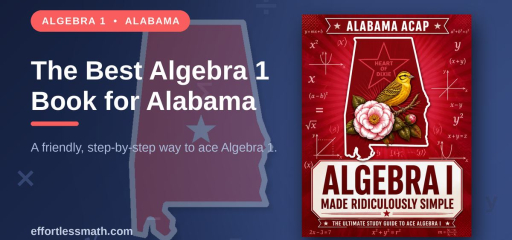
Every Alabama parent wants the same simple thing: for their child to walk into class feeling capable, not cornered. In most subjects that feeling holds up fine. Then Algebra 1 arrives, and for a lot of students it wobbles. The letters, the rules, the sense that the pace just doubled overnight, it can shake a kid’s confidence fast.
So let’s name the real issue early. A student wobbling in Algebra 1 is almost never short on ability. They are short on clear explanations. Algebra is a genuinely new way of thinking, and nearly every student needs it taught slowly and plainly the first time. The right book does precisely that, and it is the most direct way to steady a shaky start.
Algebra 1 in Alabama
Alabama teaches math through its Course of Study, and Algebra 1 is assessed within the state’s testing program, ACAP, the Alabama Comprehensive Assessment Program. Most students take the course in eighth or ninth grade. The material is the standard core of Algebra 1: linear equations and inequalities, functions and how they are written and graphed, systems of equations, exponents and polynomials, factoring, and quadratics.
That is a learnable list for any Alabama student. The reason a capable kid still struggles usually comes down to pace and presentation. A classroom keeps moving whether or not everyone is ready, and a textbook often explains a fresh idea too quickly to truly land. A student who needed one more walkthrough simply does not get it, and the gap widens from there. A clear, patient book is how you close those gaps before they pile up.
The book we recommend for Alabama students
For an Alabama student learning Algebra 1, the book we recommend is Alabama ACAP Algebra I Made Ridiculously Simple.
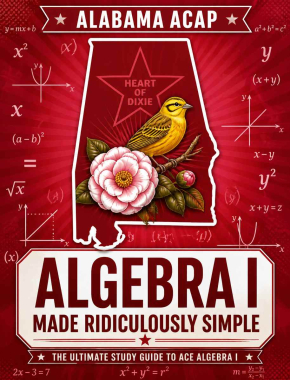
The book lives up to its name. Every topic opens with a clear explanation in everyday language, no jargon dropped without warning. Then a worked example shows each step. Then the student practices, with answer keys for immediate feedback. It follows Alabama’s standards and the topic order classrooms use, so it fits right alongside what your child is learning in school.
Because the explanations are complete, the book does not need a teacher beside it. A motivated student can learn from it on their own. That makes it a dependable choice for homeschoolers, for summer catch-up, and for any student whose class has pulled ahead of them.
How to study with it
The routine that makes the book pay off is short and steady:
- Short, regular sessions beat long, rare ones. Half an hour a few times a week is plenty.
- Use a pencil on every problem. You learn algebra by doing it, not by reading it.
- Check answers as you go and study the misses. Each one shows exactly what to practice next.
- Do not move on until a section feels easy. A weak spot left behind in algebra always returns.
For a wider view of learning the subject from the start, our guide to the best Algebra 1 book for self-study is a good companion read.
How to use this book during the school year
A strong math book works best when it becomes part of the weekly routine, not something saved only for the week before a test. For a Alabama Algebra 1 student, the most useful rhythm is simple: preview the lesson, work through two or three examples, complete a short practice set, then review the missed problems while the mistake is still fresh.
Parents do not need to reteach the whole course. Their best role is to help the student slow down, show work clearly, and name the exact step that caused trouble. If the mistake is a computation error, assign a few fluency problems. If the mistake is a setup error, return to the explanation and copy one worked example before practicing again.
Skills to check before moving on
Before leaving a Algebra 1 unit, make sure the student can do more than recognize the topic. A student is ready to move forward when they can:
- solve linear equations, inequalities, and systems with clearly written steps
- connect slope, intercepts, tables, graphs, and equations
- work with polynomials, factoring, quadratics, radicals, and functions
- read word problems carefully and define variables before calculating
- check an answer and explain why it is reasonable
This quick check prevents the most common problem in math study: moving ahead while the student only half-understands the previous lesson. That half-understanding often looks fine during easy practice, but it breaks down on mixed review and state-style questions.
A simple weekly study plan
| Day | What to do |
|---|---|
| Day 1 | Read the lesson, copy one worked example, and talk through the steps. |
| Day 2 | Complete a short practice set without rushing. Mark every uncertain problem. |
| Day 3 | Review missed questions, correct the work, and write one sentence explaining each error. |
| Day 4 | Do mixed review so older skills stay active while new topics are added. |
| Day 5 | Try a short timed set to build focus and confidence. |
This schedule is intentionally simple. Consistency matters more than long sessions. Twenty to thirty focused minutes several times a week usually produces better results than one long study session that leaves the student tired and frustrated.
What to do if your child is already behind
If your child is missing earlier skills, do not rush through the current chapter just to stay on pace. Start with the first lesson that feels shaky, rebuild that foundation, and then return to the current assignment. In math, catching up usually means repairing one small skill at a time, not trying to relearn the whole year at once.
A good sign of progress is not simply getting more answers correct. It is seeing cleaner work, fewer skipped steps, and better explanations. When a student can show the process clearly, they are much more likely to handle Alabama's classroom work, homework, and year-end assessment questions with confidence.
Used this way, the book becomes more than a product recommendation. It becomes a practical study system: learn the lesson, practice the skill, correct mistakes, and keep old topics alive until the student is ready for geometry and higher-level high school math.
Questions Alabama families ask
How is Algebra 1 tested in Alabama?
Algebra 1 is part of Alabama’s Course of Study and the state’s ACAP testing program. Your school can confirm exactly how and when your student will be assessed, but solid Algebra 1 preparation helps in every case.
When do Alabama students take Algebra 1?
Most take it in eighth or ninth grade, depending on their school and their middle school math track.
Can my child use this book without a tutor?
Yes. It was written to teach a student directly, with self-contained explanations and answer keys for instant feedback. It also works well alongside a tutor or a helping parent.
My child has lost confidence in math. Can a book really help with that?
It genuinely can. Confidence in math is built from small, repeated successes. A book that explains clearly and lets a student get problems right starts that cycle, and the confidence grows from there.
The bottom line
Algebra 1 is where a lot of Alabama students first feel their confidence wobble, but a wobble is not a fall. With a clear, patient book, the subject steadies and the confidence comes back. Alabama ACAP Algebra I Made Ridiculously Simple gives a student explanations that make sense and practice that rebuilds belief. Start early, keep it steady, and your child walks back into class feeling capable again.

Related to This Article
More math articles
- Top 10 6th Grade PARCC Math Practice Questions
- The Best Grade 3 ELA Practice Tests for Nevada Students
- How the Federal Bureaucracy Works
- The Ultimate 7th Grade MCAP Math Course (+FREE Worksheets)
- Full-Length ASVAB Math Practice Test-Answers and Explanations
- Choice begins with opportunity cost and the margin
- Climate, Greenhouse Gases, and Ozone
- Cofunction Identities
- Use of Technology in Math Class that Works
- How to Interpret Remainders of Division Two-digit Numbers By One-digit Numbers


















What people say about "The Best Algebra 1 Book for Alabama Students"?
No one replied yet.