Nixon’s Domestic Record, New Federalism, and the Southern Strategy
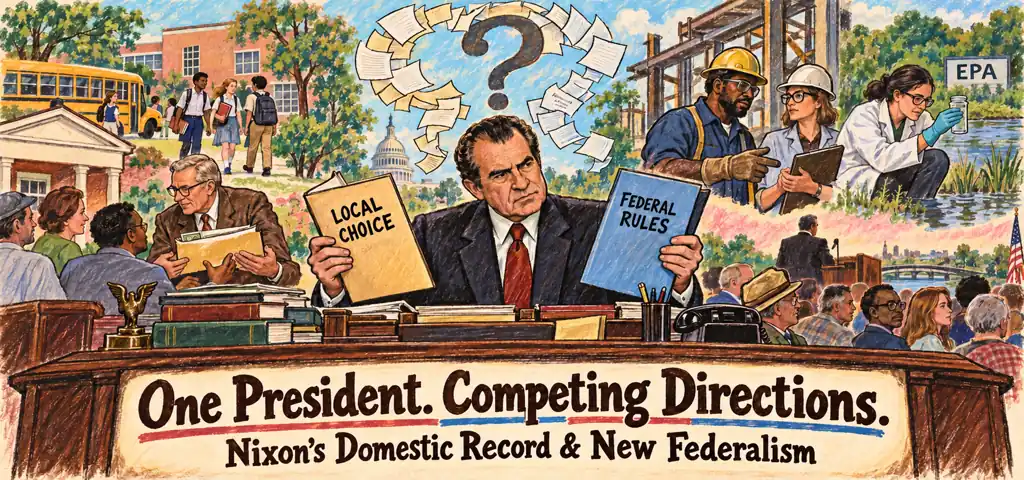
Chapter 15 of the CLEP History of the United States II study guide on Effortless Math covers Nixon’s Domestic Record, New Federalism, and the Southern Strategy: the key terms, the core ideas, and worked examples showing how this topic is tested on the exam.
CLEP History of the United States II, Chapter 15
Nixon joined conservative rhetoric to activist government
Richard Nixon campaigned against disorder, bureaucracy, and liberal cultural authority, yet his administration did not simply dismantle the regulatory state. It created the EPA, signed major environmental and workplace-safety laws, expanded food assistance and Social Security benefits, and proposed national health and income programs Congress did not enact. The tension between conservative coalition building and selective federal activism defines his domestic record.
The Southern strategy was electoral realignment, not one speech
Republican candidates appealed to many white voters alienated by civil-rights enforcement, urban unrest, school integration, and cultural change. Nixon used themes of law and order, local control, and the "silent majority" rather than openly promising restoration of Jim Crow. Wallace's 1968 strength showed the available electorate. Realignment was gradual: southern Democrats retained offices for years, and economics, religion, national security, and race interacted.
Goldwater's map differed from Eisenhower's southern support
Eisenhower's 1952 southern victories lay chiefly in the peripheral South, where Republican presidential voting could build on urban, suburban, and border-state strength. Goldwater in 1964 carried Louisiana, Mississippi, Alabama, Georgia, and South Carolina, Deep South states with especially high Black population shares. His opposition to the Civil Rights Act helped reorganize presidential voting around federal civil-rights power. The contrast marks a stage in realignment; it does not mean Republicans instantly captured every southern office.
The Philadelphia Plan used federal contracting power
The Labor Department's Philadelphia Plan required federal construction contractors in the region to pursue numerical goals and timetables for minority hiring in skilled trades. It responded to unions and hiring systems that excluded Black workers. The plan was not a rigid quota guaranteeing jobs to unqualified applicants; contractors remained responsible for good-faith efforts. It helped establish affirmative-action policy through the government's purchasing authority.
School desegregation accelerated under judicial and administrative pressure
The Supreme Court rejected indefinite delay in Alexander v. Holmes County and approved busing as a possible remedy in Swann v. Charlotte-Mecklenburg. Nixon criticized forced busing but his administration enforced court orders and used federal pressure, producing rapid southern school desegregation. Later resistance shifted toward metropolitan boundaries, where Milliken v. Bradley limited interdistrict remedies absent proof of interdistrict violations.
New Federalism redirected rather than eliminated federal money
Nixon sought to consolidate categorical programs and give states and localities greater discretion. General revenue sharing distributed federal funds with fewer program-specific conditions, while block grants grouped related purposes. The federal government still raised and transferred the money and imposed some rules. New Federalism changed who chose among uses; it did not restore a pre-New Deal system of no national fiscal role.
Family Assistance revealed the limits of policy innovation
Nixon proposed a Family Assistance Plan with a national income floor for many poor families, work requirements, and benefit phaseouts. The House passed a version, but the Senate did not. Conservatives objected to a federal guarantee, while welfare-rights advocates and liberals criticized low benefits and work provisions. The failure shows why a proposal cannot be counted as an enacted achievement even when it came from a sitting president.
The administration built new regulatory institutions
The Occupational Safety and Health Act created OSHA and a research institute to address workplace hazards. The Consumer Product Safety Commission followed in 1972. Environmental laws set national responsibilities even while New Federalism promised decentralization. This was not necessarily ideological inconsistency: Nixon accepted federal rule making in fields where pollution, products, and workplaces crossed local boundaries while challenging detailed administration of social programs from Washington.
Law and order drew power from real disorder and selective framing
Crime, riots, antiwar confrontation, and rapid social change worried many voters. Campaign rhetoric often blurred peaceful protest with violence and treated local disorder as evidence against liberal governance. Policies such as preventive detention in the District of Columbia and the administration's approach to demonstrations expanded executive claims. A sound analysis distinguishes actual public-safety concerns from racialized or partisan use of those concerns.
classify policy by its instrument, not its slogan
A federal rule changes hiring on projects paid for by federal contracts.
Environmental policy combined popular pressure with administrative design
The first Earth Day, highly visible pollution, and bipartisan concern helped produce the Clean Air Act of 1970, the Clean Water Act of 1972 over Nixon's veto, and federal review of environmental effects. The EPA brought scattered duties into one agency, while states often implemented standards under federal supervision. National rules were attractive because air and water crossed local boundaries, but enforcement still depended on permits, monitoring, courts, and budgets. Creating an agency or announcing a standard did not itself clean a river. The policy record must be judged through authority, implementation, and measurable change.
Electoral change appeared first in presidential voting, then spread unevenly
Nixon won much of the South while Democrats retained many congressional, state, and local offices. Older loyalties, candidate reputations, disfranchisement, and local issues slowed a complete partisan transfer. Suburban growth and migration also changed southern electorates, and Black voters became an essential Democratic constituency after federal voting protections. The realignment was therefore neither an overnight party swap nor a story of race alone. Presidential returns reveal one stage; officeholding and voter identification over later decades reveal another. Distinguishing pace and level of government prevents one landslide map from becoming a complete account of political change.
Watch the history in motion
This short lesson adds voices, images, and chronology to the ideas you just studied.
Video: History vs. Richard Nixon – Alex Gendler, TED-Ed.
Try four CLEP-style questions
- What did the Philadelphia Plan require?
- Guaranteed union membership for every applicant from a designated racial group
- Good-faith minority hiring goals and timetables for federal construction contractors
- A national ban on all private construction performed without federal supervision
- Direct federal appointment of workers to permanent skilled-trade positions
- Elimination of apprenticeship standards for projects financed by state governments
- How did general revenue sharing embody New Federalism?
- It prohibited federal taxation and required states to finance national defense.
- It required every grant dollar to be spent on one congressionally specified service.
- It replaced elected local governments with regional administrative boards.
- It transferred federal money while giving state and local officials wider spending discretion.
- It ended federal civil-rights conditions attached to all public expenditures.
- Why is the Family Assistance Plan not an enacted Nixon welfare reform?
- The plan applied only to full-time federal employees rather than families receiving public assistance.
- The Supreme Court invalidated it before the administration sent it to Congress.
- Nixon vetoed the measure after both houses passed an identical bill.
- State governors enacted it independently without requesting federal funds.
- The Senate did not approve the proposal after the House passed a version.
- Which statement best captures Nixon's domestic record?
- The administration rejected environmental, workplace, and consumer regulation as unconstitutional.
- New Federalism shifted the principal federal taxing and transfer role to state governments.
- Law-and-order politics prevented the administration from enforcing school desegregation orders.
- Conservative coalition building coexisted with selective expansion of federal regulation and benefits.
- Every major domestic proposal became law with support from a unified Republican Congress.
Check your answers and reasoning
Independent preparation. CLEP is a registered trademark of the College Board, which does not endorse this lesson.

Related to This Article
More math articles
- Vermont SBAC Grade 4 Math Free Worksheets: Free Printable PDF Worksheets with Worked Solutions
- Signal Transduction Cascades: Amplification and Control
- 7th Grade SBAC Math Worksheets: FREE & Printable
- What Is on the Florida Algebra 1 EOC? Topics, Timing, Score, and Study Plan
- How to Master the ISEE Math Section: 2026 Guide for Lower, Middle & Upper Level
- How to Be A Great SAT/ACT Math Tutor?
- Atoms and Their Parts
- Adding Money Amounts for 4th Grade
- New Mexico NM-MSSA Third-Grade Math: 49 Free Printable Worksheets, Chapter by Chapter
- CLEP U.S. History I 100: Black Military Service and the Destruction of Slavery


















What people say about "Nixon's Domestic Record and New Federalism"?
No one replied yet.