Détente, China, SALT I, and the Limits of Triangular Diplomacy
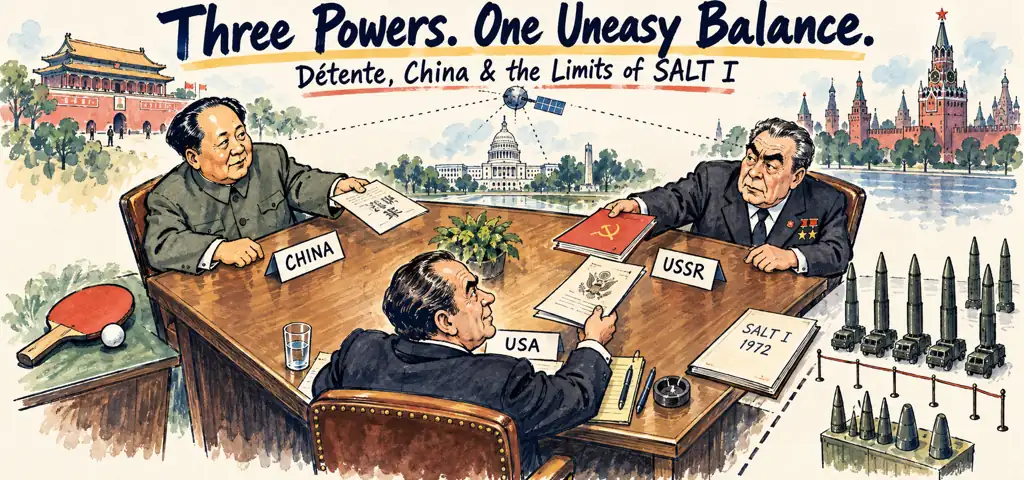
Chapter 15 of the CLEP History of the United States II study guide on Effortless Math covers Détente, China, SALT I, and the Limits of Triangular Diplomacy: the key terms, the core ideas, and worked examples showing how this topic is tested on the exam.
CLEP History of the United States II, Chapter 15
Détente sought managed rivalry rather than friendship
Nixon and national security adviser Henry Kissinger tried to reduce immediate superpower tension while preserving American power. Détente meant negotiation, communication, trade, and arms limits alongside continuing competition. It did not end containment or ideological conflict. The administration believed a stable balance could make Soviet behavior more predictable and help the United States manage Vietnam and other regional crises.
The Sino-Soviet split created triangular bargaining power
China and the Soviet Union had moved from alliance to bitter rivalry, including border clashes in 1969. Washington could improve relations with Beijing and Moscow separately, encouraging each communist power to value its American relationship. Triangular diplomacy worked only while all three believed the other two might cooperate. It did not make China an American military ally or allow Washington to dictate either communist government's policy.
The opening to China began before the presidential visit
Secret contacts, relaxed travel and trade rules, Pakistan's mediation, and "ping-pong diplomacy" prepared Nixon's February 1972 trip. The Shanghai Communiqué acknowledged that Chinese on both sides of the Taiwan Strait maintained there was one China and stated the American interest in a peaceful settlement. The United States did not immediately transfer diplomatic recognition from Taipei to Beijing; that occurred under Carter in 1979.
The opening changed diplomatic structure
The visit allowed cooperation where interests overlapped and gave Beijing greater international standing after its 1971 admission to the United Nations. It put pressure on Moscow to improve relations with Washington. Yet Taiwan remained a dispute, and ideological differences persisted. The achievement was an altered strategic relationship, not a settlement of every issue or an American endorsement of Chinese domestic policy.
SALT I limited categories, not the entire nuclear rivalry
The 1972 Interim Agreement froze numbers of certain land-based and submarine-launched ballistic-missile launchers for five years. It did not require elimination of existing arsenals or restrict every warhead. Because multiple independently targetable reentry vehicles allowed several warheads on one missile, competition could continue through qualitative improvement even under launcher limits.
The ABM Treaty rested on deterrence logic
The Anti-Ballistic Missile Treaty limited nationwide missile defenses, initially allowing two sites per country and later one. If both sides remained vulnerable to retaliation, neither could expect to launch a nuclear attack and then shield itself. Critics disliked restraining defense; supporters argued that unlimited defenses would provoke more offensive missiles. The treaty was therefore designed to stabilize mutual deterrence, not to protect civilian populations from all attack.
Linkage had limited power
Kissinger hoped benefits in trade, arms control, and diplomacy could influence Soviet behavior in Vietnam and regional conflicts. Congress tied trade benefits to freer Jewish emigration through the Jackson-Vanik Amendment, while human-rights critics attacked amoral bargaining. The Soviets continued supporting allies and repressing dissent. Negotiation produced real agreements, but the United States could not reliably exchange one issue for compliance on another.
The 1973 war showed both the value and danger of superpower management
During the Yom Kippur War, the United States resupplied Israel and the Soviet Union supported Arab clients. Washington raised its alert level amid concern about unilateral Soviet intervention, then both powers supported cease-fire diplomacy. Détente supplied channels for crisis management but did not prevent proxy conflict. The Arab oil embargo also demonstrated that regional actors had bargaining power beyond the superpower triangle.
test what an arms agreement counts
A treaty freezes missile launchers, while each missile can carry more warheads later.
Verification made limited agreements politically usable
National technical means, including satellites and other observation, allowed each side to monitor launchers without routine on-site inspection. The agreements prohibited interference with those systems and concealment that impeded verification. Verification did not prove peaceful intent or reveal every warhead, but it reduced dependence on trust. Arms control therefore worked through specified objects, counting rules, and observable behavior. A statement that the superpowers "agreed to limit weapons" is incomplete unless it identifies what was counted, how compliance could be checked, and which forms of competition remained outside the rule.
Economic exchange exposed a conflict between stability and human rights
The administration supported grain sales, scientific contacts, and trade as incentives for a more predictable relationship. Congress's Jackson-Vanik Amendment tied favored trade treatment for nonmarket economies to freer emigration, especially for Soviet Jews. The dispute was not simply trade versus isolation. It concerned whether economic benefits should reward strategic cooperation, pressure internal reform, or be withheld when rights were violated. That argument foreshadowed later criticism of détente: an agreement might reduce nuclear danger while leaving dissidents and captive peoples under repression. Security and morality could be assessed separately without pretending either was irrelevant.
Watch the history in motion
This short lesson adds voices, images, and chronology to the ideas you just studied.
Video: President Nixon's Cold War Strategy, Richard Nixon Foundation.
Try four CLEP-style questions
- What made triangular diplomacy possible?
- China and the Soviet Union had merged their armed forces under a single command after the 1969 border clashes.
- The Vietnam War had ended before Nixon began contacts with either communist power.
- Congress had recognized Taiwan as the legal government of the Soviet Union.
- The rivalry between China and the Soviet Union gave each reason to value ties with Washington.
- Both communist states had abandoned their ideological and regional interests.
- What did the Shanghai Communiqué do?
- It admitted the People's Republic to the United Nations through presidential order.
- It established formal diplomatic recognition in 1972 and pledged American defense of China.
- It recorded areas of agreement and disagreement while moving toward relations with Beijing.
- It required China to withdraw support from North Vietnam before Nixon returned home.
- It placed Chinese nuclear forces under the inspection system of the ABM Treaty.
- Why did SALT I not stop nuclear expansion?
- Launcher limits left room for additional warheads and improvements not covered by the count.
- The agreement applied only to conventional artillery stationed in Western Europe.
- Neither government possessed ballistic missiles when the interim agreement was signed.
- The treaty required both sides to build a nationwide missile-defense shield under one joint command system.
- Congress converted the agreement into a ban on all submarine-launched weapons.
- What was the strategic logic of the ABM Treaty?
- The treaty protected every city by sharing one joint American-Soviet radar network.
- Nationwide defenses would permit both states to reduce offensive forces without preserving retaliatory capacity.
- The agreement transferred command of strategic forces to the United Nations.
- Missile defense was limited because accurate nuclear retaliation was no longer technically feasible.
- Limiting defenses preserved the retaliatory vulnerability on which deterrence rested.
Check your answers and reasoning
Independent preparation. CLEP is a registered trademark of the College Board, which does not endorse this lesson.

Related to This Article
More math articles
- The 10,000x Max Win: How Often It Actually Hits
- Character Motivation and Change
- Finding Text Evidence
- Free Grade 6 English Worksheets for Utah Students
- New Hampshire NH SAS Grade 4 Math Free Worksheets: Printable Standards-Aligned Practice with Answers
- Free Grade 6 English Worksheets for South Carolina Students
- Math Classroom Decorations and Bulletin Board Supplies
- Horse Racing Odds Explained: Probability & Expected Value
- FREE ATI TEAS 7 Math Practice Test
- Climate and the Greenhouse Effect





















What people say about "Detente, China and SALT I"?
No one replied yet.