Watergate, Executive Power, and Post-Watergate Reform
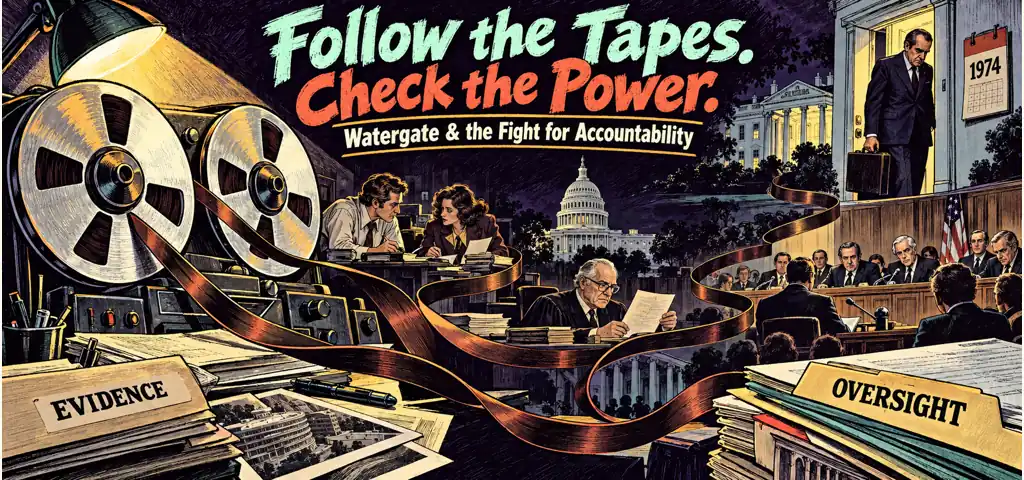
Chapter 15 of the CLEP History of the United States II study guide on Effortless Math covers Watergate, Executive Power, and Post-Watergate Reform: the key terms, the core ideas, and worked examples showing how this topic is tested on the exam.
CLEP History of the United States II, Chapter 15
Watergate began as a burglary and became an abuse-of-power investigation
On June 17, 1972, police arrested burglars inside Democratic National Committee offices in the Watergate complex. The men had connections to Nixon's reelection operation. The larger scandal involved hush money, obstruction, misuse of agencies, campaign finance, and efforts to contain the investigation. The decisive constitutional problem was not merely that campaign employees committed a crime; it was how presidential power was used afterward.
Institutions accumulated evidence
Reporters Bob Woodward and Carl Bernstein pursued leads, but journalism did not remove the president. A Senate committee held televised hearings; Judge John Sirica pressed defendants; prosecutors sought evidence; the House Judiciary Committee considered impeachment. Alexander Butterfield disclosed the White House taping system. The scandal advanced because courts, Congress, investigators, witnesses, and records imposed overlapping forms of accountability.
The Saturday Night Massacre sharpened the conflict
Special prosecutor Archibald Cox sought tapes. Nixon ordered Attorney General Elliot Richardson to fire Cox; Richardson resigned, as did Deputy Attorney General William Ruckelshaus. Solicitor General Robert Bork carried out the order. The October 1973 episode intensified public concern that the president was using removal authority to obstruct an investigation, prompting renewed demands for an independent prosecutor.
United States v. Nixon rejected absolute privilege
In July 1974, the Supreme Court unanimously ordered Nixon to comply with a subpoena for tape recordings in a criminal case. The Court recognized a qualified executive privilege for confidential presidential communications but held that a generalized claim could not outweigh the demonstrated need for evidence in the administration of justice. It did not abolish executive privilege or decide the impeachment articles.
Resignation came before a Senate trial
The House Judiciary Committee approved articles alleging obstruction of justice, abuse of power, and defiance of subpoenas. After release of the "smoking gun" tape showed Nixon had participated early in the cover-up, Republican support collapsed. Nixon resigned on August 9, 1974, before the full House voted and before any Senate trial. Gerald Ford then became president and pardoned Nixon in September.
Congress enacted controls on money and information
The Federal Election Campaign Act amendments created contribution limits, disclosure, public financing for presidential campaigns, and the Federal Election Commission. In Buckley v. Valeo, the Court upheld contribution limits and disclosure but struck limits on independent spending and candidates' personal spending, treating expenditures as protected expression. Congress also strengthened the Freedom of Information Act over Ford's veto and passed the Privacy Act.
Budget reform responded to impoundment
Nixon claimed broad authority to withhold funds Congress had appropriated. The Congressional Budget and Impoundment Control Act of 1974 created House and Senate Budget Committees and the Congressional Budget Office. It required the president to notify Congress of proposed rescissions or deferrals and limited unilateral withholding. The statute addressed separation of powers over spending, not campaign finance or criminal prosecution.
War Powers and the Case Act addressed foreign commitments
The Case-Zablocki Act required executive agreements to be reported to Congress. The War Powers Resolution required notification when armed forces entered hostilities and generally contemplated withdrawal without authorization. These measures reflected concern about Vietnam and executive secrecy. They did not transfer operational command to Congress, and presidents of both parties have challenged or evaded aspects of the framework.
Investigations exposed intelligence abuse
The Senate Church Committee and House Pike Committee examined domestic spying, assassination plots, mail opening, and surveillance by intelligence agencies. Congress created permanent intelligence committees, and the 1978 Foreign Intelligence Surveillance Act established a special court for national-security surveillance warrants. Reform increased legal process and oversight without ending covert activity or later controversy.
The National Emergencies Act made declarations visible and renewable
A Senate inquiry found that four presidential emergencies remained legally active, including the 1933 banking emergency. The National Emergencies Act of 1976 ended the old declarations after a transition and required future proclamations to identify the statutory powers being invoked, be published, and be renewed annually. The reform did not erase emergency authority or give presidents a permanent secret power. It turned an inherited body of dormant declarations into time-bounded, reviewable choices whose continuation required an overt presidential decision.
match scandal evidence to the accountable institution
A prosecutor subpoenas presidential recordings needed for a criminal trial.
Ford's pardon separated criminal exposure from political accountability
One month after Nixon resigned, President Gerald Ford granted him a full pardon for federal offenses he had committed or might have committed while president. Ford argued that a prolonged prosecution would prevent national recovery; critics believed the pardon denied the public a trial and suggested a bargain. Acceptance of a pardon did not constitute a judicial verdict on each allegation, and the pardon could not erase impeachment evidence or reach state offenses. The episode shows how constitutional authority can lawfully close one route of accountability while intensifying electoral distrust. Ford paid a political cost even though the pardon was within presidential power.
Reporting converted fragments into an institutional record
Journalists did not remove Nixon by publishing accusation alone. Reporting by the Washington Post and other outlets connected money, officials, and investigative pressure, while grand juries, courts, congressional committees, and the special prosecutor obtained evidence with legal force. Anonymous sources could guide inquiry but required corroboration. Televised hearings then allowed citizens to hear testimony directly. Watergate's press lesson is therefore not that reporters replaced constitutional institutions. It is that persistent reporting can expose leads, keep attention on inconsistencies, and make it harder for official bodies to ignore evidence that those bodies must still authenticate and act upon.
Watch the history in motion
This short lesson adds voices, images, and chronology to the ideas you just studied.
Video: What Was Watergate?, Mr. Beat.
Try four CLEP-style questions
- What transformed Watergate from a campaign crime into a constitutional crisis?
- The existence of partisan journalism during a presidential election campaign
- Presidential obstruction and misuse of government power during the cover-up
- A Supreme Court ruling that political parties could not rent office space
- Congress's refusal to investigate any activity connected to the White House
- The burglars' claim that no campaign organization had employed them
- What did United States v. Nixon hold?
- Congress may direct every confidential discussion inside the executive branch.
- Presidents possess absolute immunity from subpoenas for recorded conversations.
- The Senate may remove a president without articles approved by the House.
- Executive privilege exists in qualified form but did not defeat the criminal subpoena.
- Campaign expenditures receive no protection under the First Amendment.
- What problem did the Budget and Impoundment Control Act address?
- Unreported intelligence operations conducted by local police departments
- Independent campaign spending by corporations and labor unions
- Judicial appointment of special prosecutors during criminal trials
- Executive agreements that committed American troops to foreign countries
- Presidential withholding of funds that Congress had appropriated
- How did Buckley v. Valeo divide campaign-finance rules?
- It invalidated disclosure but upheld an unlimited ban on candidate spending.
- It required public financing for every federal, state, and local candidate.
- It upheld contribution limits and disclosure while striking several expenditure limits.
- It held that money had no relationship to political expression under the Constitution.
- It abolished the Federal Election Commission and all contribution reporting.
Check your answers and reasoning
Independent preparation. CLEP is a registered trademark of the College Board, which does not endorse this lesson.

Related to This Article
More math articles
- Choice begins with opportunity cost and the margin
- How to Graph Linear Equations: Every Form, Step by Step for 2026
- Shop Materials: Wood, Metal, Masonry, and Plastic
- Free Grade 7 English Worksheets for Wyoming Students
- Unfunded mandates
- How to Categorize Rational Numbers
- How to Find Rotation of Axes and General Form of Conic Sections
- How Do You Prove Angles Are Congruent?
- How to Use Area Models to Multiply One-Digit Numbers By Two-digit Numbers
- The Best Grade 4 Math Book for New Jersey Students


















What people say about "Watergate and Post-Watergate Reform"?
No one replied yet.